How to care for Tradescantia? Let us introduce you to this flower with a wild, natural charm
Tradescantia has beautiful leaf color and small pink flowers, giving it strong decorative appeal. It grows vigorously even under rough, minimal management, so it is especially suitable for people with little experience to grow, and it is an ideal plant for decorating a balcony. Now let us take a look at what there is to know about Tradescantia.
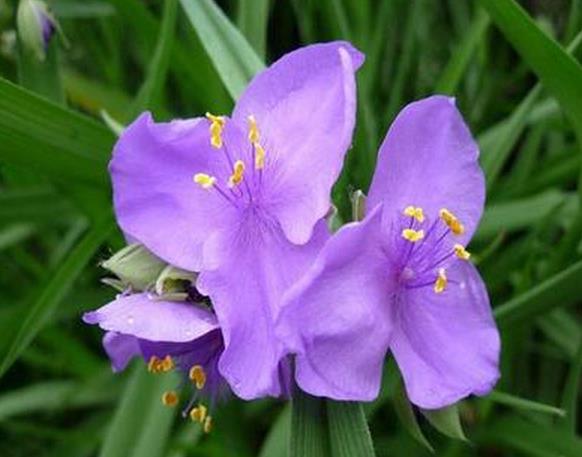
I. Introduction to Tradescantia
Tradescantia is a perennial herbaceous plant of the genus Tradescantia in the Commelinaceae family, native to Mexico, with aliases including purple big spiderwort, purple brocade grass, purple-leaf grass, purple bamboo plum, and so on. Because Tradescantia has a long flowering period, upright stems, distinct nodes, and leaf sheaths, its plant form is unusual and elegant, with a full wild charm; planted in masses under trees, or combined with the long leaves of iris, its plant form, buds, and inflorescences are striking to view, with endless charm. Because Tradescantia has a long flowering period, upright stems, distinct nodes, and leaf sheaths, its plant form is unusual and elegant, with a full wild charm; planted in masses under trees, or combined with the long leaves of iris, its plant form, buds, and inflorescences are striking to view, with endless charm. Planted in masses under trees, or combined with the long leaves of iris, its plant form, buds, and inflorescences are suitable for viewing. Tradescantia works well for flower beds and mass planting along both sides of roads, and can also be potted for indoor display, or grown as a hanging plant. Tradescantia flowers from May to July.
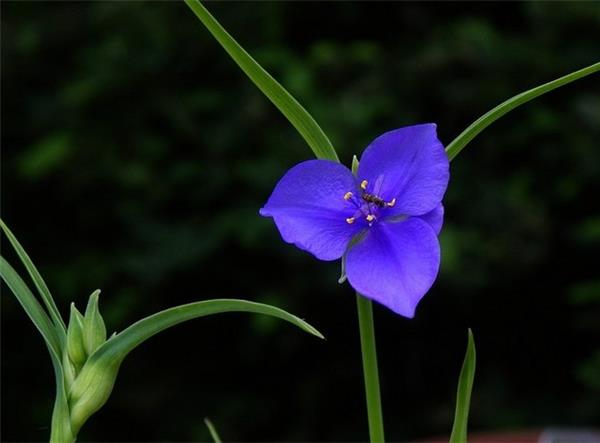
II. Cultivation techniques for Tradescantia
1. Transplanting
When potting young seedlings, first place a 2-3 cm thick layer of coarse-grained substrate or ceramsite at the bottom of the pot as a drainage layer, then sprinkle a layer of fully decomposed organic fertilizer on top as a base fertilizer, about 1-2 cm thick, then cover with another layer of substrate about 1-2 cm thick, and then place the plant in, so as to separate the fertilizer from the root system and avoid burning the roots. For the potting substrate, one of the following can be chosen. Garden soil: furnace slag = 3:1; or garden soil: medium-coarse river sand: sawdust (mushroom residue) = 4:1:2; or one of paddy soil, pond mud, or leaf mold. Or peat + perlite + ceramsite = 2 parts + 2 parts + 1 part; garden soil + furnace slag = 3 parts + 1 part; peat + furnace slag + ceramsite = 2 parts + 2 parts + 1 part; sawdust + vermiculite + medium-coarse river sand = 2 parts + 2 parts + 1 part. After potting, water thoroughly once, and keep it in a shaded environment for care.
2. Management
Tradescantia likes a warm, humid, and semi-shady environment, is not cold-tolerant, and is not strict about soil, but grows more vigorously when planted in loose, fertile sandy loam.
When growing Tradescantia, pay attention to the following points:
a. Humidity
It likes a humid climate environment, and requires the relative air humidity of the growing environment to be 60-75%.
b. Temperature
The optimum growing temperature is 18°C-30°C. It fears cold and frost, and the overwintering temperature needs to be kept above 10°C. When the winter temperature drops below 4°C, it enters a dormant state, and if the ambient temperature approaches 0°C, it will die from frost injury.
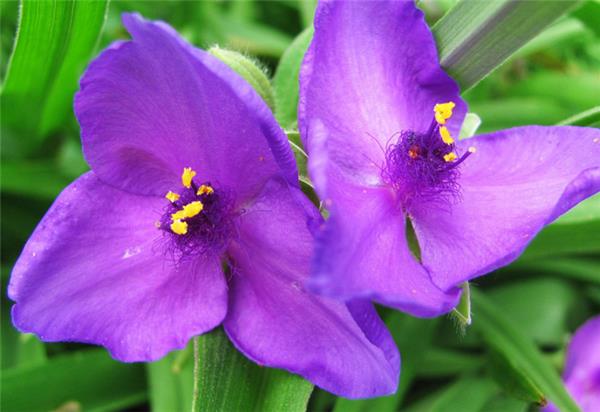
c. In summer
1. Strengthen air convection so that the heat inside the plant can be released;
2. Place it in a semi-shady spot, or give it 50% shade;
3. Mist it appropriately, 2-3 times a day.
d. In winter
1. Move it indoors to a bright place for care;
2. Outdoors, you can wrap it in plastic film to overwinter, but every two days at noon when the temperature is higher, uncover the film to let it breathe;
e. Light management
Placing the flower pot in a dark place easily causes the branches to grow leggy, with sparse stems and few leaves, losing their luster; in summer, exposure to direct strong light will scorch the leaves. Therefore, in spring and autumn, it is best to hang the flower pot in the air on a balcony or under a corridor eave where it is not exposed to direct sunlight at noon, and keep the potting soil moist regularly. It fears direct strong light, so it needs to be kept in a semi-shady spot for care, or given 70% shade. If cared for indoors, place it in as bright a place as possible, and every one or two months move it outdoors to a semi-shady spot or shaded care for one month, so that it can accumulate nutrients and recover its growth.
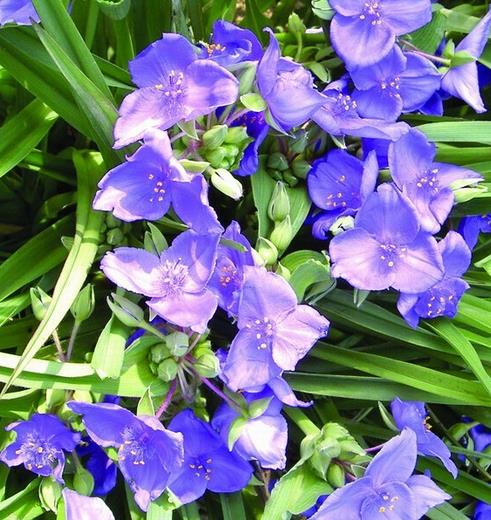
f. Fertilizer and water management
It has high requirements for fertilizer and water, but it is most afraid of careless fertilizing, concentrated fertilizer, and one-sided application of nitrogen, phosphorus, or potassium fertilizer. It is required to follow the fertilizing (and watering) principle of "apply dilute fertilizer frequently, use small amounts but more often, and provide complete nutrition."
The above is what there is to know about Tradescantia. We hope it can help you.