How do you grow yucca? Introduction to the cultivation method of the air-purifying little bell
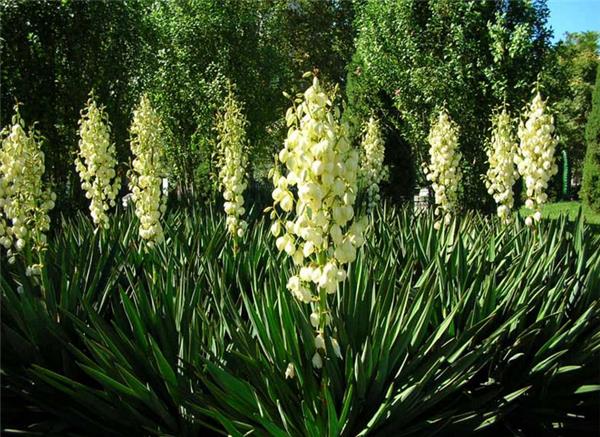
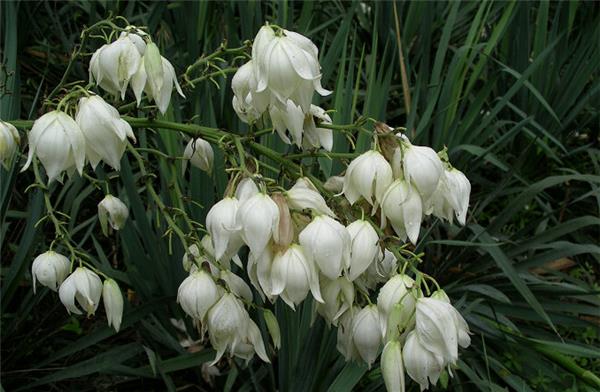
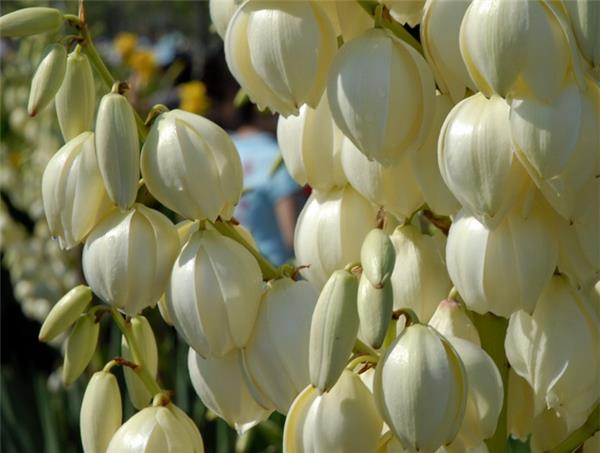
Yucca is an evergreen plant with beautiful flowers and leaves, a distinctive tree form, and sword-shaped leaves. When it blooms, the flower stalks rise tall and upright, the flowers are pure white, and the many white flowers hang down like bells. It has an elegant posture and a pleasant delicate fragrance, making it a fine ornamental garden tree and also a good cut flower material. Below, let us look at some knowledge about yucca.
I. Introduction to yucca
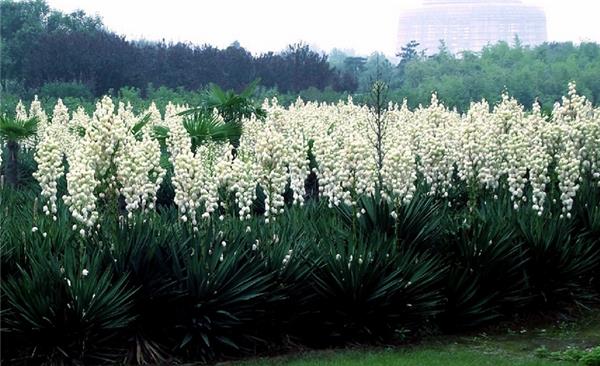
Yucca, also known as soft-leaf yucca, hairy-edged yucca, and foreign pineapple, is a plant of the genus Yucca in the family Liliaceae. It is the national flower of the country of Seychelles. Its stem is very short or inconspicuous. The leaves are clustered in a nearly rosette shape, hard, nearly sword-shaped or long strip-shaped lanceolate. The flowering (fruiting) period is in summer and autumn. It is native to North America and is now widely cultivated outdoors in warm regions. Yucca is an evergreen shrub of the genus Yucca in the family Agavaceae. Yucca flowers open at night, and when they open they give off a strange fragrance to welcome the visit of the yucca moth. The moth has a slender, bendable proboscis in its mouthparts used to collect pollen. Yucca is native to North America and is now widely cultivated outdoors in warm regions. Yucca is often planted in the center of flower beds, on terraced slopes, by buildings, along roadsides, and in green hedges. The leaf fiber of yucca is white, strong, and resistant to water and moisture, and is called "white hemp palm"; it can be used to make cables. The leaves can also be used to extract steroid hormones. Yucca is the national flower of the country of Seychelles. Yucca is widely used in road greening, courtyards, landscape greening, and protective isolation. It has strong resistance, wide adaptability, stays green all year round, and has high ornamental value. It is an important tree species for landscaping, and its leaf fiber can be made into rope.
II. Cultivation method for yucca
Cultivation notes
1. For plants propagated by cuttings and division, dig them up and plant them with the original soil. As long as they are watered a few times, they can survive. In daily management, attention should be paid to proper earthing up and fertilizing to promote the emergence of the inflorescence.
2. It likes loose, well-drained leaf mold or peat soil rich in humus.
3. It likes warmth and brightness, but avoids direct sunlight and is not cold-resistant. In North China, it is suitable for pot or box planting, overwintering indoors or in a cold room, with the temperature kept at 5-10°C.
4. It likes moisture. In summer outdoors it should be watered thoroughly, but waterlogging should be avoided. In winter, the amount of watering should be appropriately reduced according to the temperature. If the air temperature is too low, the leaf edges will turn yellow. It can resist drought, and in summer there is no need to spray water on the leaves or around the plant.
5. Repot once every 1-2 years. Repotting can be done in spring. During the growing period from March to August, fertilize once every half month. After flowering, the entire inflorescence can be cut off to maintain the plant shape and allow the terminal bud to continue developing. If dead leaves and residual stems are found, they should be pruned in time to keep it neat and beautiful. In winter, it should be pruned appropriately, and dead branches and fallen leaves should be cleared away, which is beneficial for flowering the following year.
6. There are relatively few pests and diseases. If the indoor temperature is too high in winter, too dark, and the air is stuffy, it is easy to cause pest damage. Environmental conditions should be improved immediately, and targeted prevention and control measures should be taken.
III. The uses and functions of yucca
1. Ornamental value
Yucca is an ornamental plant with both beautiful flowers and leaves. It is often planted in the center of flower beds, in front of buildings, in lawns, by ponds, on terraced slopes, by buildings, along roadsides, and in green hedges. Its leaf fiber is white, strong, and resistant to water and moisture, and is called "white hemp palm"; it can be used to make cables. The leaves can also be used to extract steroid hormones. Yucca is the national flower of the country of Seychelles.
2. Air purification
Yucca has strong resistance to and absorption capacity for harmful gases such as sulfur dioxide, hydrogen fluoride, chlorine, and ammonia. Tests show that in an environment with a daily average sulfur dioxide concentration of 0.1 ml/cubic meter, many trees such as sabina chinensis, photinia, winter jasmine, and paulownia all show severe damage symptoms, while yucca remains upright and robust. Yucca also has a relatively strong ability to absorb hydrogen fluoride. According to measurements, 1 kg of dry leaves can absorb 266 mg of fluorine. In addition, yucca has a certain resistance to ammonia, ethylene, and others, and planting yucca should be vigorously promoted in areas with heavier pollution.
3. Ecological value
Yucca has a good air-purifying function and has strong resistance to and absorption capacity for harmful gases such as sulfur dioxide, hydrogen fluoride, chlorine, and ammonia. Tests show that in an environment with a daily average sulfur dioxide concentration of 0.15 ml/m3, many trees such as sabina chinensis, photinia, winter jasmine, and paulownia all show severe damage symptoms, while yucca remains upright and robust. Yucca also has a relatively strong ability to absorb hydrogen fluoride. According to measurements, 1 kg of dry leaves can absorb 266 mg of fluorine. Yucca has a certain resistance to ammonia, ethylene, and others, and can be used in large quantities in polluting industrial and mining enterprises.
4. Economic value
Yucca extract is a new type of feed additive. It plays an important role in promoting the health and high yield of livestock and poultry, improving their digestive tract environment, improving meat product quality, promoting nutrient absorption, and increasing feed utilization. In particular, yucca extract has a unique nitrogen-fixing ability and has significant effects in reducing the concentration of harmful substances such as ammonia, hydrogen sulfide, and skatole in livestock and poultry manure, as well as improving the rearing environment.
The above is some knowledge about yucca. I hope it can help you.
It plays an important role in promoting the health and high yield of livestock and poultry, improving their digestive tract environment, improving meat product quality, promoting nutrient absorption, and increasing feed utilization. In particular, yucca extract has a unique nitrogen-fixing ability and has significant effects in reducing the concentration of harmful substances such as ammonia, hydrogen sulfide, and skatole in livestock and poultry manure, as well as improving the rearing environment.The above is some knowledge about yucca. I hope it can help you.