Basic Introduction to Grape Hyacinth and How to Grow It
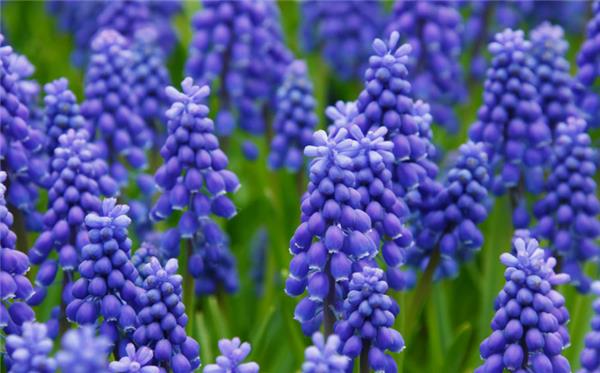
The entire inflorescence of the grape hyacinth resembles a cluster of blue-purple grapes, elegant and refined, and it can be grown as an indoor hanging potted flower. Now let's take a look at what we know about grape hyacinth.
I. Introduction to Grape Hyacinth
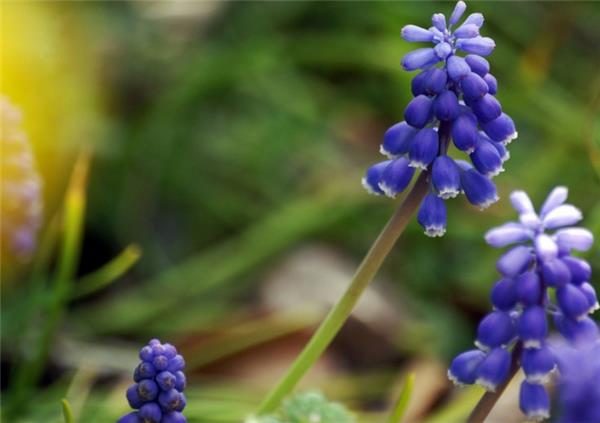
Grape hyacinth is a perennial herb, with an ovate bulb covered by a white tunic; the corm is 1-2 cm. The leaves are basal, linear, slightly fleshy, dark green, with margins often rolled inward, about 20 cm long. The flower stems emerge from the leaf cluster, 1-3 stems, with stems 15-25 cm tall, a raceme, with numerous small flowers densely arranged and drooping, the corolla small and urn-shaped with a constricted tip, blue or white at the tip, and there are also white, flesh-colored, light blue, and double-flowered varieties. The grape hyacinth bulb is roughly spherical, covered with a white tunic, with basal, linear-lanceolate, dark green leaves, 10 cm to 20 cm long, and a raceme about 10 cm long, with small flowers slightly drooping, the flowers shaped like grape berries, and the entire inflorescence like a bunch of grapes; the flower colors include white, blue-purple, light blue, and others. The flowering period of grape hyacinth is from March to May.
II. Morphological Characteristics of Grape Hyacinth
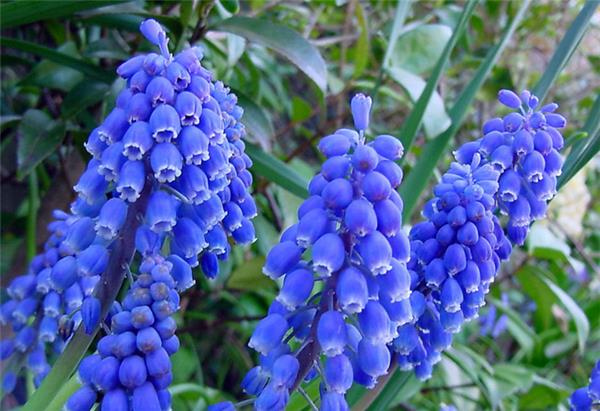
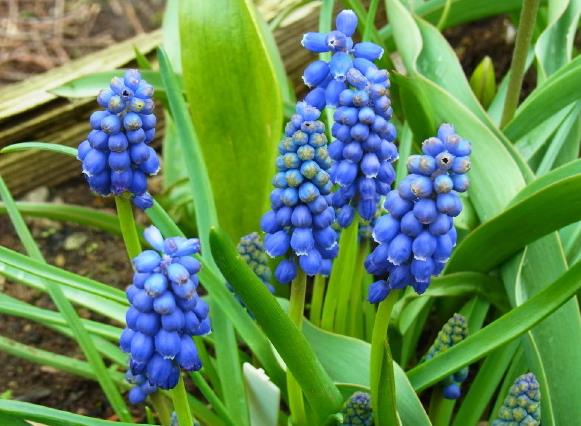
Grape hyacinth is a perennial herb, with an ovate bulb covered by a white tunic; the corm is 1-2 cm. The leaves are basal, linear, slightly fleshy, dark green, with margins often rolled inward, about 20 cm long. The flower stems emerge from the leaf cluster, 1-3 stems, with stems 15-25 cm tall, a raceme, with numerous small flowers densely arranged and drooping, the flowers shaped like grape berries, and the entire inflorescence like a bunch of grapes, the corolla small and urn-shaped with a constricted tip, blue or white at the tip, and there are also white, flesh-colored, light blue, and double-flowered varieties. The grape hyacinth plant is 15-30 cm tall, with an underground bulb covered by a white tunic, 1-3 cm in diameter and about 1.5 cm high. It is native to Central Europe and prefers fertile, well-drained sandy soil, tolerating partial shade and cold. The flower stems emerge from the leaf cluster, cylindrical, about 15 cm long, densely bearing many small grape-hyacinth flowers, with drooping pedicels, and the flowers are blue-purple, light blue, white, and others. The flowering period is from March to May. The leaves are basal, linear, slightly fleshy, dark green, with margins often rolled inward, 15-30 cm long and about 0.6 cm wide. The flowering period of grape hyacinth is from March to May.
III. How to Grow Grape Hyacinth
Management Tips
1. Planting depth: the stem tip should be visible.
2. Watering amount: after planting in moist substrate soil, water more, then water less or not at all.
3. Natural cold treatment: in areas where winter temperatures are especially low, a temperature-controlled cold storage room is needed.
4. Method of natural cold treatment: bury the flowerpot in soil and cover the shoot tips with about 5 cm of soil.
5. Frost protection: for natural cold treatment, the flowerpots buried in the soil must be in good contact with the soil, and a layer of straw (at least 10 cm thick) should be spread on the surface. During frost, plastic film or bubble film should also be put on, and then additional straw should be spread on top. After the frost period, remove the plastic film and the extra straw.
5. Fertilization: not needed.
6. Greenhouse temperature: 14-15°C; relative humidity 60-80%.
7. Watering amount: little, but do not let the soil dry out.
8. Controlling leaf growth: can be done by watering sparingly and providing sufficient light.
The above is what we know about grape hyacinth, and I hope it can help you.