Introduction to Marigolds and How to Grow Them, a Flower Native to Africa
The marigold is a plant with strong vitality and can adapt to any kind of soil. Even cut flowers with stems attached remain as beautiful as ever. That is why its flower meaning is health. Now let us look at some knowledge about marigolds.
I. Introduction to Marigolds
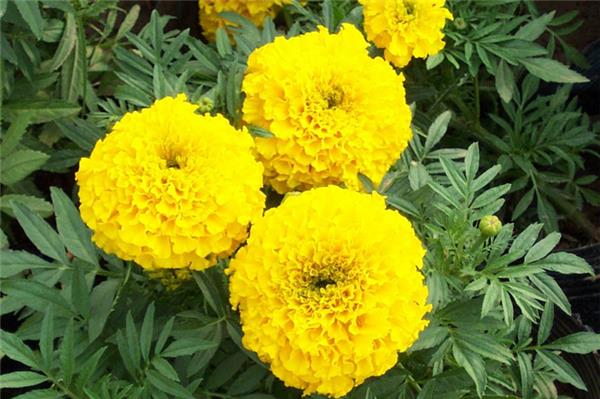
The marigold is an annual herbaceous plant, 50-150 cm tall. It is an ideal raw material for extracting pure natural yellow pigment. In Africa it is called Khakibush, and it is commonly seen hanging under the thatched huts of indigenous people to drive away swarms of flies.
II. Cultivation Techniques for Marigolds
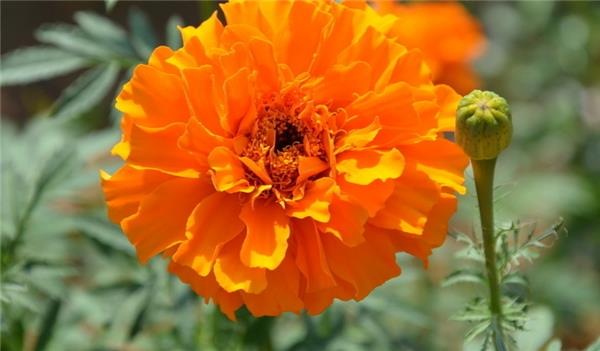
Marigolds are sown in spring, from late March to early April, in open-field seedbeds. Because the seeds are light-sensitive (photophobic), they must be covered with soil and watered after sowing. The optimum temperature for seed germination is 20-25 degrees, and seedlings emerge about 1 week after sowing, with a germination rate of about 50%. When sown in summer, they can bloom 60 days after emergence. Marigolds are propagated by cuttings in summer, which root easily and form seedlings quickly. Cut 8-12 cm young shoots from the mother plant as cuttings, remove the lower leaves, and insert them into potting soil, 3 cuttings per pot. After inserting, water thoroughly and shade slightly; they will root after 2 weeks. Then gradually move them to a sunny spot for routine care, and they can bloom after about 1 month.
Raising Marigold Seedlings
1. Seedling raising time, area and seed quantity
The seedling raising time can be determined according to the transplanting time. Generally, spring marigolds are raised about 40 days before transplanting. For every 667 sq m of spring marigolds planted, a seedbed of 20-25 sq m is needed, using about 30 g of seed.
2. Seedling raising method
Spring-sown marigolds are raised in cold frames or small arch sheds, mostly small arch sheds. Choose a seedbed that is sheltered from the wind and faces the sun, preferably running east-west. The width and length of the seedbed should suit the size of the film and be convenient for management; generally the width should not exceed 1.3 m. The height of the arch shed should be about 60 cm. For the film, it is best to choose a drip-free film with good warming and heat-retention performance. Marigolds are mostly grown from seed, but can also be propagated by cuttings. The former method is mostly used for large-area planting, while the latter is often used for cultivating rare varieties. Seed propagation can be sown all year round; usually spring sowing gives autumn flowers, and summer sowing gives autumn and winter flowers. The seeds germinate easily and can self-sow and propagate. From late March to early April, prepare the land and make beds, and after sowing cover with soil to a thickness of 0.8 cm. Then water with a fine-rose watering can to keep the soil moist. At a temperature of 20-21°C, the seeds germinate and emerge 1 week after sowing, and in about half a month the leaves reach 7, at which point they can be transplanted. The optimum temperature for seedling growth is 15°C. When the seedlings are 10-13 cm tall, they can be planted out at a spacing of 30-35 cm. Early-maturing varieties have a short vegetative growth period and bloom in about 40 days, while late-maturing varieties bloom in about 90 days, with a flowering period of 2 months. During the growing period in May-June, cut healthy young shoots with 3-4 nodes, 6-10 cm long, and insert them under a shade shed for cutting propagation, using washed river sand or garden soil as the medium. The cutting depth is 2-3 cm, and the soil should be kept moist. They root after 2 weeks, are ready to leave the nursery and be planted out after 3 weeks, and bloom in about 1 month. For large-scale cuttings, use the full-light misting method, and perlite can be used as the medium. Because misting increases air humidity, the cuttings do not need shading during the day, and more leaves can be left on the cuttings than in conventional seedling raising. They root in about 1 week, and are then transplanted.
3. Preparing beds and fertilizing
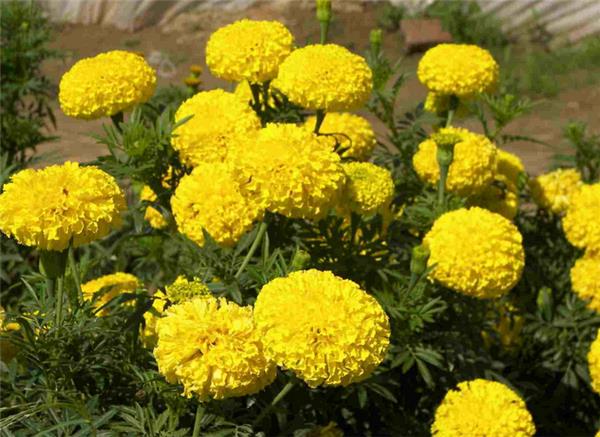
Marigolds are not demanding about soil, but soil with deep, loose, well-drained and airy layers should be chosen. Harrow to a depth of 20-25 cm so that the surface soil is soft and fine and the field surface is level. For every 667 sq m of seedbed, apply 200 kg of farmyard manure and 2 kg of special chrysanthemum fertilizer. Plow the farmyard manure into the ground, spread the chemical fertilizer evenly over the bed surface, then hoe it into the ground, and finally harrow fine and level.
4. Seed treatment
First carefully select the seeds, removing impurities and shriveled seeds to ensure the seeds are plump. Then sun the selected seeds to kill pathogens, enhance seed vigor and increase the germination rate. Before sowing, soak the seeds in warm water at 35-40°C for 3-4 h, then take them out, rinse once with clean water, and drain before sowing. To prevent diseases during the seedling stage, the seeds can be dressed with thiophanate-methyl or chlorothalonil.
5. Sowing
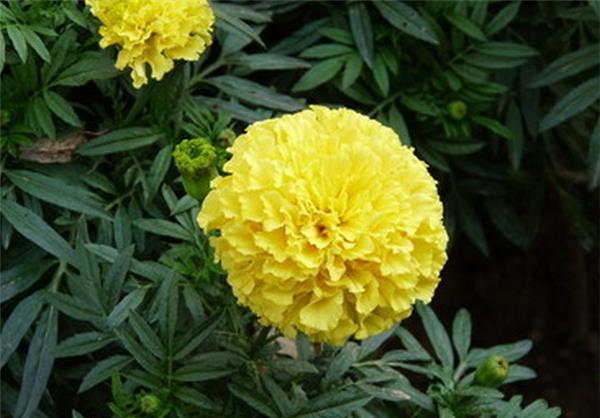
Sowing should be done on a windless, sunny day. On the day of sowing, irrigate the seedbed thoroughly, and sow once the water has seeped down. When sowing, mix the treated seeds with fine sandy soil and scatter them over the seedbed in 2-3 passes. After sowing, cover with sieved soil to 0.7-1 cm.
6. Watering
After earthing up, water according to the soil moisture; each watering should not be too heavy, do not flood the ridges, and keep the soil alternately dry and moist.
7. Foliar topdressing
Carry out foliar topdressing when the flowers are in full bloom. It is best to spray after 6 p.m., applying 30 g of urea and 30 g of monopotassium phosphate per 667 sq m.
The above is the knowledge about marigolds; I hope it can help you.