How to grow firecracker plant? Introduction to firecracker plant and how to grow it
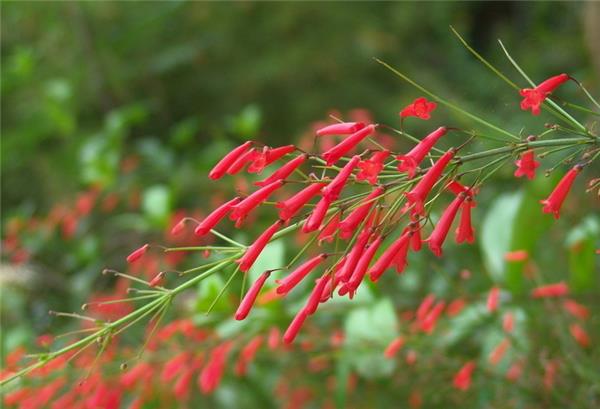
Firecracker plant (Russelia equisetiformis) is a beautiful flowering plant. It blooms profusely, with long-lasting bright red flowers that look like firecrackers, making it an ideal trailing green plant for balconies. In warm regions it can bloom continuously all year round, and it is even more treasured because it is already in flower during Spring Festival. Let's take a look at what we know about firecracker plant.
I. Introduction to firecracker plant
Firecracker plant has bright red flowers, hanging down in long strings just like firecrackers, and is quite spectacular. In warm regions it blooms almost continuously all year round, and it is even more treasured because it is already in flower during Spring Festival. It can be grown in pots for display, and can also be used in flower beds, beside rocks, and in lawns. Firecracker plant has slender, drooping branches and leaves, blooms profusely, and its flowers are long-lasting and bright red, like firecrackers. It is an ideal trailing green plant for balconies and can be used for greening cultivation in balcony flower troughs, on dam tops, and on slope edges. Firecracker plant belongs to the genus Russelia in the family Plantaginaceae, also known as "firecracker flower" and "lucky grass", and is native to Mexico and Central America. Firecracker plant is a perennial herbaceous plant of the genus Russelia in the family Scrophulariaceae. Under suitable conditions, it can bloom in all four seasons.
II. Morphological characteristics of firecracker plant
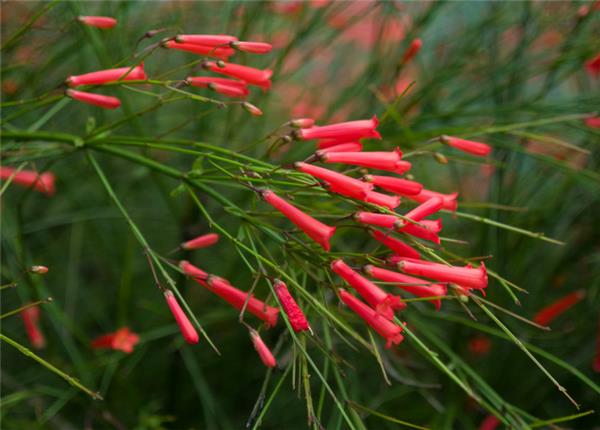
Firecracker plant is a multi-branched, clustered semi-vine flowering plant, about 1 m tall. The stems are initially upright, with the tips bending and drooping, and they hang down under gravity when in flower. The small branches are whorled, slender, with obvious nodes. The leaves are ovate or linear-lanceolate, and are mostly reduced and very small. The large panicle composed of cymes bears many flowers and bends downward; the flowers are bright red, with a tubular corolla, slightly two-lipped, about 2.5 cm long. The capsule is spherical. The flowering period is mainly from March to June, and in warm regions it often blooms continuously all year round. Firecracker plant is 60-100 cm tall, with slender stems and branches that have longitudinal ridges and are green, whorled at the nodes, and much branched. The small leaves are opposite or whorled, and most are reduced to small scales. The cymes have a long tubular red corolla, with an indistinct two-lipped tip, the upper lip 2-lobed and the lower lip 3-lobed.
III. Cultivation techniques for firecracker plant
1. Cultivation environment
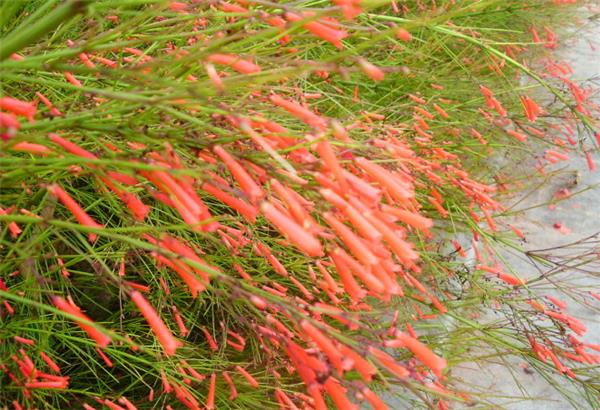
Firecracker plant is a sun-loving, light-demanding plant. It likes a warm, high-temperature, humid climate and is suitable for planting in sunny, well-ventilated places. A well-drained sandy loam soil is best. It has strong vitality, grows vigorously, and is easy to cultivate. It is often planted in courtyards, on trellises, on flower arches and fences for vertical greening.
2. Cultivation substrate
Field-grown firecracker plant requires deep soil layers and good soil permeability. It is highly adaptable, and can also grow normally in ordinary soil. Seedlings from layering are planted in the same year and bloom the following year. Never let it suffer drought in fertilizer and water; keep the soil moist and water twice a day in the hot season. Apply dilute liquid fertilizer 1-2 times a month. For shaping and maintenance, vertical greening requires installing a support to guide growth. Do not turn the vines during the growth period, so as not to damage the tendrils and cause poor growth and weak flowering.
3. Key cultivation points
For cultivating firecracker plant, choose an environment with plenty of light and heat and ample fertilizer and water. If the cultivation environment is too shaded, the plant grows spindly, producing only long branches and stems without flowering; while if the climate is too hot and dry, the plant will show premature aging. The cultivation soil should be loose, fertile, and rich in organic matter. In the peak growing season, liquid fertilizer should also be top-dressed 1-3 times a month. Early overly thin and overly dense branches should be pruned off, and at the same time the plant height should be controlled to prevent excessive rampant growth.
4. Potted management
(1) Potting up
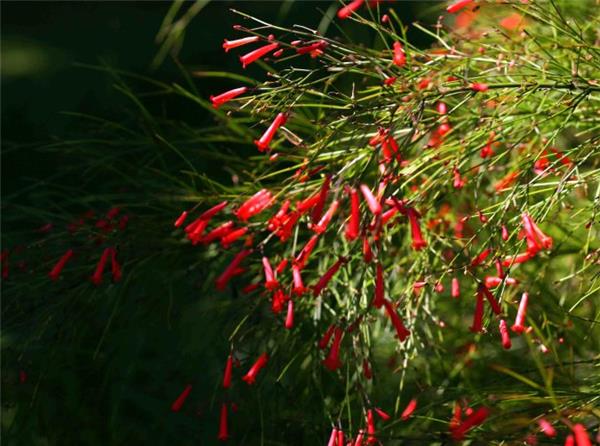
When potting up small seedlings or repotting large plants that have been grown for several years, first place a 2-3 cm thick layer of coarse-grained substrate at the bottom of the pot as a drainage layer, sprinkle a layer of fully decomposed organic fertilizer on top as base fertilizer, about 1-2 cm thick, then cover with a thin layer of substrate about 1-2 cm thick, and then place the plant in, so as to separate the fertilizer from the roots and avoid burning the roots.
(2) Pruning
In winter, when firecracker plant enters dormancy or semi-dormancy, cut off weak, pest- or disease-affected, dead, and overly dense branches.
(3) Repotting
As long as it is maintained properly, it will grow very fast. When it grows to a certain size, consider giving it a larger pot so that it can continue to grow vigorously. For the potting soil and component ratios used for repotting, one of the following can be chosen: vegetable garden soil : cinder = 3:1; or garden soil : medium-coarse river sand : sawdust (mushroom residue) = 4:1:2; or one of paddy soil, pond mud, or leaf mold.
(4) Removing from the pot
Place the flower to be repotted on the ground, first pat the sides of the pot lightly with the palm of your hand so that the root system is shaken and separates from the pot wall, then turn the flower pot upside down and hold it on your left hand. Lightly pinch the plant between the index finger and middle finger of your left hand, brace the rim of the pot with your wrist and fingertips, pat the bottom of the pot with your right hand, and then use your thumb to push the root soil downward from the bottom hole, letting the plant come out. After it comes out, pat the pot soil lightly with both palms so that excess soil falls off.
The above is what we know about firecracker plant. We hope it can help you.
so that excess soil falls off.The above is what we know about firecracker plant. We hope it can help you.