How to grow Mimosa pudica? Get to know this shy little plant
Mimosa pudica is a fascinating plant. Unlike ordinary plants, when it is touched by the outside world, its leaf stalks droop and its leaflets close up, a movement people interpret as "shyness." Let's take a look at what we know about Mimosa pudica.
I. Introduction to Mimosa pudica
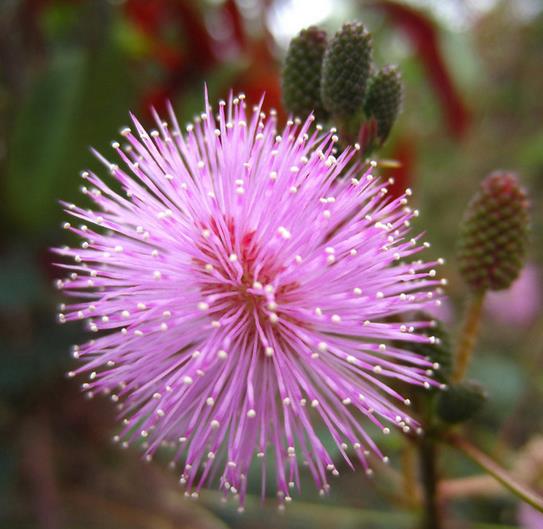
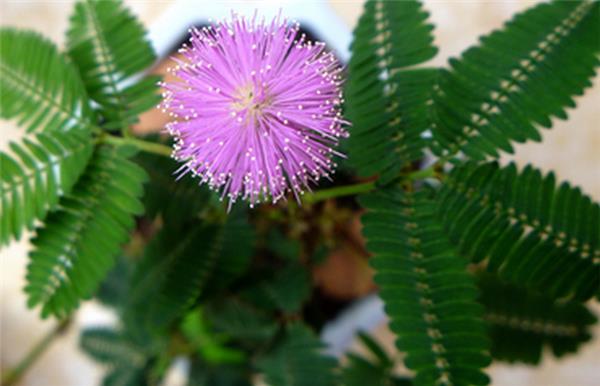
Mimosa pudica is a perennial herb or subshrub in the Fabaceae family. Because its leaves respond to heat and light and close immediately when touched by an external force, it is named "mimosa" (the shy plant). It is native to the tropical regions of South America, prefers warmth and humidity, and is not demanding about soil. Its flowers are pink and shaped like fluffy balls, lovely and appealing. After flowering it produces pods, and the fruit is flat and round. The leaves are feathery compound leaves arranged alternately, in a palmate arrangement. The flowers, leaves and pods of Mimosa pudica all have good ornamental value, and it is relatively easy to keep alive, making it suitable as a potted flower for balconies and indoors; it can also be grown in courtyards and other places.

II. Cultivation techniques for Mimosa pudica
1. Cultivation and planting
It can be grown in ordinary soil. It does not need much fertilizer during the growing period; applying diluted liquid fertilizer 2 to 3 times is enough. Fertilizer should not be excessive; it is enough for the leaves to be green and the growth robust, and it should not be allowed to grow leggy, because Mimosa pudica is mainly a novelty foliage plant and is best kept small. The growing technique for Mimosa pudica is simple and management is extensive. It is not demanding about climate, sunlight or soil, but fertile, loose sandy loam is best, and it likes a warm, humid environment. Planting method: usually propagated by seed, sown from late March to early April. Scatter the seeds evenly on fine soil, cover with about 1.5 cm of soil, and at a temperature of about 18°C, seedlings can emerge in about 10 days (generally they grow once in the soil and need no special effort at management). Seedlings grow slowly, and can be planted out when they are 7 to 8 cm tall.
2. Field management
For field planting, the spacing between plants is 25 to 30 cm; loosen the soil, hoe weeds and water in good time. For indoor potting, water once every 2 to 3 days in summer.
3. Key care points
During the growing period of Mimosa pudica, along with watering, apply decomposed diluted liquid fertilizer about every 10 days, 3 to 4 times. As a potted ornamental flower, it is easy to move indoors to a sunny spot, and keeping a room temperature of 0 to 12 degrees is enough for it to overwinter safely.
Water: it likes humidity; water once a day during the summer growing period. Fertilizer: apply a top dressing once every half month during the seedling stage. If you do not want the plant to grow too large, reduce the amount of fertilizer.
Soil: it requires deep, fertile, moist soil.
Temperature: it is not cold-hardy and likes a warm climate; in winter the plant dies back on its own.
Light: it likes plenty of light and tolerates partial shade slightly.
Propagation: seed propagation. Sow from late March to early April; seedlings grow rather slowly, and can be planted out when the seedlings are 7 to 8 cm tall.

III. Uses and purposes of Mimosa pudica
1. Decorative applications
Mimosa pudica has a loose, spreading form and delicate, graceful feathery leaves, and its leaves close as soon as they are touched, giving people an impression of delicate elegance. Grown in the ground, it can be scattered along courtyard walls and corners. In pots, it can be placed on windowsills and desks.
2. Ornamental value
Mimosa pudica has a loose, spreading form and delicate, graceful feathery leaves, and its leaves close as soon as they are touched; its flowers are abundant and elegant, charming and moving, giving people an impression of delicate elegance. It can be grown in the ground along courtyard walls and corners, or potted on windowsills and desks. When giving it as a gift, gently drape the pot with pink gauze and tie it with a pink ribbon bow. If you can add pink mohair pompoms as a finishing touch, it will be even more interesting.
3. Weather forecasting
Mimosa pudica is a wonderful plant that can foretell changes between sunny and rainy weather. If you touch it with your hand, its leaves close very quickly, and when they open they do so very slowly, this indicates that the weather will turn clear; if when you touch Mimosa pudica its leaves contract slowly and droop slowly, or even close slightly and then open again, this indicates that the weather will turn from clear to overcast or that it is about to rain. The reason the speed at which the leaves of Mimosa pudica open and close can foretell whether the weather will be overcast or clear is mainly that at the leaf neck of Mimosa pudica there is a small drum-shaped thin-walled cell tissue, the pulvinus, and the pulvinus is full of water. When you touch a leaf of Mimosa pudica with your hand, the leaf vibrates, and the water in the cells of the lower part of the pulvinus immediately flows upward and to both sides, so the lower part of the pulvinus deflates while the upper part swells, and the leaf stalk droops and the leaf closes. So the closing and opening of the leaf is caused by the turgor pressure effect of the pulvinus. And the turgor pressure effect of the pulvinus is closely related to the humidity in the air. When the air humidity is very low, the turgor pressure effect of the pulvinus is obvious, and the leaf closes and opens quickly; when the air humidity is very high, the leaf opens and closes slowly. So the speed at which the leaves of Mimosa pudica open and close indirectly reflects the level of humidity in the air and can serve as a reference for weather forecasting.
4. Predicting earthquakes
According to Turkish seismologist Ercan, several hours before a strong earthquake occurs, the leaves of Mimosa pudica, which are sensitive to outside touch, suddenly wither and then dry up. In earthquake-prone Japan, scientists have found through research that under normal conditions, the leaves of Mimosa pudica open during the day and close at night. If the leaves of Mimosa pudica show the abnormal phenomenon of closing during the day and opening at night, it is a precursor to an earthquake. For example: at 7 a.m. on January 11, 1938, Mimosa pudica began to open, but by 10 o'clock the leaves suddenly all closed, and sure enough a strong earthquake occurred on the 13th. In 1976, members of the Japan Earthquake Club observed the abnormal closing phenomenon of Mimosa pudica leaves many times, and earthquakes occurred afterward each time. These are real events! In addition, Mimosa pudica can also predict disastrous weather changes, and will produce growth activity contrary to its normal patterns in response to sudden out-of-season temperature differences, geomagnetic and geoelectric changes, and so on. We can place some potted Mimosa pudica plants in our living rooms to observe and help predict and guard against natural disasters.
The above is what we know about Mimosa pudica; I hope it can help you.