Tuberose Introduction and Growing Methods: Learn to Grow the Queen of the Night
Because of its strong fragrance, slender flower stems, soft lines, and the ease of planting and controlling its flowering period, tuberose is one of the most important cut flowers and a main filler flower in bouquets, flower arrangements, and similar uses. Now let's take a look at what you need to know about tuberose.
I. Introduction to Tuberose
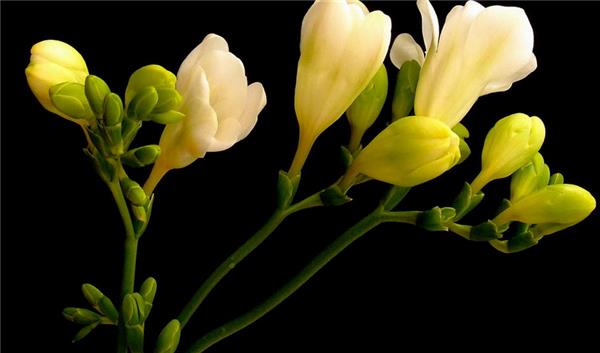
Tuberose, also known as night-blooming jasmine or moonflower, is a perennial bulbous flowering plant in the genus Polianthes of the Amaryllidaceae family (or Agavaceae family). It is a perennial herb with a tuberous rhizome; linear leaves grow in a cluster with pointed tips; the flower stem is relatively long, with a raceme at the upper part. It blooms white flowers in summer and autumn with a strong fragrance that becomes even stronger at night. Tuberose flowers open at night, and in eastern India people call it "Ratkirani," which means "Queen of the Night." When planted in the open ground, the flowering period is usually from early July to early November, with peak bloom in August-September, making it a summer cut flower type.
II. Morphological Characteristics of Tuberose
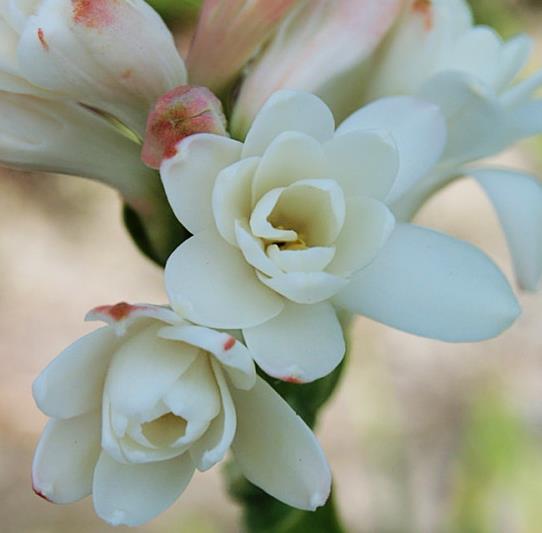
Tuberose, also known as night-blooming jasmine or yuelai xiang. It belongs to the Amaryllidaceae family as a winter-dormant bulbous plant, a perennial scaly-bulb herbaceous flower. It grows about 80 cm tall, with a bulb that is scaly-tuberous (the upper half is bulb-like, the lower half is tuber-like). The spike-like flower cluster is terminal, with 12-32 flowers per spike. The flowers are white, funnel-shaped, and strongly fragrant, with the fragrance becoming stronger at night, which is how it got its name. When planted in the open ground, the flowering period is usually from early July to early November, with peak bloom in August-September, making it a summer cut flower type. It grows about 80 cm tall, with basal leaves that are lanceolate and slightly red at the base, and the stem leaves are short and small. The spike has paired flowers in groups of 12-18, opening successively from bottom to top. The flowers are white, funnel-shaped, fragrant, with a stronger scent at night, hence the name night-blooming jasmine. The flower scape is upright, 40-90 cm tall; the flowers are opposite, white, arranged in a relatively long spike, with a strong fragrance that becomes stronger at night; the perianth tube is slender with 6 lobes shorter than the perianth tube; there are double-flowered cultivars with a lighter fragrance, flowering from July to October. The fruit is a capsule. Tuberose self-pollinates, but because the pistil matures later than the stamens, the natural seed-setting rate is very low, and under normal cultivation it does not set seed. It blooms from May to November. Capsule. Cultivated varieties come in two types, white-flowered and light purple-flowered: the white-flowered type is mostly single-flowered with a stronger fragrance; the light purple-flowered type is mostly double-flowered, with each inflorescence bearing up to about 40 flowers. It is a winter-dormant bulbous plant, evergreen in its place of origin, with a scaly-tuberous bulb (the upper half is bulb-like, the lower half is tuber-like).
III. Cultivation Techniques for Tuberose
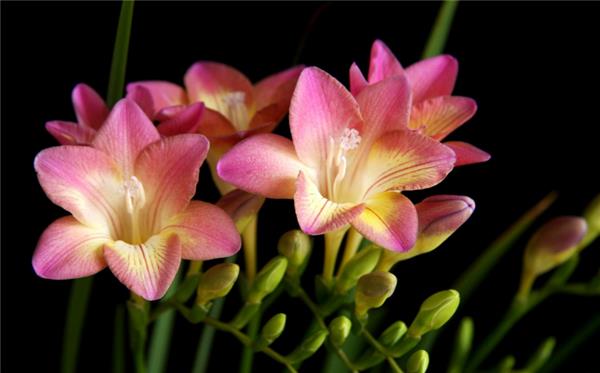
It is usually planted from April to May. The bulbs should first undergo a 10-15 day moist treatment at 25°C-30°C before planting. Large bulbs, small bulbs, and old bulbs that flowered last year (commonly called "old remnants") should be planted separately. For large bulbs, the plant spacing is 20 cm × 25 cm (or 30 cm); for small bulbs, 10 cm × 15 cm or closer; the planting depth should be slightly shallower than for other bulbs, but it also varies depending on the cultivation purpose, soil properties, and bulb size. Generally, "deep planting for bulbs, shallow planting for scapes" means that deep planting favors bulb growth and enlargement, while shallow planting favors flowering. For large bulbs, it is generally best to plant with the bud tip slightly exposed above the soil surface; for small bulbs and "remnants," the bud tip should be below or level with the soil surface. Tuberose sprouts slowly, taking more than 1 month, but grows quickly after sprouting. Therefore, in the early planting stage, since the seedlings are small and have few leaves, there is no need to water too much; when the flower stem is about to emerge and in the early flowering stage, it should be watered thoroughly and the soil kept consistently moist. Tuberose likes fertilizer and should be given regular topdressing: generally once after 1 month of planting, once before flowering, and then once every 1.5 or 2 months. During the rainy season, pay attention to drainage and to preventing the flower stems from lodging. Before frost in late autumn, dig up the bulbs, dry them slightly, remove the soil and fibrous roots, and thinly cut off a layer from the bottom of the bulb, preferably until white is revealed; continue drying until dry, then braid the remaining leaf clusters into a braid and hang it in a warm, dry place to store over winter. Alternatively, use the method of fumigation with a stove: hang the bulbs indoors and place a stove below for fumigation. Initially keep the room temperature at 25°C-26°C to gradually reduce the moisture in the bulbs until the outer skin becomes dry and wrinkled, then lower the temperature to 15°C-20°C until they are taken out the following spring. After fumigation, the bulbs can be fully dried, thereby forcing them into complete dormancy, which is beneficial for growth and flower bud differentiation after planting the following spring. Some also dry the bulbs and pile them in a dry, sunny cellar, covering them in layers with straw and soil and pressing them down firmly to overwinter; or plant them continuously for 2-3 years before digging them up and replanting, but the flowering quality is poor and the flowering period is not uniform.
1. Cultivation Management
The planting site should be prepared and base fertilizer applied. Large bulbs, small bulbs, and old bulbs that flowered last year should be planted separately. For large bulbs, the plant spacing is 25 cm; for small bulbs, about 10 cm. The planting depth is shallower than for other bulbs. For large bulbs, it is best to plant with the bud tip slightly exposed above the soil surface; for small bulbs and old bulbs, the bud tip should be below the soil surface. Old bulbs that flowered last year can no longer bloom, and only produce many thin, pointed small bulbs around them. "Deep planting for bulbs, shallow planting for scapes" is the principle to follow for tuberose planting depth. In the early planting stage, because the seedlings are small and have few leaves, water should not be too much; when the flower scape is about to emerge, give sufficient water and topdressing; only after the scape emerges can a more concentrated liquid fertilizer be applied. In summer, special attention should be paid to watering, keeping the soil consistently moist. After the aboveground parts wither, in the Jiangnan region people often cover with leaves or dry grass to protect against freezing, and let them overwinter in the open ground. But it is best to dig up the bulbs, dry them slightly, remove the soil, braid the remaining leaf clusters into a braid, continue drying until dry, and hang them in a warm, dry place to store over winter; keeping the room temperature above 4°C is sufficient. Tuberose can also be grown in pots, and pot cultivation can be used for forcing. Plant the bulbs in late November, keep them in a high-temperature greenhouse, and they can bloom early in April-May; for home gardening, forcing is not convenient.
2. Points to Note
Fertilizing: Tuberose likes fertilizer and should be given regular topdressing: generally once after 1 month of planting, once before flowering, and then once every 1.5 or 2 months. During the rainy season, pay attention to drainage and to preventing the flower stems from lodging. Before frost in late autumn, dig up the bulbs, dry them slightly, remove the soil and fibrous roots, and thinly cut off a layer from the bottom of the bulb, preferably until white is revealed; continue drying until dry, then braid the remaining leaf clusters into a braid and hang it in a warm, dry place to store over winter. Alternatively, use the method of fumigation with a stove: hang the bulbs indoors and place a stove below for fumigation.
Care: "Deep planting for bulbs, shallow planting for scapes" is the principle to follow for tuberose planting depth. In the early planting stage, because the seedlings are small and have few leaves, water should not be too much; when the flower scape is about to emerge, give sufficient water and topdressing; only after the scape emerges can a more concentrated liquid fertilizer be applied. In summer, special attention should be paid to watering, keeping the soil consistently moist. After the aboveground parts wither, in the Jiangnan region people often cover with leaves or dry grass to protect against freezing, and let them overwinter in the open ground. But it is best to dig up the bulbs, dry them slightly, remove the soil, braid the remaining leaf clusters into a braid, continue drying until dry, and hang them in a warm, dry place to store over winter; keeping the room temperature above 4°C is sufficient. Tuberose can also be grown in pots, and pot cultivation can be used for forcing. Plant the bulbs in late November, keep them in a high-temperature greenhouse, and they can bloom early in April-May; for home gardening, forcing is not convenient.
That is everything about tuberose. I hope it can help you.
In summer, special attention should be paid to watering, keeping the soil consistently moist. After the aboveground parts wither, in the Jiangnan region people often cover with leaves or dry grass to protect against freezing, and let them overwinter in the open ground. But it is best to dig up the bulbs, dry them slightly, remove the soil, braid the remaining leaf clusters into a braid, continue drying until dry, and hang them in a warm, dry place to store over winter; keeping the room temperature above 4°C is sufficient. Tuberose can also be grown in pots, and pot cultivation can be used for forcing. Plant the bulbs in late November, keep them in a high-temperature greenhouse, and they can bloom early in April-May; for home gardening, forcing is not convenient.
2. Points to Note
Fertilizing: Tuberose likes fertilizer and should be given regular topdressing: generally once after 1 month of planting, once before flowering, and then once every 1.5 or 2 months. During the rainy season, pay attention to drainage and to preventing the flower stems from lodging. Before frost in late autumn, dig up the bulbs, dry them slightly, remove the soil and fibrous roots, and thinly cut off a layer from the bottom of the bulb, preferably until white is revealed; continue drying until dry, then braid the remaining leaf clusters into a braid and hang it in a warm, dry place to store over winter. Alternatively, use the method of fumigation with a stove: hang the bulbs indoors and place a stove below for fumigation.
Care: "Deep planting for bulbs, shallow planting for scapes" is the principle to follow for tuberose planting depth. In the early planting stage, because the seedlings are small and have few leaves, water should not be too much; when the flower scape is about to emerge, give sufficient water and topdressing; only after the scape emerges can a more concentrated liquid fertilizer be applied. In summer, special attention should be paid to watering, keeping the soil consistently moist. After the aboveground parts wither, in the Jiangnan region people often cover with leaves or dry grass to protect against freezing, and let them overwinter in the open ground. But it is best to dig up the bulbs, dry them slightly, remove the soil, braid the remaining leaf clusters into a braid, continue drying until dry, and hang them in a warm, dry place to store over winter; keeping the room temperature above 4°C is sufficient. Tuberose can also be grown in pots, and pot cultivation can be used for forcing. Plant the bulbs in late November, keep them in a high-temperature greenhouse, and they can bloom early in April-May; for home gardening, forcing is not convenient.
That is everything about tuberose. I hope it can help you.