Introduction to Ixora and How to Grow It: Learn to Grow a Beautiful Ixora
Ixora is widely grown in pots for ornamental display both in China and abroad. Ixora is compact and delicate, with lush flowers and foliage, and its clustered blooms have a steady, imposing, unified feel. Its potted forms are especially suited to windowsills, balconies and living rooms. Let's take a look at what you need to know about Ixora.
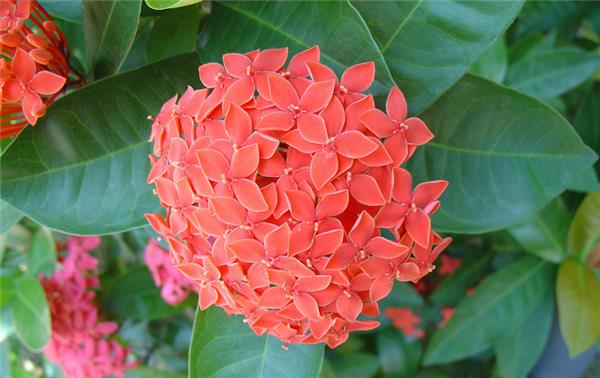
I. A Brief Introduction to Ixora
As the saying goes, the moon is not full for a hundred days, and a flower is not red for a hundred days, yet Myanmar's national flower, Ixora, is called "Hundred-Day Red" precisely because its flowering period is so long. The Intha people of Myanmar have a particularly romantic and interesting marriage custom. They have lived by the water since ancient times, and any family with a daughter would early on build a floating little garden of bamboo and wood on the water near their house, plant it full of Ixora, and tie it in place with ropes. On the day their daughter marries, they dress her up beautifully, seat her in this floating little garden, and finally cut the ropes, letting it drift downstream. The groom waits on the bank downstream from early morning, ready to welcome the little garden drifting toward him carrying his bride. When the little garden floats over, the groom grabs the rope and pulls it ashore, then leads the bride home together to hold the wedding. Before Ixora blooms, it looks very much like tiny slender hairpins stabbing straight into the blue sky, and once open, its four petals spread flat into little crosses. In ancient times, the cross shape represented a charm to ward off evil spirits and drive away disease and plague, so every year during the Dragon Boat Festival, the people rowing dragon boats, in order to ward off evil, remove disease and plague, and seek good fortune, would insert this flower together with calamus and mugwort on the dragon boat. Over time, the flower came to be called "dragon boat flower" (Ixora).
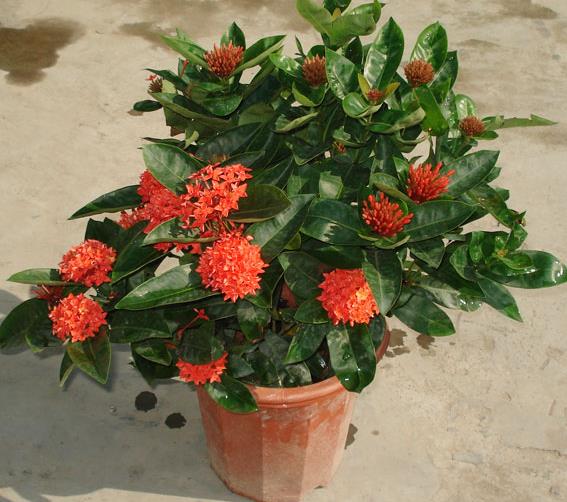
II. How Ixora Propagates
Propagate by cuttings or by seed. It likes warmth, humidity and fairly ample sunlight. It is an indicator plant of acidic soil and must be grown in acidic soil, which should be loose and well drained. When grown in the north, it needs shading in summer. During the growing period, pay attention to fertilizing and pinching out the growing tips to encourage branching. In the north it is grown in pots in greenhouses for ornament; in warm regions it is grown and arranged in gardens.
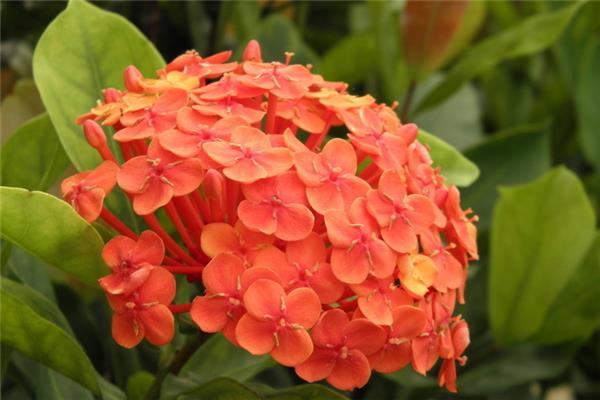
1. Propagation is mostly by cuttings
After the weather warms each year, from March to October, cuttings can be taken. Choose vigorous one-year-old branches (too tender and they root poorly; old branches with dark, spotted bark root poorly), cut them into 10-15 cm sections, remove the lower leaves, and insert them in a sand bed. Water after inserting to keep the soil moist; roots appear in about 50 days, and about ten days after rooting they can be transplanted or potted and kept in half shade for care; once they have rooted and established, move them to a spot with ample sunlight for care. Fertilize again after new shoots appear. During the growing period, apply liquid fertilizer twice a month. When the seedlings are 15-20 cm tall, pinch out the tips once to encourage many side branches and a full shape sooner. Old plants need repotting with fresh soil once a year, and shaping and pruning in early winter. June to July is the best time. Choose semi-mature branches 10-15 cm long and insert them in a sand bed at a room temperature of 24-30°C; they root 40-50 days after insertion. If, before inserting, you soak the base of the cuttings in 0.5% indolebutyric acid solution for 3-5 seconds, the rooting period can be shortened and the root system will be especially well developed.
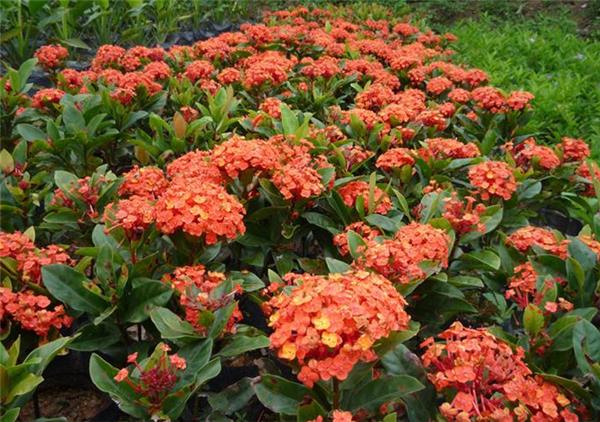
2. Propagation by seed
Collect seeds in winter and sow in spring the following year; the optimum germination temperature is 22-24°C. Sow in seed trays indoors, and germination takes about 20-25 days. When 3-4 pairs of true leaves have grown, the seedlings can be moved into 8 cm pots. Where branching is abundant and dense, layering can also be used: at 20 cm from the tip, make a ring of bark removed, bind it with peat and film, and it will heal and root in about 2 months or more. Ixora is commonly potted in 10-20 cm pots, depending on the size of the seedlings and the number of plants. Potted plants must be full, with neat flowering and uniform flower color. After the seedlings are planted out, pinch out the tips when they reach 25 cm tall to encourage many side branches. During the growing period, fertilize once every half month or use "Huiyou" 21-7-7 acid fertilizer; if leaves turn yellow, apply alum fertilizer water. When potted indoors in winter, the temperature must be kept above 15°C so growth can continue; if the temperature is too low, leaf drop will occur. After old potted plants get through the winter, repot them and prune and shape them to keep a graceful plant form. For old potted plants, repot each year after they are brought out, and add soybean cake, dried manure and similar materials as base fertilizer; in ordinary care do not let the soil get too dry, and keeping it constantly moist is best. To get more flowers, fertilizer and water must be ample; apply 20% cake fertilizer water or superphosphate infusion once a week. In summer, do not let direct sunlight hit them; bright, diffused light is best. After flowering, prune the plant, remove weak branches and encourage new shoots so it flowers repeatedly. During the flowering period, aphids and scale insects often cause damage because of poor ventilation and other reasons, so take care to control them as early as possible. In winter, move it indoors to a sunny spot, keep the temperature no lower than 0°C, and water about once a week, just enough to keep the soil slightly moist. Ixora can be propagated by seed, layering or cuttings. Cuttings can be taken throughout the growing season, especially in June-July. Take 2-3 nodes of plump one-year-old branches; insert them in sand, shade them and keep them warm, and they root in about 50 days. Layering is done in early spring. For newly propagated small seedlings, keep them in half shade after potting; once they have established and sent out new shoots, apply a light fertilizer once every 10-15 days, and in dry weather take care to spray water to raise humidity. When the seedlings reach about 15 cm, pinch out the tips to encourage side branches and make the plant fuller.
That is what you need to know about Ixora; I hope it helps you.
so it flowers repeatedly. During the flowering period, aphids and scale insects often cause damage because of poor ventilation and other reasons, so take care to control them as early as possible. In winter, move it indoors to a sunny spot, keep the temperature no lower than 0°C, and water about once a week, just enough to keep the soil slightly moist. Ixora can be propagated by seed, layering or cuttings. Cuttings can be taken throughout the growing season, especially in June-July. Take 2-3 nodes of plump one-year-old branches; insert them in sand, shade them and keep them warm, and they root in about 50 days. Layering is done in early spring. For newly propagated small seedlings, keep them in half shade after potting; once they have established and sent out new shoots, apply a light fertilizer once every 10-15 days, and in dry weather take care to spray water to raise humidity. When the seedlings reach about 15 cm, pinch out the tips to encourage side branches and make the plant fuller.That is what you need to know about Ixora; I hope it helps you.