Introduction to Autumn Zephyrlily and How to Grow It: A Guide to Growing Graceful Autumn Zephyrlilies
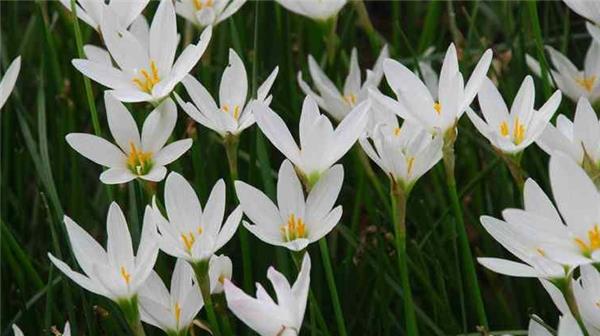
The autumn zephyrlily, as its name suggests, has leaves shaped like scallions, standing gracefully upright, and its color is as fresh and green as scallions. The autumn zephyrlily is native to the Americas and is the most common groundcover plant in the Jiangnan region. Let's take a look at what we know about the autumn zephyrlily.
I. Introduction to the Autumn Zephyrlily
The autumn zephyrlily, also known as onion grass, is a perennial evergreen bulbous flower of the Amaryllidaceae family. The whole plant with stems is also a folk herbal medicine, with effects of calming the liver, soothing the heart, and extinguishing wind; it can treat acute infantile convulsions, epilepsy, and liver heat in children. It also has effects of reducing swelling and dissipating blood stasis.
II. Morphological Characteristics of the Autumn Zephyrlily
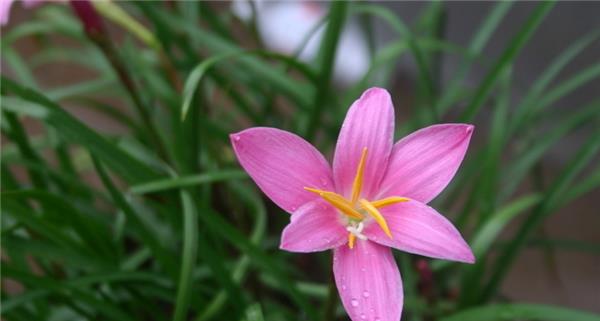
Perennial herb; bulb ovate, about 2 cm thick, 2.2 cm tall, rooting at the base, outer coat membranous, light brown, turning blackish brown after autumn, membranous; small bulbs form in the axils of the outer scale segments, often several clustered together, sprouting new leaves in spring at the same time as the old bulb, and in summer and autumn they do not separate from the mother bulb, still wrapped by the same outer coat. Leaves 2-4, linear, green, flat-tubular, flattened after drying, about 30 cm long, 3-4 mm wide, apex obtuse, the lower 7-10 cm expanded into a membranous leaf-sheath tube, overlapping layer upon layer to form a cylinder 7-8 cm long. The base is nearly fleshy, namely the scale segments of the inner layer of the bulb's membranous outer coat. The flower stem emerges from one side of the leaf cluster in autumn, light green, cylindrical, nearly as long as the leaves, hollow; flowers solitary and terminal, spathe-like involucre membranous, blue-purple, 2-2.5 cm long, the lower half fused into a funnel-shaped tube, apex 2-lobed; pedicel slender, 0.5-1 cm long; flowers white, often tinged with pale red on the outside and pale green at the base, tepals 3-5 cm long, free, without a perianth tube, arranged in two whorls forming a broad bell shape, lobes elliptical, apex acute or obtuse, outer whorl about 7 mm wide, inner whorl 10 mm wide; stamens 6, inserted at the base of the tepal lobes, filaments pale green, linear, 5 mm and 7.5 mm long, anthers golden yellow, linear, versatile, about 5 mm long, pollen golden yellow; ovary obovate, pale green, 2-3 mm long, style greenish white, 12 mm long, stigma nearly disc-shaped, small, 3-slightly lobed. Pedicel short, flower stem hollow, solitary, perianth 6 segments, corolla diameter 4 cm to 5 cm, petals long elliptical to lanceolate. Perennial herb, plant height about 20 cm. Underground it has a small, long-necked tunicate bulb. Leaves basal, flat-linear, slightly fleshy, dark green, scape hollow, emerging from the leaf cluster, flowers solitary, perianth 6 segments, white with a purplish-red tinge on the outside, flowering period July-September. Capsule nearly spherical.
III. Landscape Uses of the Autumn Zephyrlily
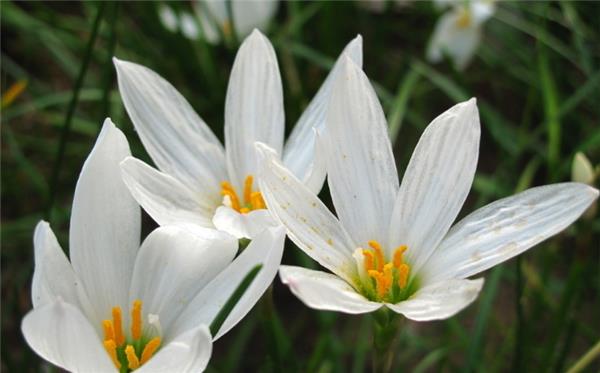
Cultivated for ornamental purposes, the autumn zephyrlily is mostly used as a groundcover plant, and can be used for flowerbed edging, groundcover in open woodlands, and flower paths. Its leaves are emerald green and its flowers pure white; potted plants decorating a desk are also very elegant. As a potted plant, its cultivation and management are simple. The autumn zephyrlily is a common groundcover plant in landscaping in the Jiangnan region. It is suitable for clustered planting in flowerbeds, flower paths, and lawns, and can also be potted for indoor viewing. The autumn zephyrlily stays evergreen all year round; compared with Manila grass, which has a yellow-leaf period, the autumn zephyrlily is lush and lovely. Plain-looking, it seems no different from grass in people's eyes, and only when the flowering season arrives and it quietly blooms do all who see it feel moved and cry out in amazement. The plant is low and neat, with abundant flowers and a long flowering period; it is often used as edging material for flowerbeds, and is also suitable for clustered planting in green spaces, and is best used as a groundcover plant in semi-shaded areas under trees, or planted beside courtyard paths. The autumn zephyrlily is a very common plant; its slender figure can be seen in flowerbeds on campus and green belts in parks. It seems delicate but has extremely strong cold resistance, and will not be damaged even at a low temperature of -10°C. Entering the cold, bleak winter, facing fallen leaves everywhere and the scene of companion grasses already wilted and yellow, it still stubbornly keeps its true color of emerald green.
IV. Water Cultivation Methods for the Autumn Zephyrlily
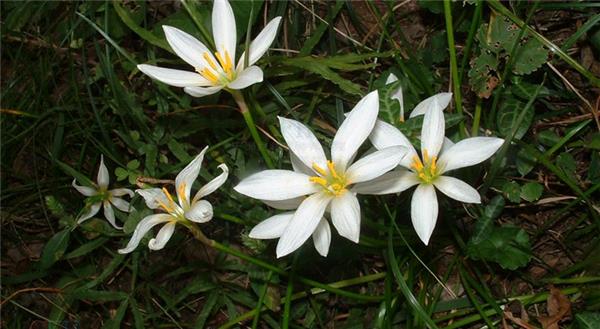
The autumn zephyrlily can also be planted in a water tank, growing bright leaves. Entering August, the plant height has reached over 30 cm, and at this time dozens of flower stems can be produced; by late September, white flowers bloom. What is admirable is that these flowers are all located below the water surface, and through the bright water body, they set off the crystal-clear white autumn zephyrlily flowers at varying heights. The specific method for water cultivation of the autumn zephyrlily is: prepare several glass fish tanks 90 cm long, 50 cm high, and 35 cm wide. In early April, in white plastic bags or shallow porcelain pots 4 cm to 5 cm high, long or round, filled with soil, place plump autumn zephyrlily bulbs at a spacing of 2 cm to 3 cm, with roots spread out, press the roots down with clay, fill soil until level with the top of the bulbs, gently compact the soil, cover the surface with a 0.5 cm layer of coarse sand, and finally separate the bulbs with pebbles. After planting, sink the pot into a water tank or pool, gently sway it left and right, rinse off the floating mud adhering to the surface, then place it into a fish tank already filled with water. Do not fill the fish tank too full with water; 4/5 of the tank height is appropriate. To add interest, some small tropical fish can also be kept in the tank.
The above is what we know about the autumn zephyrlily; we hope it can help you.
Gently compact the soil, cover the surface with a 0.5 cm layer of coarse sand, and finally separate the bulbs with pebbles. After planting, sink the pot into a water tank or pool, gently sway it left and right, rinse off the floating mud adhering to the surface, then place it into a fish tank already filled with water. Do not fill the fish tank too full with water; 4/5 of the tank height is appropriate. To add interest, some small tropical fish can also be kept in the tank.The above is what we know about the autumn zephyrlily; we hope it can help you.