Cosmos Introduction and Growing Methods: Teach You to Grow Beautiful Cosmos
Cosmos is a beautiful ornamental plant with a relatively tall and airy, graceful form, large beautiful flowers, and very strong vitality. It can be planted in front of and behind houses. Below, let's take a look at the relevant knowledge.
I. Introduction to Cosmos
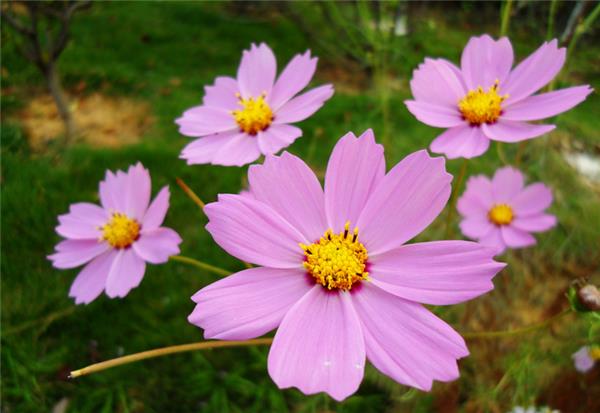
Cosmos is an annual herbaceous plant belonging to the Asteraceae family and the genus Cosmos. It is also called cosmos, large autumn cherry, Gesang flower, eight-petal plum, and broom plum. Cosmos, also known as Cosmos bipinnatus, is native to Mexico. It likes light, tolerates poor soil, and dislikes fertilizer; overly fertile soil is taboo, as are intense heat and waterlogging. It is not suited to high summer temperatures and is not cold-tolerant. It needs loose, fertile, well-drained loam. It belongs to the Asteraceae family and the genus Cosmos. It is an herbaceous plant with slender upright stems and opposite simple leaves. The flower heads are borne on slender pedicels, terminal or axillary. The tubular flowers occupying the central part of the flower disk are all yellow. The achenes have ribs, the seeds live 3-4 years, and the thousand-grain weight is 69. The flowering period is summer and autumn.

II. Morphological Characteristics of Cosmos
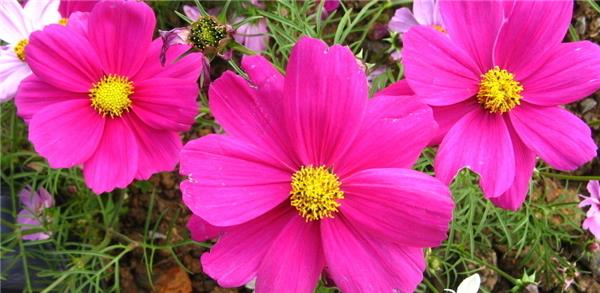
Cosmos is an annual herbaceous plant with a plant height of 30-120 cm. The stems are slender and upright, with many branches, either smooth or slightly hairy. The simple leaves are opposite, about 10 cm long, bipinnately parted, with narrow linear entire segments without teeth. The flower heads are borne on slender pedicels, terminal or axillary, with flower stems 5-8 cm. The involucre has 2 layers, with the inner layer membranous at the margin. There is 1 whorl of ligulate flowers, the petal tips are toothed, with 8 petals, in white, pink, and deep red. The tubular flowers occupying the central part of the flower disk are all yellow.
III. Cultivation Techniques for Cosmos
Cosmos is vigorous, likes sunlight, tolerates drought, and has little requirement for soil, but it cannot be waterlogged. If it is planted in fertile soil, it easily causes excessive vegetative growth of branches and leaves, affecting flower quality. Transplant when the seedlings are 5 cm tall, and set them in place when they have 7-8 leaves; direct sowing followed by thinning is also possible. If base fertilizer is applied at the planting site, no further fertilizer is needed during the growing period; if the soil is too fertile, the branches and leaves tend to grow excessively and flowering decreases. Alternatively, during the growing period, apply decomposed urine diluted 5 times with water once every 10 days. In dry weather, water 2-3 times, and it can grow and bloom well. Flowers that bloom during the high-temperature period from July to August do not easily set seed. The seeds fall off easily after ripening, so collect them in the early morning. Cosmos is a short-day plant; spring-sown seedlings often have lush leaves but few flowers, while summer-sown seedlings are short, neat, and bloom continuously. It grows rapidly and can be pinched back multiple times to increase branching. Cosmos plants are tall, so when planted in windy locations, supports should be set up to prevent lodging and breakage. Generally, dwarf plants are mostly cultivated, that is, when the seedlings are 20-30 cm tall, remove the growing tip, and then repeatedly remove the new terminal buds several more times, and the plant will become dwarfed; at the same time, the number of flowers also increases. The planting bed should be given a little base fertilizer. For seed collection, pick the achenes when they turn slightly black, so as to avoid scattering after full ripening.

From late March to early April, sow the seeds in an open-ground seedbed. They can also germinate at a relatively low soil temperature of 15°C, but if sown very early, they will grow into huge plants 2 m tall and are prone to lodging due to typhoons or the weight of the plant. There are also early-flowering varieties that bloom 50-70 days after sowing, so sowing should be divided into early-flowering and autumn-flowering types. After the flowers fade and the fruits ripen, the cosmos plant dies, and the seeds also sow themselves, continuing life. Seeds can also be collected when the fruits ripen, and sowing and seedling raising can be carried out in late March of the following year, with flowering after 2 months. Cutting propagation can also be used, carried out in May; select thick, strong terminal shoots, cut a section 8 cm to 10 cm long as a cutting, and insert 3 to 5 cuttings as a clump into a flowerpot. The pot should be buried in the soil, exposed 4 cm to 5 cm above the ground, watered, and shaded; roots will form after half a month. After rooting, apply a dilute fertilizer solution once every 15 days, and when it grows to 15 cm, remove the terminal bud again to encourage more branching. If fertilizer and water are controlled properly, flowers can be seen in about 45 days.
1. Notes:
① Sow in the relatively late month of July.
② After spring sowing, when it grows to 40-50 cm, pinch off the growing tip to let the axillary buds bloom.
③ Set up supports such as short bamboo as early as possible.
2. Preventing cosmos from lodging:
① Sow in July-August. Cosmos sown during this period can bloom in October, and the plants are short and neat.
② Pinching. During the growing period of cosmos, pinching back needs to be done multiple times; on one hand, it can dwarf the whole plant, and on the other hand, it can also promote the sprouting of branches and increase the number of flowers.
③ Apply less fertilizer and water less. Too much fertilizer and water easily causes excessive vegetative growth of the plant and lodging, as well as sparse flowering.
The above is the knowledge about cosmos. I hope it can help you.