A detailed introduction to the balloon flower, giving you a comprehensive understanding of this ornamental plant
The balloon flower is widely loved for its beautiful flower shape and brilliant colors, so how well do you know the balloon flower? Let us go and take a look together!
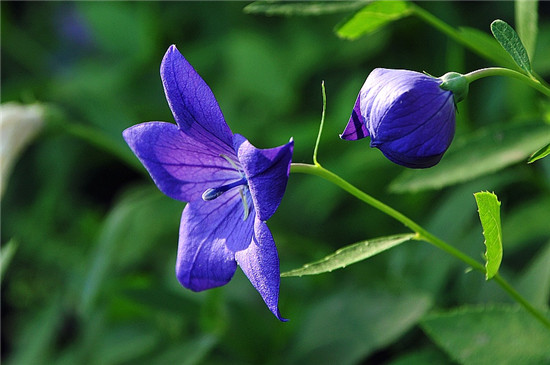
The balloon flower, also known as monk's hat, bellflower, bundle flower, four-leaf vegetable, and sand oil vegetable, is a perennial herbaceous flowering plant of the genus Platycodon in the family Campanulaceae. Li Shizhen explained its name in the "Compendium of Materia Medica": "The root of this plant is firm and its stem is straight, hence it is named jiegeng (balloon flower)." The leaves are opposite, whorled, or alternate, smooth on the surface, with a light dusting of white powder on the underside. The flowers are borne singly or two or three together at the tips of the shoots, resembling a monk's hat when in bud and bell-shaped after opening. The flowers come in many colors such as purple-blue, emerald blue, and pure white, mostly single-petaled, though there are also double and semi-double forms; the flower posture is tranquil and elegant, and the flower color is delicate but not gaudy.
In Japan, purple represents the balloon flower; in Korea, the balloon flower stands for lofty integrity. The balloon flower's purple tinged with blue, and blue showing through purple, is refreshing to the mind and pleasing to the eye, giving people an enjoyment of tranquility, elegance, detachment, and comfort. In a garden of a hundred flowers, it makes a distinctive scene, and is praised as "the recluse among flowers, not craving prosperity"; paired with red flowers, it gives a feeling of "standing out from the rest." It is a beautiful cut flower, widely used in flower baskets and bouquets; a single stem of balloon flower can enhance the ornamental effect of a flower arrangement. It can also be grown as a potted plant or planted in the ground in flower borders and flower beds. In recent years it has been developed for cut flowers, with both flowers and medicinal use, and has great prospects for development.
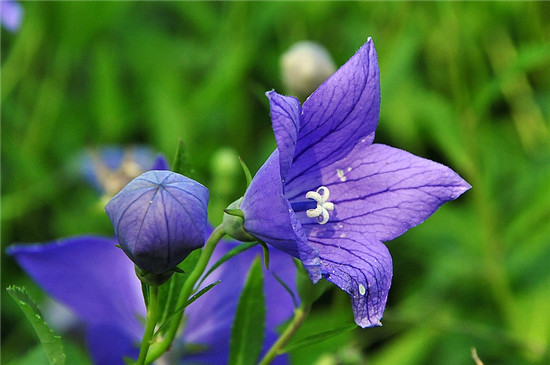
Morphological characteristics of the balloon flower
The balloon flower grows 40-80 cm tall, with 3-5 leaves that are alternate, whorled, or opposite; the flowers are large and solitary, terminal, or several flowers forming a loose raceme; there are 5 sepals, the corolla is bell-shaped with 5 lobes, 5 stamens, a 5-chambered ovary, and a 5-lobed stigma; the capsule is ovoid-spherical. The root is fleshy, thick and strong, pale yellow. The stem is upright and contains milky sap. The root is plump and fleshy, carrot-shaped, with a pale yellowish-white skin. The leaves are alternate or in whorls of 3. The flowers are often solitary, occasionally several clustered at the top of the stem; the corolla is broadly bell-shaped, slightly tilted, usually blue, but also white and pale lilac, with a flowering period from June to September. In gardens it is mostly used to arrange flower beds and perennial borders, to accent rock gardens, and is sometimes also used as a cut flower or potted plant; the root can be used as medicine. There are double-flowered varieties with deep blue flowers and abundant blooms; there is also a large-flowered variety whose flowers are large, with colors ranging from purple to white.
Balloon flower cultivation techniques
I. Selection of land
The balloon flower is suitable for growing in looser soil, and especially prefers sloping land and mountainous land, with a semi-shaded, semi-sunny terrain being best; flatland cultivation requires good drainage conditions. The balloon flower is not suitable for continuous cropping.
II. Land preparation
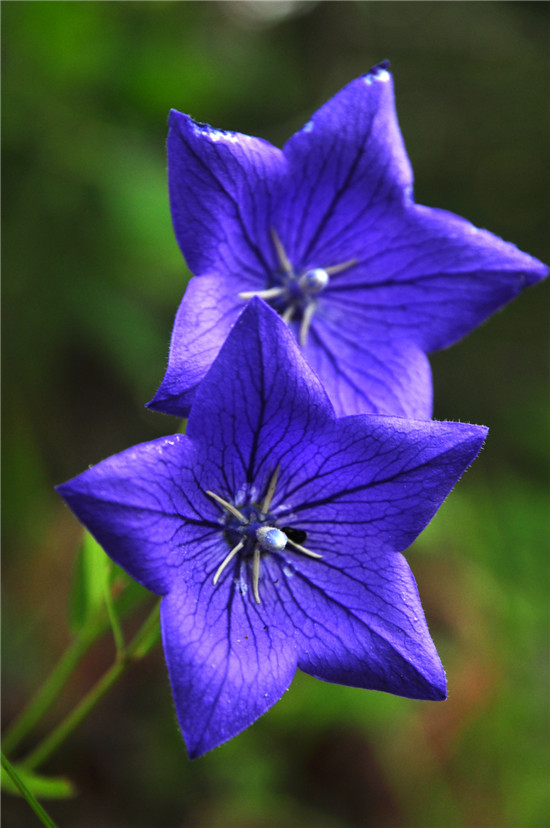
The balloon flower has relatively long fleshy roots, so it is best to cultivate it on ridges. In early spring (mid-to-late April), spread farmyard manure and plow the land deeply, harrow it fine, and level it (deep plowing 30 cm). When making the ridges, first mark grid lines on the ground at 2 m intervals, open furrows, then spread the soil from the furrows to both sides, making ridge beds about 1.7 m wide with furrows about 30 cm wide; if drought occurs, irrigation can be carried out along the furrows in preparation for sowing.
III. Selecting good seed
For balloon flower seeds, choose seeds that are more than 2 years old and not stale (if seeds are kept stale for one year, the germination rate drops by more than 70%). Before planting, carry out a germination test to ensure the seed germination rate is above 70%. The specific method for the germination test is: take a small amount of seeds, soak them in warm water at 40°C-50°C for 8-12 hours, remove the seeds, drain off the water, place them on cloth, mix with wet sand, and germinate them at a temperature of about 25°C, taking care to turn them and spray water in time; they will germinate in 4-6 days.
IV. Sowing
The balloon flower can be sown in spring or summer. Spring sowing should be around mid-May, that is, when the soil temperature reaches above 15°C; summer sowing should be done before late July. In our local area, it is suitable to open furrows and sow in rows when the rains come (mid-to-late May). Before sowing, first open small furrows on the ridge bed at a row spacing of 20 cm, 5 cm wide and 2 cm deep, spread the seeds evenly into them, using about 1-1.2 kg of seed per mu, then immediately cover with decomposed fine manure soil or humus soil, with a covering depth of about 3 cm, and be sure the depth is consistent. After sowing, cover with mulch, then spray the seedbed surface with Decis at 2000 times dilution to prevent underground pests and ensure the seedling emergence rate.
What is the flower language of the balloon flower?
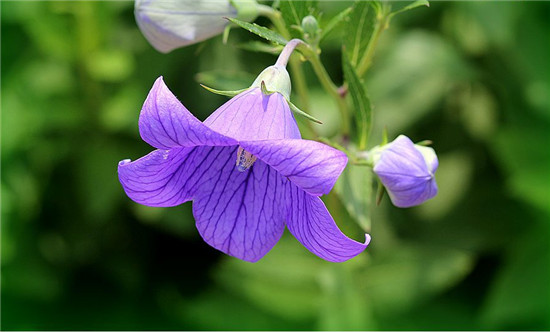
The balloon flower has a double-layered meaning -- eternal love and hopeless love. Legend says that when the balloon flower blooms, it represents the arrival of happiness once again. When happiness arrives, some people can seize it, while others are destined to miss it, unable to grasp it and unable to keep the flower either. Thus there are two kinds of flower language; though they seem to run in opposite directions, they are both bestowed upon one flower. This tells us that happiness depends on grasping it yourself; if you do not know how to grasp it when happiness arrives, then you can only let happiness pass you by.
The legend of the balloon flower
Legend says that long ago, in a certain village, there lived a young girl named Jiegeng (Balloon Flower). She had no parents and had always lived alone at home. In the village there was also a young boy who had grown up with her as childhood sweethearts; when they were young, they always played together and even made a lifelong vow.
A few years later, Jiegeng grew into a beautiful young woman, and the boy grew into a handsome young man, and they became a couple. However, in order to fish, the young man had to take a boat to a faraway place. Before leaving, the young man repeatedly urged Jiegeng to wait for him and promised he would definitely return, and Jiegeng agreed. Though reluctant in her heart, Jiegeng had no choice but to send her sweetheart off on his journey.
Day after day and year after year, Jiegeng's heart was shattered in the torment of waiting. She constantly prayed to heaven for her beloved to come back quickly, but the young man who loved Jiegeng left no news and never returned. Jiegeng could not let go of the longing in her heart and always ran to the seaside, praying for a miracle to appear, that the sea might bring her beloved back to her side.
Several decades passed, and Jiegeng became an old woman in the twilight of her years, yet she still went to the seaside every day to wait for her beloved's return. While waiting, Jiegeng thought at every moment of her beloved young man. Finally one day, as Jiegeng recalled the sweet times of their youth, she slowly closed her eyes, and her body turned into a beautiful balloon flower.
The above is all the content of the detailed introduction to the balloon flower that I have summarized for everyone. I hope this article can help you. Please also continue to follow us.