What are the effects and benefits of Platycodon grandiflorus? Learn in one article
Platycodon grandiflorus is a very beautiful plant while growing, and once mature it is a very valuable medicinal herb. Next, let us take a look at the benefits of Platycodon grandiflorus.
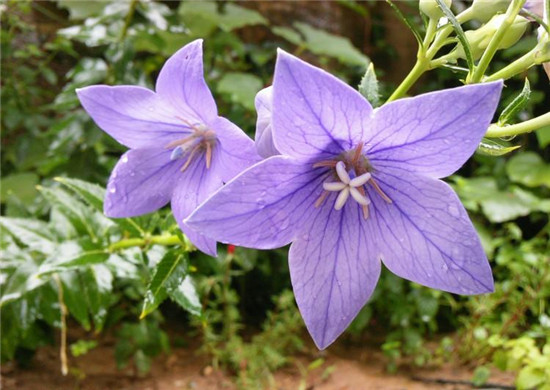
Introduction to Platycodon grandiflorus
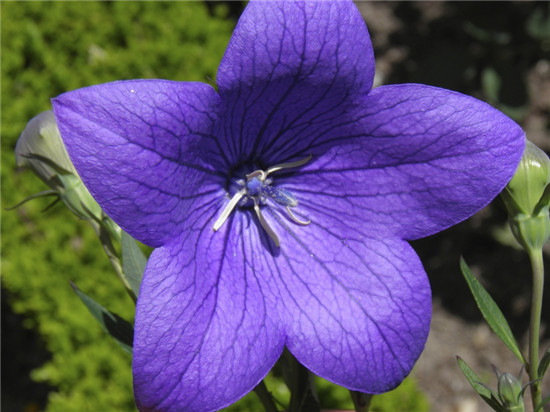
Perennial herb, 40-90 cm tall. The plant contains milky sap and is smooth and hairless throughout. The root is thick and fleshy, conical or forked, with a yellowish-brown outer skin. The stem is erect and branched; the leaves are mostly alternate, a few opposite, nearly sessile, with long ovate leaf blades and serrated edges; the flowers are large, borne singly at the top of the stem or several in a loosely arranged raceme; the corolla is bell-shaped, blue-purple or blue-white, with 5 lobes. The capsule is ovate and splits open at the top when ripe. Perennial herbaceous plant. Leaves ovate or ovate-lanceolate, flowers dark blue or dark purple. The root can be used as medicine, with functions such as dispersing lung qi, resolving phlegm, and draining pus.
The flower language of the Platycodon grandiflorus flower is eternal, unchanging love. Eternal love, hopeless love. The first time I encountered Platycodon grandiflorus was not with my own eyes, but in Yukio Mishima's short story "The Forest in Full Bloom," which has a passage like this: the autumn dew drifted past like a mass of white smoke from the back door of the residence; these mists spread through the nearby area like silent fireworks. In the drifting autumn dew, many Platycodon grandiflorus flowers could be faintly seen in the distance, blooming in the autumn dew like thin cotton quilts, lonely. From then on, the impression Platycodon grandiflorus left in my heart was that of being accompanied by this dreamlike autumn dew, silent fireworks, and the sound of a flute carried across a plain covered with flowers and grass, lonely and eternal. Later, once in a flower shop, I saw a very beautiful flower.
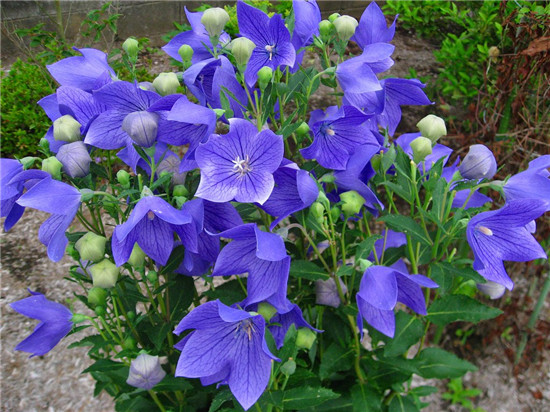
What are the benefits of Platycodon grandiflorus flowers
1. Used for cough with profuse phlegm, chest tightness, and poor chest circulation due to failure of lung qi to diffuse.
Platycodon grandiflorus is pungent and dispersing, bitter and draining; it opens up and diffuses lung qi, transforms phlegm, and promotes the flow of qi, and can be used whether the condition is cold or heat in nature. For wind-cold cases, combine with perilla leaf and apricot seed, as in Xingsu San; for wind-heat cases, combine with mulberry leaf, chrysanthemum flower, and apricot seed, as in Sangju Yin; if there is stuffiness and oppression in the chest and diaphragm, with phlegm obstructing and qi stagnating, and the ascending and descending functions impaired, combine with bitter orange to regulate the ascending and descending of qi movement, rectify qi, and ease the chest.
2. Used for sore and swollen throat and loss of voice.
Platycodon grandiflorus can diffuse lung qi, benefit the throat, and open the voice. Whenever external pathogens invade the lung and cause sore throat and loss of voice, combine with licorice and great burdock fruit, as in Jiegeng Tang and Jiawei Ganju Tang.
If the throat is sore and swollen and heat toxin is abundant, combine with belamcanda rhizome, puffball, and isatis root to clear heat, resolve toxin, and benefit the throat.
3. Used for lung abscess with coughing and expectoration of purulent phlegm.
Platycodon grandiflorus is dispersing in nature and upward-moving, and can benefit lung qi to discharge the purulent phlegm congesting the lung. To treat lung abscess with coughing, chest fullness, frequent discharge of turbid, fishy, foul saliva, and prolonged pus expectoration, use it with licorice, as in the Jiegeng Tang from Jin Gui. In clinical practice it is further combined with heartleaf houttuynia and winter melon seed to strengthen the effects of clearing the lung and discharging pus.
4. Used to treat urinary retention and constipation.
Use Platycodon grandiflorus to diffuse and open lung qi and free both urination and defecation, for the treatment of urinary retention and constipation.
Dosage and usage: 3-10 grams. Decocted for oral use. Used for discharging pus.
Usage precautions: Platycodon grandiflorus is ascending and dispersing in nature, so it should not be used in those with upward rebellion of qi movement, vomiting, choking cough, dizziness, or coughing blood due to yin deficiency with fire hyperactivity. Excessive dosage easily causes nausea and vomiting, and because Platycodon saponins have a hemolytic effect, it should not be administered by injection.
Toxicity of Platycodon grandiflorus
Platycodon saponins have a hemolytic effect, so they cannot be used for injection, but after oral administration they can be effectively hydrolyzed and destroyed in the digestive tract, which means there can be no hemolytic effect. Its hemolytic index varies with source, place of origin, years of growth, processing method, and so on; the hemolytic effect of the phloem is about 4 times that of the xylem.
Therefore Platycodon grandiflorus must not be administered by injection. Experiments have shown that the minimum lethal dose by subcutaneous injection in mice is 770 mg/kg. For crude Platycodon saponins, intragastric administration in white rats and subcutaneous injection were 22.3 mg/kg respectively. After intragastric administration of a large dose of Platycodon saponins, there will be reflex excitation of the vomiting center, which can cause nausea and vomiting.
The above is the full content of my summary of what effects Platycodon grandiflorus has and what benefits Platycodon grandiflorus has. I hope this article can help everyone. Please also continue to follow us.