Causes and Symptoms of Four Common Bamboo Pests and Diseases
There are many diseases of bamboo, but how many of these pests and diseases do you know? Let's take a look below at some of the common pests and diseases and what their symptoms look like! 1. Rust disease Pathogen: Dasturelle divina English name: Rust prevention Common name: Red mushroom Bamboo rust is
There are many diseases of bamboo, but how many of these pests and diseases do you know? Let's take a look below at some of the common pests and diseases and what their symptoms look like!
1. Rust disease
Pathogen: Dasturelle divina
1. Rust disease
Pathogen: Dasturelle divina
English name: Rust prevention
Common name: Red mushroom
Bamboo rust is a disease caused by a fungus and occurs only on bamboo leaves and leaf sheaths. In the early stage, many small brown spots form on the leaves, and later they gradually rise on the underside of the leaves, forming spindle-shaped or hemispherical, yellowish-brown or rust-colored protruding lesions with a powdery surface. These are the summer spore masses and summer spores of the pathogen. Infected leaves tend to dry up and fall off. In the later stage, the lesions form dark brown, hard, slightly raised winter spore masses. In Taiwan, China, it is very difficult to find the sexual stage winter spores in the field.
Rust disease can occur throughout the year, but its severity differs from season to season. It begins to become gradually more serious in July, and reaches its peak around October. The summer spores on the leaves spread by rain or wind and land on uninfected parts. If the temperature is suitable (20-30°C) and the leaf surface is moist, the summer spores easily germinate and invade the leaf tissue, causing repeated infection and producing summer spores again. From invasion to the production of summer spores takes about 7-10 days. Leaves on the same branch closer to the base are exposed to the atmosphere for a longer time, so the disease is more severe there and gradually decreases upward, with the heart leaves being lighter. During the year, new leaves begin to grow in spring, and because the temperature and humidity are suitable, the lesions remaining on the leaves begin to produce summer spores and cause repeated infection. During spring and summer, new leaves continue to grow, so rust disease does not appear very serious. After autumn begins, the growth vigor of the bamboo plants weakens while the temperature and humidity are suitable for disease development, causing the leaves grown in summer to be rapidly infected, and leaf fall begins, showing the severity of the disease. Because it is more likely to occur in hot, humid environments with poor ventilation, as long as cultivation and management work is emphasized, chemical control may not be necessary.
⟦NL>
2. Bamboo bacterial wilt
Pathogenic bacterium: Erwinia sinocalami
English name: Bacterial wilt
Common names: Hualong shell, turtledove wing
Symptom of bamboo bacterial wilt: the affected area has a pattern like turtledove wings
Symptom of bamboo bacterial wilt
This is a disease caused by an aerobic bacterium. The pathogen usually inhabits the soil surface and harms newly emerged shoots that have wounds. Because green bamboo shoots are earthed up high and are harvested before the shoots grow out of the ground, they have very little chance of being damaged, while shoots retained as mother culms are less easily infected by the pathogen because the temperature has already turned cooler at that time. Generally speaking, ma bamboo shoots are more commonly affected, mostly occurring on young plants and young shoots within one year of age. They wilt from the tip and finally dry up. After young shoots become diseased, they develop poorly or even wilt and are unable to develop. The affected area after breaking off smells foul. The condition spreads from the bottom of the shoot sheath upward, gradually wilting or drying up and forming a pattern like turtledove wings, also called "Hualong shell" or "turtledove wing."
Old and inferior shoot plantations are more prone to occurrence than newly planted ones. The bacteria exist in the soil. When young tender bamboo shoots emerge from the ground, the bacteria invade and infect through the shoot sheaths. If tools such as knives and hoes used in intertillage, earthing up, or cultivation management injure healthy shoots and create wounds, the bacteria will invade through these wounds. In terms of cultivation environment, acidic soil, old shoot plantations with shallower covering soil, and poorly drained areas are more prone to occurrence.
For control, attention must be paid to field sanitation. Diseased shoots must not be arbitrarily discarded in the field, as this creates a secondary source of infection. Use lime or alkaline fertilizers to adjust the soil pH to near neutral or above neutral.
3. Sooty mold
Pathogens: Scorias communis
Triposporiopsis spinigera
English name: Sooty mold fungus
Common name: Black soot disease
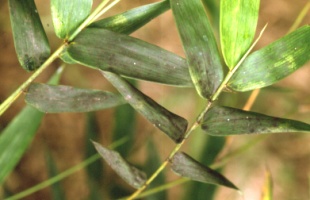
This disease mainly occurs in shoot plantations with poor ventilation and high aphid density. Because there is insect honeydew on the leaves, the sooty mold pathogen grows on the leaves. The leaf surface, especially the upper surface in most cases, turns black or coal-colored, which is why it is called sooty mold. In severe cases, the black mycelium on the leaf surface can be peeled off by hand, but the leaves still remain green. This disease mainly affects photosynthesis and the production of nutrients, so shoot output is affected. Avoiding excessive dense planting, keeping the bamboo plantation well ventilated, and thoroughly controlling the population density of small insects such as the bamboo leaf aphid and bamboo stem aphid can prevent the occurrence of sooty mold.
4. Bamboo mirid bug
Scientific name: Mecistoscelis scirtetoides Reuter
Chinese: Bamboo in trouble
Common names: Bamboo mosquito, green mosquito
The bamboo mirid bug is commonly called "bamboo mosquito." This insect can be found in bamboo plantations throughout the year. Adults lay eggs near the leaf tips of tender leaves. The eggs are oblong-oval, initially milky white, later gradually becoming pale red, and becoming transparent black before hatching. Dozens of them are arranged in a row. Adults and nymphs crawl and move on the underside of leaves, and all use piercing-sucking mouthparts to penetrate the epidermis and reach into the mesophyll tissue to pierce and feed, causing the cells in the damaged area to die. On the surface of damaged leaves, white spots of varying sizes and nearly rectangular shape appear. After the white spots appear, the underside of the leaves mostly turns reddish-brown or orange-yellow rusty spots. In severe cases, the entire leaf dries up and shoot output drops sharply, making this the most important pest affecting the quality and yield of bamboo. The insect body can be seen year-round, with the highest density from May to October.
In spring and summer, during drought, the density often remains high. The best control effect is achieved by carrying out joint chemical control early during the renewal period of cutting away old culms and retaining mother culms. You can apply 30% fenitrothion emulsion at 1500 times dilution or 20% fenvalerate emulsion at 2000 times dilution 1 to 2 times, or apply a 1:4 dilution of 25% methidathion emulsion by painting a ring around the bamboo node at chest height. Stop application 18 days before harvest. Thorough plantation cleanup work, such as burning cut old leaves, can block its reproduction. Placing yellow and green sticky paper in the plantation can not only detect increases and decreases in its population density, but also reduce its population.