How to Grow Phalaenopsis Orchids? Water the Queen of Orchids with Love
How to grow Phalaenopsis orchids? The Phalaenopsis orchid has graceful blooms and gorgeous colors, making it a treasure among tropical orchids, and it is known as the "Queen of Orchids." Phalaenopsis orchids are also often used to decorate living rooms, so how do you grow them well? In fact, Phalaenopsis orchids are not difficult to grow, provided you have enough patience to follow the steps below. Let's take a look at how to grow Phalaenopsis orchids well.
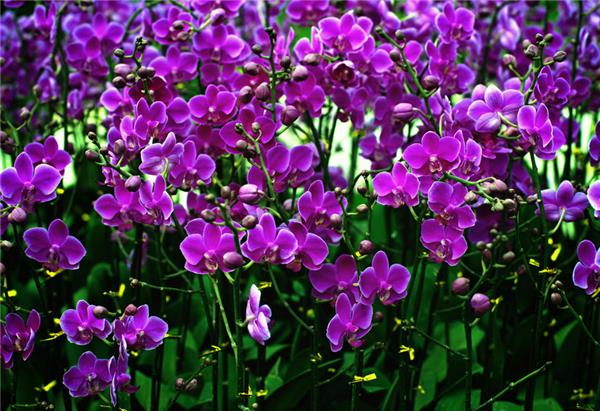
Its appearance already leaves you nothing to find fault with. The Phalaenopsis orchid has a graceful bearing, with elegant and varied flower colors, and it gets its name because its flowers resemble butterflies. It is widely cultivated around the world. Although it is an epiphytic orchid, it has no pseudobulbs, only a very short stem at the base. The leaves are broad and thick, oblong, and can reach more than 50 cm. Some varieties have beautiful pale silvery mottling on the leaves, with purple underneath. The flower stalk emerges from the leaf axils, slightly curved, varying in length, and bears from a few to several hundred flowers, shaped like butterflies. The sepals are oblong, and the tip of the lip is three-lobed. The flower colors are numerous and varied, and blooming can last more than a month. Abroad, it is often used as a cut flower and is a high-grade type among exotic orchids. The genus Phalaenopsis is a famous type of cut flower. The Phalaenopsis orchid is a monopodial epiphytic orchid with a short stem, large leaves, and one to several arching flower stems. The flowers are large and named for their butterfly-like shape. Its flowers are graceful and its colors gorgeous, making it a treasure among tropical orchids, and it is known as the "Queen of Orchids." Its appearance goes beyond what language can describe, beyond what words can adorn. In my impression, its beauty is hard to describe.
II. How to Grow Phalaenopsis Orchids
(1) The care of Phalaenopsis orchids needs to be divided into two stages: early-stage management and late-stage management. At each different period, you need to adjust the care temperature and moisture well and pay attention to pest removal. For example, during the flowering period in late-stage care, water and fertilizer management is especially important. Watering should be done at 10 a.m., and avoid sprinkling water directly onto the flowers. After watering, use an exhaust fan for ventilation to keep the air in the shed fresh so that residual moisture dissipates as quickly as possible. At this time, fertilizing with Huaduoduo No. 2 (nitrogen, phosphorus, potassium ratio of 10:30:20) at 1000 times dilution is best, depending on the condition of the Phalaenopsis orchid itself.
Phalaenopsis orchids are prone to soft rot and gray leaf spot. Soft rot is extremely contagious; once it is discovered, immediately isolate the diseased plant. Diseased plants can be treated with mancozeb or haoshengling. Usually, sterilize once every 15 days.
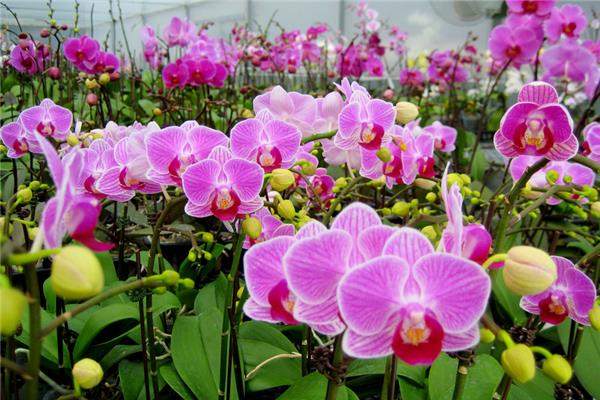
1. Watering too frequently can cause root rot. Friends who grow Phalaenopsis orchids always worry that the orchid lacks water, so regardless of whether the growing medium is dry, they water every day, causing severe root rot.
2. Maintain an appropriate temperature and do not let the temperature get too low. Usually, flowering Phalaenopsis plants are mostly marketed in early spring, and after being bought and taken home, they are generally placed in living rooms and other places for appreciation. Although the daytime temperature in these places is sufficient, the nighttime temperature is somewhat on the low side. On the other hand, professionally cultivated orchids are mostly kept in well-equipped greenhouses. By comparison, the temperature and humidity at home are somewhat insufficient, so the plants tend to weaken day by day. Therefore, sometimes no matter how well they are cared for, the orchids still fail to bloom.
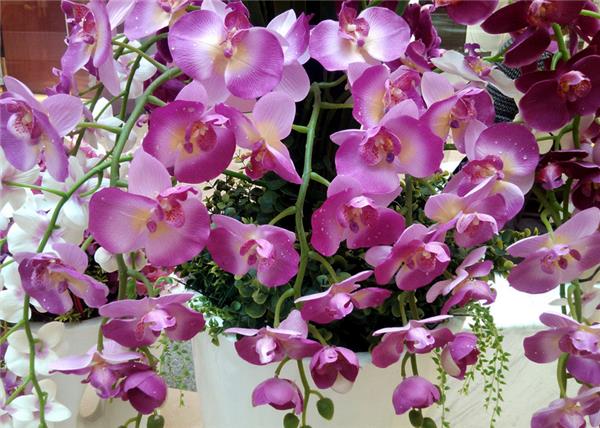
4. Use a small pot for a small plant; do not plant a small plant in a large pot. Some people think that using a large pot can give the Phalaenopsis orchid a more spacious environment and provide plenty of material. In fact, after using a large pot, the sphagnum moss is not easy to dry. You should know that Phalaenopsis orchids like ventilation, and when air circulates freely, they thrive.
5. Increase indoor humidity to supplement moisture and avoid dry bud drop. Most Phalaenopsis orchids nowadays are forced into bloom. After leaving the production base, once the environment changes, dry bud drop problems easily appear. At this time, do not assume it is due to dryness and do not water more. Instead, increase indoor humidity and control indoor temperature; the temperature must not be too high. When buying flowers, try to choose ones with thicker petals.
6. Light should not be excessive. Although Phalaenopsis orchids prefer shade, the plants still need to receive some light, especially before and after the flowering period. Appropriate light can promote flowering in Phalaenopsis orchids and make the flowers more brilliant and long-lasting. Generally, they should be placed in a spot indoors with scattered light, and direct sunlight should be avoided.
Good ventilation must be used to prevent heat stress, and at the same time it can also avoid infection by pests and diseases.