How to Grow Chinese Roses: A Brief Introduction to Chinese Rose Cultivation Methods
What are the cultivation methods for Chinese roses? I love Chinese roses more than any other flowers. Her shyness and gentleness cannot be compared to the proud peony, the aloof narcissus, or the flamboyant rose. She blooms quietly, forming buds in early summer and blossoming silently. Watering Chinese roses should keep the soil moderately moist, neither too dry nor too wet. Chinese roses are highly cold-resistant and can tolerate temperatures as low as -10°C, and they love plenty of sunlight. Let's take a look at the cultivation methods for Chinese roses below.
1. Choosing Flower Pots for Growing Chinese Roses
The flower pots used for cultivation should ideally be water-permeable and breathable. Ordinary clay pots are best, and a beautifully crafted ceramic pot on the outside can enhance the aesthetics. New clay pots should be soaked in water before use. For newly rooted cuttings, use a 15 cm small pot; for 1-2 year old seedlings, use an 18-20 cm pot; afterward, gradually switch to larger pots as the plant grows.
2. Choosing Potting Soil for Growing Chinese Roses
Chinese roses prefer fertile, moist soil and are afraid of drought and waterlogging. You must choose a sandy loam soil that is loose in texture, rich in organic matter, has good drainage and aeration, and also retains water and fertilizer. They can be grown in soil with a pH range of 5.6-7.2, but slightly acidic to slightly alkaline soil with a pH of 6.8-7.2 is better. For the growing medium, you can use 5 parts garden soil, 3 parts compost, 2 parts rice husk ash, plus an appropriate amount of rapeseed cake. Alternatively, use 4 parts horse manure, 4 parts garden soil, 2 parts river sand, plus a small amount of rapeseed cake and bone meal.
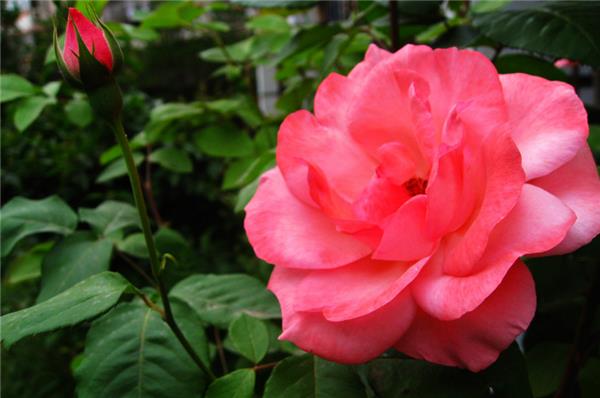
Potted Chinese roses placed indoors can safely overwinter. Pay attention to cooling during hot seasons. The most suitable temperature for Chinese roses is 18-20°C, which is why flowers blooming in April-May and September-October are large, have many petals, vivid colors, and strong fragrance. When temperatures rise above 25°C, growth speeds up, but the flowers do not last long; in high temperatures above 30°C and humid climates, not only are the flowers small with few petals, pale colors, and faint fragrance, but various pests and diseases are also prone to occur. Under high temperature and dry conditions, they may shed leaves and go dormant, stopping growth and flowering. Above 5°C they can continue to grow and bloom, but very slowly. Below 5°C, growth stops and they enter a dormant state.
4. Light Requirements for Growing Chinese Roses
Chinese roses are sun-loving plants that enjoy ample sunlight. Daily sunlight must not be less than 5-6 hours, otherwise the branches and leaves become weak, grow leggy, bloom poorly, and have dull colors. Generally, they are best placed in a spot with sufficient light, but if placed on concrete ground near tall buildings, appropriate shading and sun protection are needed during summer noontime.
 5. Watering Methods for Growing Chinese Roses
Watering Chinese roses should keep the soil moderately moist, neither too dry nor too wet. When new branches and leaves grow in March, water once every 2 days in the morning. When flower buds form in April, water once a day. After entering the flowering period in May, both overly dry and overly wet soil can cause flowers to drop. Generally, water once around 8 AM, and around 4 PM, supplement with an appropriate amount of water as needed. Follow the principle of "don't water until dry, and water thoroughly when you do." In summer, the leaves need frequent misting to cool down.
6. Fertilization Methods for Growing Chinese Roses
Follow the principle of "apply light fertilizer frequently" and avoid applying raw or concentrated fertilizer. In winter, apply a small amount of organic fertilizer at the roots to enhance cold resistance for overwintering. Before sprouting in early March, you can apply liquid fertilizer with a relatively high concentration, such as decomposed human waste, soybean cake, chicken and duck manure, or fish innards. When buds are about to open, apply one additional round of diluted liquid fertilizer. After flowers fade in summer and before axillary buds develop, apply one round of medium-concentration decomposed liquid fertilizer to encourage abundant autumn blooming.
Potted Chinese roses can be given appropriate additional fertilizer, mainly cake fertilizer. Apply 50 grams for one-year-old plants, 70 grams for three-year-old plants, and 100 grams for four-to-five-year-old plants. During the growing season, diluted liquid fertilizer can also be applied, commonly using decomposed water from soaked water chestnuts, sesame paste residue water, or dilute chemical fertilizer solutions.
7. Precautions for Growing Chinese Roses
If the temperature difference is large, use sun-warmed water when watering to reduce the temperature difference between the potting soil and the water, avoiding stimulation of root development from water that is too cold.
If you do not plan to harvest flower seeds, it is best to cut off spent flowers before they set seed.
If excessive fertilization causes leaf burn, water immediately to rescue the plant.
Sexual propagation is mostly used for breeding new varieties. In home cultivation, cutting and grafting methods are simple and easy, and are more commonly used.
Cuttings are usually taken in spring when temperatures are above 15°C, or in early summer or early autumn. To improve the survival rate, you can first perform girdling on the plant, and after callus tissue forms, cut off the branch for rooting.
Grafting is the main method for propagating Chinese roses. Selecting a suitable rootstock is key. Currently, commonly used rootstocks include wild rose, pink cluster rose, and others. Grafting is done during the dormant period, often using stem grafting. In the south, this is from December to February of the following year; in the north, before leaf buds sprout in spring. During the growing season, bud grafting is used, and management should be strengthened after grafting. (Does the above content on how to grow Chinese roses solve your problem? Feel free to leave a comment below to share feedback and discuss.)
Through the above introduction to Chinese rose cultivation methods, I believe everyone understands now, right? The cultivation methods for Chinese roses are relatively simple. If you like Chinese roses, you can give it a try! If you want to learn more about flowers, please stay tuned for related content.
Grafting is done during the dormant period, often using stem grafting. In the south, this is from December to February of the following year; in the north, before leaf buds sprout in spring. During the growing season, bud grafting is used, and management should be strengthened after grafting. (Does the above content on how to grow Chinese roses solve your problem? Feel free to leave a comment below to share feedback and discuss.)
Through the above introduction to Chinese rose cultivation methods, I believe everyone understands now, right? The cultivation methods for Chinese roses are relatively simple. If you like Chinese roses, you can give it a try! If you want to learn more about flowers, please stay tuned for related content.