Good luck and auspiciousness arrive at home: how to grow Guzmania
Guzmania belongs to the Bromeliaceae family, and because its flower center is bright red, it is also called "Hongyun Dangtou" (good fortune arrives). This variety is auspicious and noble, and is a premium among flowers, often used to decorate offices and living rooms. So what exactly are the cultivation methods for Guzmania? Let's take a look below at a detailed introduction to Guzmania cultivation methods, and I hope it will be helpful to flower lovers!
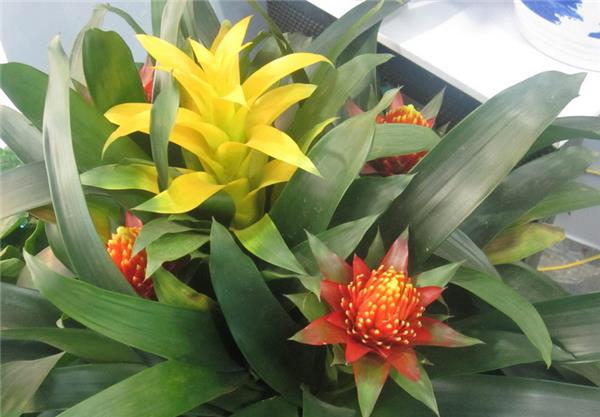
To understand how to grow Guzmania, you first need to have some understanding of the characteristics of the plant itself. Guzmania is also called ornamental bromeliad. When mentioning bromeliad, many people may suddenly realize, isn't that just pineapple? In fact, bromeliads are divided into two types: one that can bear fruit, and another that cannot. The ones that can bear fruit are like the pineapple we usually see, while the ones that cannot bear fruit are like the Guzmania we are discussing now. Although ornamental bromeliads do not bear fruit, they are even more beautiful than edible pineapples, so as ornamental plants they are very good. Guzmania is evergreen all year round and has diverse varieties. Whether flowers or leaves, they are very glossy, and the overall form presents a rosette shape, giving people a feeling that is both passionate and reserved, with excellent ornamental value. At the same time, in people's minds it also represents perfection and nobility.
1. Watering
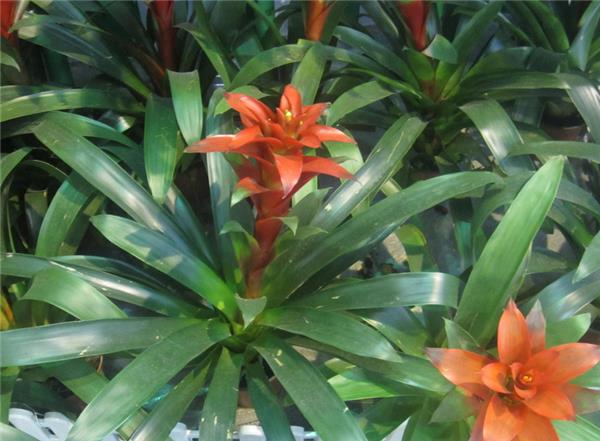
In dry, stuffy and hot weather, or when the temperature is low, the leaf margins and leaf tips of Guzmania are very prone to scorched and withered phenomena, so the potting soil should be kept moist. Clear water can be sprayed on the leaf surface 1 to 2 times per day, and the cup-shaped part in the center of the leaf rosette can be filled with clear water. Absolutely avoid watering too frequently! When watering, pour it into the "cup" shape of the plant, not directly into the potting substrate. Watering needs to be determined according to the amount of water in the leaf cup. There should be sufficient water in the leaf cup, and the water quality should be clean. Fertilizer water can also be poured in, but the clear water must be replaced in about one week.
2. Fertilizing
Plants of the Guzmania family were originally epiphytes, and their root system is not well developed, with only small and short roots, so absolutely avoid applying too much fertilizer, in case the root system rots and the leaves turn yellow. Dilute fertilizer water should be applied. No fertilizing is needed during the flowering period. After flowering, cut off the flower in time and supplement fertilizer. Fully water-soluble fertilizer can also be poured into the leaf cup along with watering, but others such as cake fertilizer and granular chemical fertilizers are not suitable for application in the leaf cup.
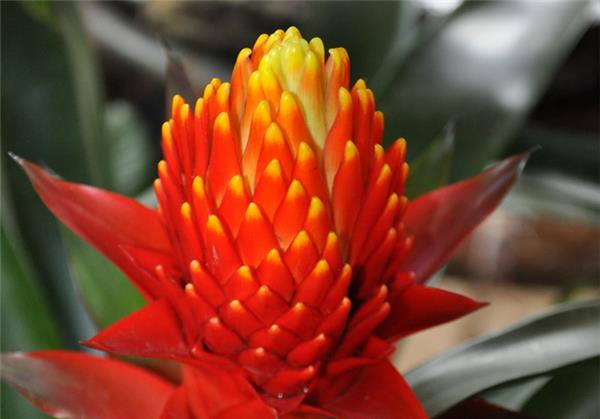
Air humidity should be high, generally 75-85% is best. When it is below 50%, the plant's growth will show phenomena such as leaf shrinkage and curling. Light of 18000-25000 lux is suitable. When the light is too strong, the leaves are easily sunburned, and when it is too weak, growth will also be poor. Ventilation is also extremely important. When the temperature is not high, the effect is not obvious, but in high-temperature seasons it is especially prominent. Ventilation not only makes the plant grow robustly, but also reduces infection by diseases.
4. Fertilizing
Guzmania does not need fertilizing during the flowering period. After flowering, cut off the flower in time and supplement fertilizer. Fully water-soluble fertilizer can also be poured into the leaf cup along with watering, but others such as cake fertilizer and granular chemical fertilizers are not suitable for application in the leaf cup. After small offsets grow out, they can be cut off from the mother plant with a sharp knife and planted separately. Generally, the old plant will not bloom again, and afterwards it can be used as a mother plant to propagate new plants.
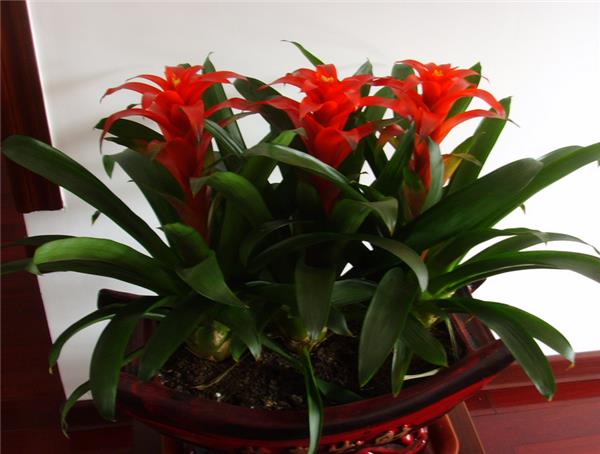
Under normal circumstances, Guzmania only blooms in autumn, and after blooming it enters a winter dormant period. But in many cases, people hope to control its flowering time and artificially make it bloom at a specific time. So how should this be done?
Step one: stop fertilizing. When the Guzmania plant is relatively large, stop fertilizing for about half a month.
Step two: use "ethephon solution" or "acetylene aqueous solution" to pour into its leaf cup. The prepared concentration is generally 1:1000, and it only needs to be poured 1 to 3 times.
Step three: during forced cultivation, the temperature should be kept at 15-18°C, not too high. Do not fertilize within half a month, and after half a month gradually increase fertilizer water to make it bloom.
Through the above introduction to Guzmania cultivation methods, I believe everyone now understands how to grow Guzmania. For such an auspicious flower, you can also follow the methods above to grow a pot. If everyone wants to learn more information about Guzmania, please pay attention to related content.