Scarlet Sage Pictures and Detailed Growing Methods
Because of its fiery red color and beautiful appearance, scarlet sage is deeply loved by the public, and as people's living standards improve, more and more people are now choosing to grow scarlet sage. However, for beginners, there is very little understanding of how to grow scarlet sage, so let's learn the skills to bring scarlet sage home.
An Introduction to the Characteristics of Scarlet Sage
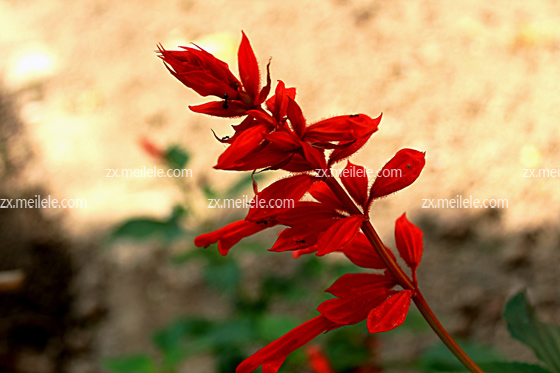
Scarlet sage is a perennial herbaceous plant. The leaves grow opposite each other on the stems; the leaves are green and ovate or triangular-ovate, with serrated leaf margins. The flowers bloom red, and of course there are now variant cultivars whose flowers bloom white or purple, but the more commonly seen ones are still red, with the flowers growing densely. Scarlet sage plants are divided into small and medium types; the small type is 20 to 40 cm, and the medium type generally does not exceed 100 cm. The fruit of scarlet sage is a small nutlet, elliptical in shape, with tiny black seeds inside.
Propagation Methods for Scarlet Sage - Sowing Method
Sowing method: Besides self-sowing propagation from fallen seeds, scarlet sage also has two propagation methods: sowing or cuttings, with sowing generally being more common. Sowing is generally best done in spring. Scarlet sage blooms relatively late, so if sown in spring the flowering period falls in autumn. If you want to advance the flowering period or to collect seeds, you should sow the seeds in a greenhouse or hotbed after the New Year when it is not too cold. Apply a small amount of base fertilizer in the sowing bed, level the bed surface and water it thoroughly; once the water has seeped in, you can sow. After sowing, cover the seeds with a thin layer of fine soil. The seeds sprout 8 to 10 days after sowing.
Cutting method: To propagate scarlet sage by cuttings, it is generally more suitable to choose March to May or September to October. Select well-developed tender branches as cuttings, and remove the terminal buds before inserting, which makes rooting easier. In summer, because the temperature is higher and the climate is dry, pay attention to shading, cooling and spraying water to keep the soil moist so that the cuttings can take root. In about 15 days the roots will grow and they can be transplanted. Compared with sowing, cuttings are a faster and simpler method of propagating scarlet sage.
Notes on Growing Scarlet Sage
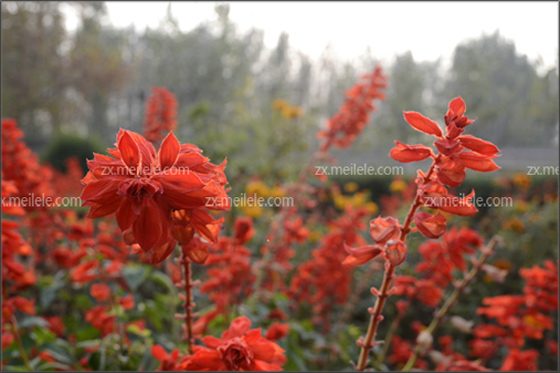
From sowing to sprouting, when the seedlings grow 3 to 4 pairs of true leaves, the stem tips should be pinched off. Select seedlings with at least 4 side branches per plant and transplant them into flower pots; when moving them to a flower bed, it is best to do so when the color of the flowers is already showing at the branch tips. Generally, when scarlet sage is planted in a flower bed, the spacing between plants is about 40 cm.
Soil: Growing scarlet sage has relatively high soil requirements, because scarlet sage is suited to growing in weakly acidic soil, so it requires loose, fertile, well-drained sandy weakly acidic soil.
Light: Scarlet sage is a plant that likes sunlight, and it is also tolerant of partial shade, so when growing it indoors, be sure to place it in a spot with sufficient light conditions.
Temperature: Scarlet sage has poor cold tolerance, and the suitable growing temperature is around 23 degrees Celsius. If the temperature is below 15 degrees Celsius, scarlet sage will stop growing, and if the temperature drops another 5 degrees Celsius, its leaves will turn yellow and fall off.
Fertilizing: During the growing period of scarlet sage, we can apply phosphorus-containing liquid fertilizer 1 to 2 times; doing so can encourage scarlet sage to have abundant flowers and a robust, beautiful appearance during the flowering period.
Watering: Scarlet sage should not be watered too much; too much will cause the leaves to turn yellow, and in severe cases will even cause the leaves to fall off, and will also result in a plant that is large but has few flowers.
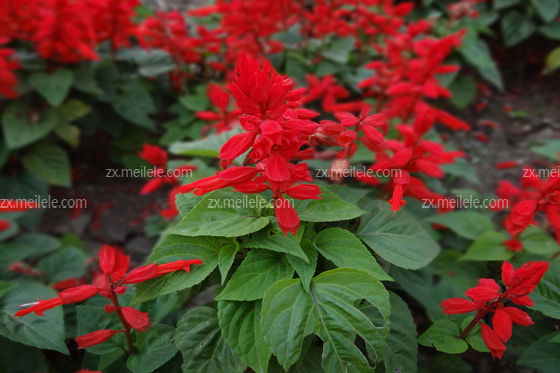
Summary: The above is an introduction to the growing methods for scarlet sage. During the growth period of scarlet sage, you should always pay attention to its growth dynamics, and always be mindful of pinching and shaping to control plant height and branching, encouraging the flower spikes to grow long and plump and to bloom uniformly, so as to ensure the beautiful appearance of scarlet sage.
Recommended reading:
☑ Strelitzia ☑ Hydroponic plants ☑ Flower-growing tips ☑ Radiation-proof plants ☑ Indian rubber tree
☑ Dianthus ☑ Four-season osmanthus ☑ Indoor potted plants ☑ How to grow asparagus fern ☑ Gold-edged snake plant