Red Spider Lily Introduction and Complete Picture Gallery Appreciation
The red spider lily is also known as manjusaka, a name derived from Sanskrit. The red spider lily is hailed as a flower without a past or future life. In Buddhism it is said, "Tumi is the last flower to bloom in the flower season; when tumi blooms, the flower season ends, leaving only the flower that blooms in the forgetfulness of past and future lives." The blood-red spider lily is the flower that blooms on the road to the underworld. Legend says it voluntarily fell into hell, but was driven back by all the demons; it lingered on the road to the underworld, refusing to leave. The demons could not bear it and agreed to let it bloom on this road, to give guidance and comfort to the souls leaving the world. Therefore the red spider lily is the flower that blooms on the far shore of the River of Forgetfulness, on the road to the underworld. Legend says the fragrance of the red spider lily has magic power and can awaken memories of one's past life, yet the red spider lily itself has no past or future life. Now let us look at an introduction to the red spider lily and appreciate its pictures.
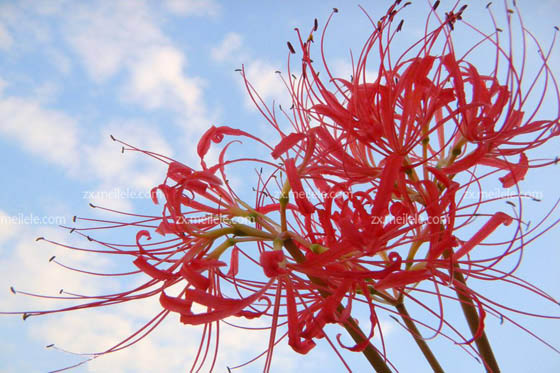
Red Spider Lily Introduction
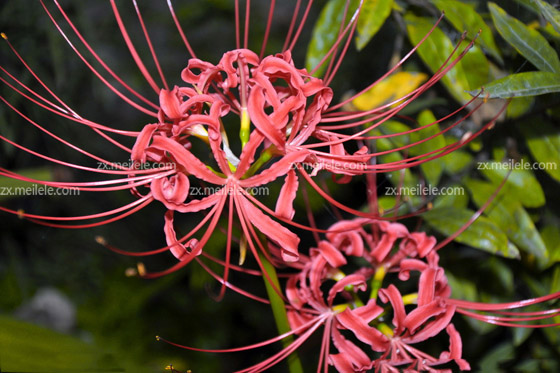
The red spider lily is a variety of Lycoris radiata, a perennial herbaceous plant. Its rhizome is thick and fleshy, its leaves are linear, and it sends up leaves from the base after the flowering period. The red spider lily is also known as manjusaka. Its scape is 30-60 cm tall, with an umbel borne terminally; the flowers are bright red, the floral tube is relatively short, the tepals are narrowly oblanceolate and curl outward, and the stamens and style protrude. Its posture is elegant, and the flowering period is September.
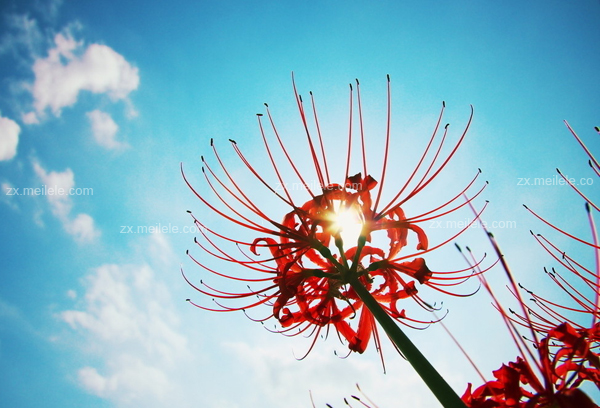
Red Spider Lily Picture Appreciation One
The red spider lily is bright red as blood, beautiful yet desolate. The red spider lily is the unblessed flower of hell; its beauty is eerie and is also associated with much misfortune. In many literary works, the red spider lily symbolizes bloodshed, madness and death. It mostly grows in cemeteries and along riverbanks, and is also called the dead man's flower, because in autumn the red spider lily blooms in an unusually bewitching color, like a celebration of death.
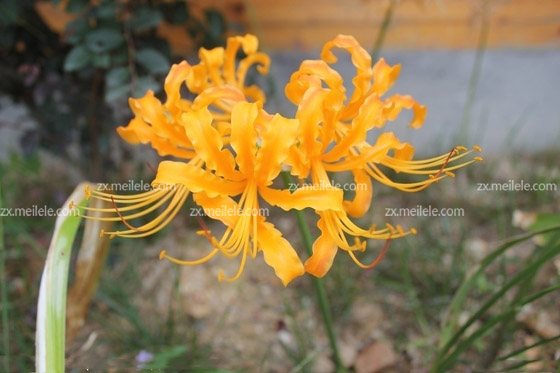
Red Spider Lily Picture Appreciation Two
The blood-red spider lily symbolizes the beauty of death and the call of hell; it is a flower used to express death and sorrow. The love of the red spider lily is also sorrowful: flower and leaf never meet, each guarding yet missing each other, knowing each other yet never seeing each other. The fate of reincarnation brings them still the destined eternal missing of each other, with the sorrow of never being able to meet.
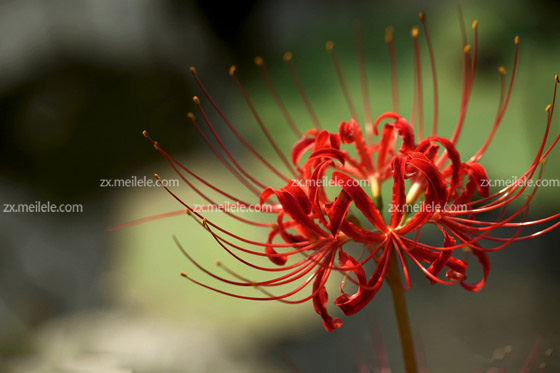
Red Spider Lily Picture Appreciation Three
The legend of the red spider lily: legend says that Bi and An were two people who loved each other, but heaven decreed that they could not meet. Yet driven by longing, the two secretly met and pledged themselves to each other for life.
Red Spider Lily Picture Appreciation Four
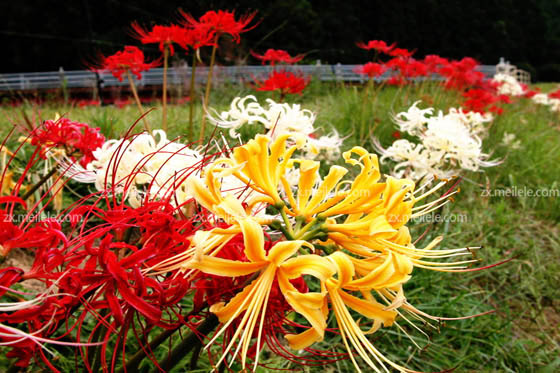
Heaven was furious and turned them into a single plant, and laid a curse: "Where there is a flower there is no leaf; flower and leaf shall never meet in this life." One day the Buddha came upon it, saw it and took a liking to it, and took it to the far shore to let it bloom freely. But while passing the Three Rivers he accidentally dropped it into the river, and when he picked it up he found the flower had turned pure white. The Buddha laughed greatly and said, "How can right and wrong be separated? Remembering is not as good as forgetting." So he planted it on the far shore and named it mandarava.
Red Spider Lily Picture Appreciation Five
But the red that dripped into the Sanzu River wailed all day long, and hearing it made one sorrowful. Ksitigarbha could not bear it and threw the seed of mandarava into the river, and before long a red, eerie flower bloomed. Ksitigarbha sighed that it could not bear to leave and remained in the sea of suffering, so he let it serve as the guide for souls in hell, and said, "The far shore already has mandarava; you shall be called manjusaka."
Later, two different flowers grew by this river: one grew on the far shore, one grew on the bank of the Sanzu River; one forgets the world, one guides souls, life after life, forever gazing at each other. And he said, "The far shore already has mandarava; you shall be called manjusaka."
Later, two different flowers grew by this river: one grew on the far shore, one grew on the bank of the Sanzu River; one forgets the world, one guides souls, life after life, forever gazing at each other.