Introduction to Lithops Varieties and How to Grow Them
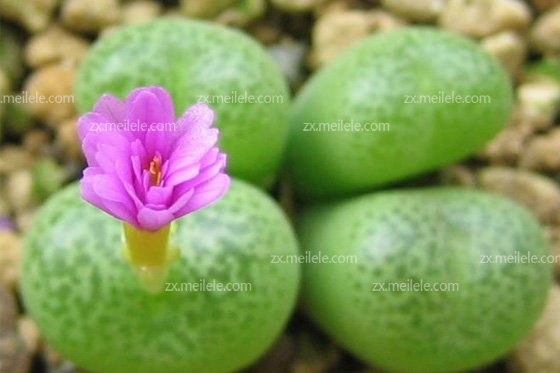
Lithops gets its name because its shape closely resembles a stone. Also known as "living stone" and "butt flower," it belongs to the family Aizoaceae and the genus Lithops. Its name really is unusual. Lithops originated in southern and southwestern Africa, where it often grows in rock crevices and among gravel. Because its living conditions are extremely harsh, people call it the "living stone." Lithops blooms during the rainy season, and at the peak of flowering the barren desert suddenly looks as if it is covered with a huge flower carpet. Lithops is a succulent plant that can mimic the shape of stones to avoid being eaten by herbivores, making it a unique sight in the plant world.
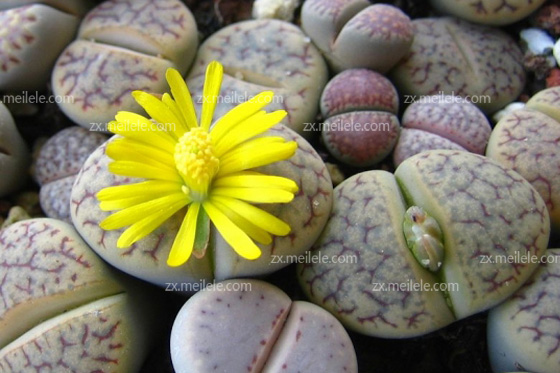
Lithops Varieties
There are roughly more than 80 original Lithops varieties as well as a large number of hybrids and cultivated varieties. With its many varieties, compact plant shape and natural, delicate appearance, it is a relatively popular small succulent on the market today. Common Lithops variety series include the "Qüyu" series, "Fushangyu" series, "Huawenyu" series, "Zixun" series and "Jushuiyu" series, among others. Lithops is mainly distinguished by plant shape, markings and flower color. Below we look at a few relatively similar Lithops variety series.
Shuangmouyu series: This Lithops variety has large flowers with yellow petals, and the white central ring of the flower is very small; in some cases the white central ring feature is even missing. This variety of Lithops carries a floral fragrance and is especially popular.
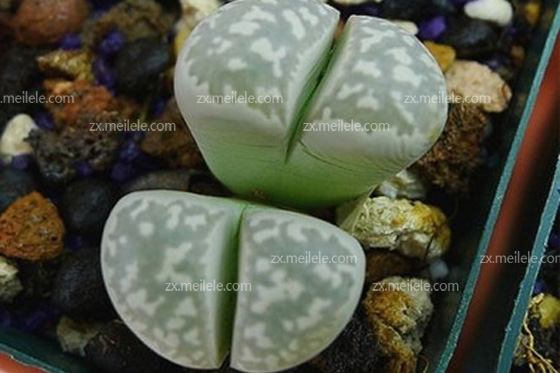
Shewenyu series: The Shewenyu series of Lithops has small flowers with a distinct white central ring, and the flower color is close to brass. This variety of Lithops usually has a dark line about 1mm along the edge of the seed capsule, and the whole plant looks relatively broad and plump.
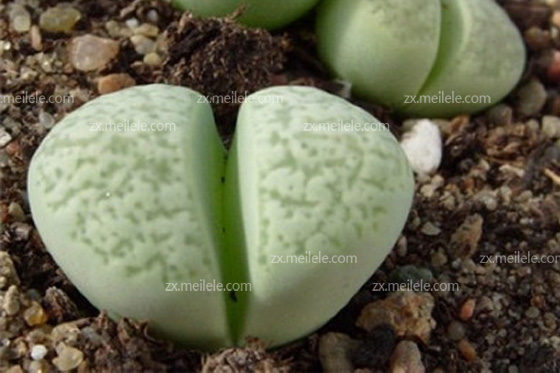
Daneiyu series: This Lithops series has white flowers, and the entire succulent body looks nearly grayish-white. This variety series of Lithops has very good clumping ability. Planted in a pot, this kind of Lithops has a very high ornamental effect.
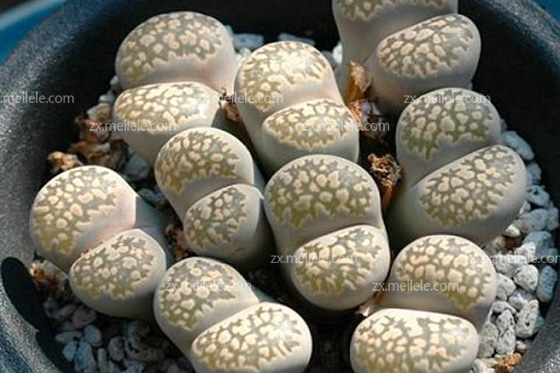
How to Grow Lithops
Lithops likes a warm, dry environment with plenty of sunlight, is especially intolerant of low temperatures, and dislikes direct strong light. The relatively suitable growing temperature for Lithops is 10-30°C, and it grows relatively well in loose, neutral sandy loam.
1. Lithops is not very demanding about its environment and is relatively easy to cultivate and manage. For the potting soil, you can use a uniform mix of leaf mold, calcareous material, river sand and so on.
2. Lithops needs sufficient water during its growing period, but it must not be overwatered; soil that is too wet easily grows moss, which in turn affects the growth of its spherical leaves.
3. Lithops is not very demanding about sunlight. In summer, Lithops is best kept in a relatively cool, shaded place, and Lithops grown this way will show more beautiful leaf color; in autumn and winter the temperature is relatively low, so at this time you should give Lithops enough sunlight to help it carry out photosynthesis.
4. Lithops fears high temperatures and muggy heat, and avoids cold and frost, so it has certain temperature requirements. For Lithops, the most suitable growing temperature is 15-25°C; when the summer temperature reaches above 33°C it enters a dormant state; because the leaves of Lithops are fleshy, if the winter temperature is below 4°C the leaves will be frostbitten and die.
5. During the care period of Lithops, it is best to fertilize once every half month, but be careful not to drip fertilizer on the leaves when fertilizing, otherwise it will corrode the leaves and affect plant growth. After Lithops blooms, fertilization can be paused.
6. During cultivation, Lithops may develop diseases such as leaf spot and leaf rot, which can be sprayed with a diluted solution of 65% zineb wettable powder; at this time special attention should be paid to care to prevent pests and diseases from adversely affecting the plant's growth.
The Main Value of Lithops
Lithops is colorful with a peculiar plant shape, making it an excellent indoor ornamental plant; when potted it can be placed beside a TV or computer and can absorb radiation, and planted indoors it can also absorb harmful substances such as formaldehyde and purify the air.
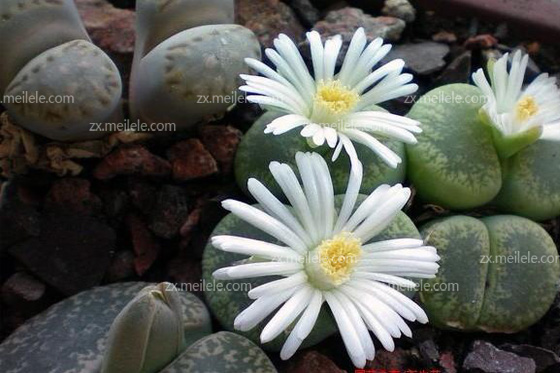
Conclusion: Lithops has a peculiar form and is small and exquisite, and today it is increasingly loved by people; Lithops has large flowers and rich colors, making it very suitable for growing indoors; that is all for the introduction of this lovely succulent, and I believe everyone now has a certain understanding of Lithops varieties and how to grow them.
The Main Value of Lithops
Lithops is colorful with a peculiar plant shape, making it an excellent indoor ornamental plant; when potted it can be placed beside a TV or computer and can absorb radiation, and planted indoors it can also absorb harmful substances such as formaldehyde and purify the air.
Conclusion: Lithops has a peculiar form and is small and exquisite, and today it is increasingly loved by people; Lithops has large flowers and rich colors, making it very suitable for growing indoors; that is all for the introduction of this lovely succulent, and I believe everyone now has a certain understanding of Lithops varieties and how to grow them.