What are the characteristics and types of carnivorous plants?
Most carnivorous plants are green plants and can break down the animals they capture. Let us take a look at carnivorous plants together!
Overview of Carnivorous Plants
About 400 species of carnivorous plants are known. Most carnivorous plants grow in moist wastelands, bogs, swamps, muddy banks and other environments with abundant water and acidic, nitrogen-poor soil. Whether aquatic, terrestrial or amphibious, carnivorous plants share similar ecological characteristics. Most carnivorous plants are perennial herbs, no more than 30 cm tall, often only 10 to 15 cm. A few species grow to 1 m, and the smallest can hide among the mosses of sphagnum bogs. Some carnivorous plants are found almost throughout the world.
Plants absorb water and minerals through their roots and carbon dioxide through their leaves, and then, through photosynthesis driven by sunlight, convert carbon dioxide, water and minerals into carbohydrates and other organic substances, allowing the plants to grow. Insectivorous plants that capture insects by means of adhesion use scent to attract insects. Sundews, rainbow plants and butterworts can give off a special scent, but these scents are usually so faint that people can hardly smell them.
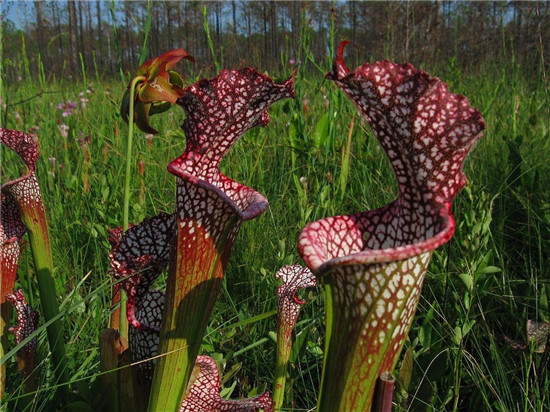
The classification of carnivorous plants is constantly changing. In the Cronquist system, based on their radially symmetrical flowers and unique traps, the Droseraceae and Nepenthaceae were placed in the order Nepenthales. The Sarraceniaceae were placed in either Nepenthales or Sarraceniales. The Byblidaceae, Cephalotaceae and Roridulaceae were placed in the order Saxifragales. The Lentibulariaceae were placed in the order Scrophulariales, and later merged into the order Lamiales. Today I will briefly introduce a few common carnivorous plants.
Insectivorous plants have 5 basic insect-trapping mechanisms
(1) Cage-like or pitcher-like traps containing digestive enzymes or bacterial digestive fluid.
(2) Mucilage traps covered all over with sticky droplets.
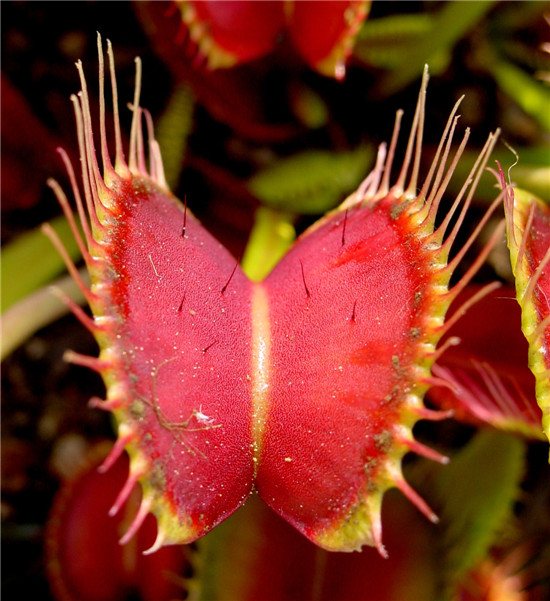
(3) Snap traps that close rapidly.
(4) Bladder-like traps that create a vacuum and suck in prey.
(5) Lobster-pot-like traps with inward-extending hairs that force prey into the digestive organ.
These traps are divided into active traps and passive traps, depending on whether they perform a movement that helps capture prey. For example, plants of the genus Triphyophyllum secrete mucilage, but their leaves cannot curl toward prey, so the traps of Triphyophyllum are passive traps. In contrast, the leaves of sundews can grow rapidly to curl around prey. This rapid elongation is achieved through cell division, not cell elongation. Therefore the traps of sundews are active traps.
Types of Carnivorous Plants
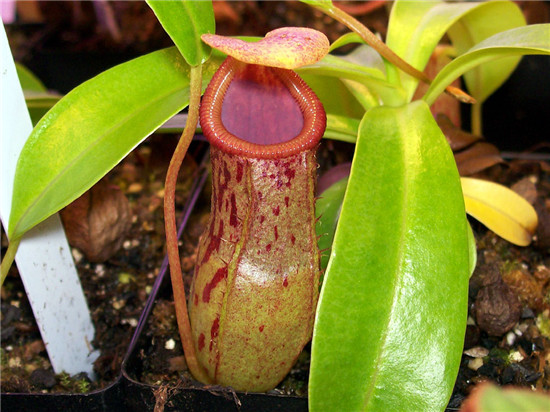
1. The genus Nepenthes is the main group of carnivorous plants with cage-like pitcher traps. The pitcher of Nepenthes grows at the end of the tendril. Nepenthes mainly preys on insects. A few species, such as Nepenthes rajah, can prey on larger animals, such as small mammals or reptiles, but their main source of prey is still small insects. Nepenthes bicalcarata has two tooth-like spikes at the base of the lower surface of its lid. These two spikes may serve to lure insects to crawl directly above the pitcher opening, so that an unwary insect falls into the pitcher and is then drowned in the digestive fluid.
2. The Cephalotus, endemic to Western Australia, is a carnivorous plant with a "moccasin"-shaped pitcher. The mouth of the pitcher is very conspicuous and secretes nectar. On the inner edge of the lip there are teeth to prevent prey inside the pitcher from climbing out. Insects are often attracted by the nectar secreted on the lip and by the flower-like shape and color.
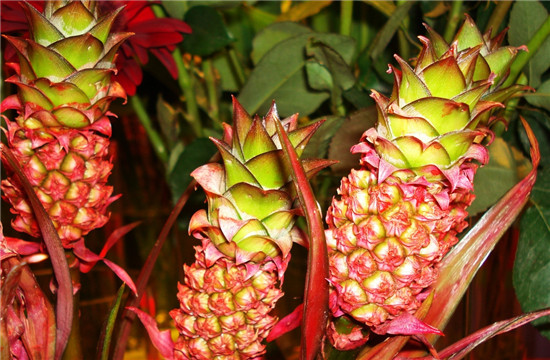
3. Brocchinia reducta is an insectivorous bromeliad carnivorous plant with a cage-like or pitcher-like trap. Like other closely related individuals, the base of its strap-shaped, waxy leaves tightly wraps into an urn-like structure. In most bromeliads this urn-like structure only serves to collect rainwater and can become a habitat for frogs, insects or nitrogen-fixing bacteria. The urn-like structure of Brocchinia reducta has become specialized into a trap with a waxy inner wall, in which large numbers of digestive bacteria live.
4. More than 100 species of Drosera are carnivorous plants, and there are considerable differences among the Drosera species of Australia. Miniature sundews, such as Drosera pygmaea, and tuberous sundews, such as Drosera peltata: the former produce winter buds in winter, while the latter have tubers necessary for surviving the overly dry summer. These species rely on insects to provide nitrogen, so they lack the nitrate reductase that most plants use to convert nitrogen in the soil into an organic form.
5. The mucilage gland stalks of Pinguicula carnivorous plants are very short, and the leaves have a glossy sheen. Their leaves are very effective at catching small flying insects. Their mucilage has a strong ability to recover. Their leaves exhibit thigmotropism, including the leaf edges curling inward to prevent prey from being washed away by rain, and the leaf forming a shallow digestive depression beneath the prey.
The above is the full content of the characteristics and types of carnivorous plants that I have summarized for everyone. I hope this article can help you. Please also continue to follow us.
There are considerable differences among the Drosera species of Australia. Miniature sundews, such as Drosera pygmaea, and tuberous sundews, such as Drosera peltata: the former produce winter buds in winter, while the latter have tubers necessary for surviving the overly dry summer. These species rely on insects to provide nitrogen, so they lack the nitrate reductase that most plants use to convert nitrogen in the soil into an organic form.5. The mucilage gland stalks of Pinguicula carnivorous plants are very short, and the leaves have a glossy sheen. Their leaves are very effective at catching small flying insects. Their mucilage has a strong ability to recover. Their leaves exhibit thigmotropism, including the leaf edges curling inward to prevent prey from being washed away by rain, and the leaf forming a shallow digestive depression beneath the prey.
The above is the full content of the characteristics and types of carnivorous plants that I have summarized for everyone. I hope this article can help you. Please also continue to follow us.