What types of aquatic plants are there? An introduction to common aquatic plants
Aquatic plants play a very big role in improving the indoor environment and air. Many people place some aquatic plants in their homes. Next, let us learn about aquatic plants and their types together.
A brief introduction to aquatic plants
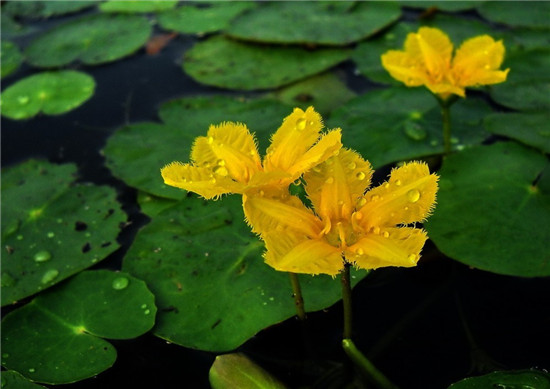
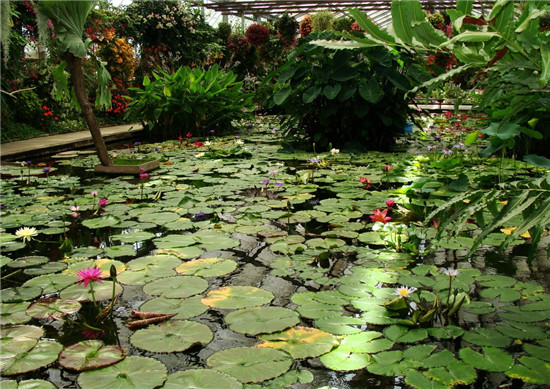
Aquatic plants refer to those plants that live in water for all or most of their lives and can successfully reproduce the next generation. Based on their distribution in the water, they can be further divided into three categories: submerged plants, floating-leaved plants, and emergent plants. Examples include lotus, water lily, Althaea officinalis, and waterweed.
The leaves of aquatic plants are soft and transparent, and some are thread-shaped, which can greatly increase the contact area with water, allowing the leaves to obtain as much as possible of the light that is scarce in water and absorb the very small amount of dissolved carbon dioxide in water, ensuring photosynthesis can proceed.
Aquatic plants have very well-developed aerenchyma, with pores connected to pores, running through one another to form a network of passages for transporting gas. Even when growing in sludge that contains no oxygen or lacks oxygen, they can still survive. The aerenchyma can also increase buoyancy and maintain balance.
The epidermis of aquatic plants is extremely thin, allowing them to absorb water and nutrients directly from the water, and their roots are not well developed. In some aquatic plants, the roots do not function to absorb water and nutrients, but mainly serve for anchorage.
In aquatic environments there are also many kinds of algae and various waterweeds. They are feed for livestock, food for fish, or places for fish to breed.
Classification of aquatic plants
According to the lifestyle of aquatic plants, they are generally divided into the following major categories: emergent plants, floating-leaved plants, submerged plants, and free-floating plants.
Emergent plants
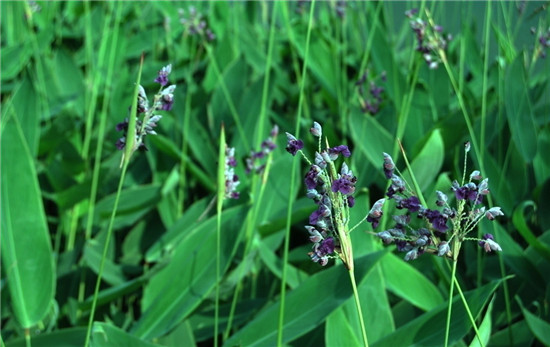
Emergent aquatic plants are tall, with brightly colored flowers, and the vast majority have distinct stems and leaves; they stand upright, with the lower part or base submerged in water, while the roots or rhizomes grow into the mud, and the upper part of the plant rises above the water surface. There are many types of emergent plants, and common ones include lotus, purple loosestrife, Acorus calamus, yellow flag iris, Schoenoplectus tabernaemontani, Thalia dealbata, pickerelweed, variegated giant reed, cattail, Alisma plantago-aquatica, Cyperus alternifolius, and reed.
Floating-leaved plants
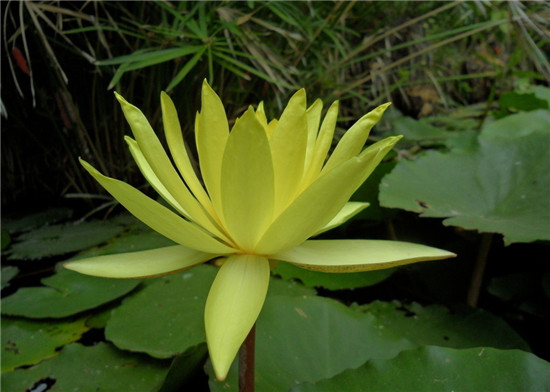
Floating-leaved aquatic plants have well-developed rhizomes, and floating-leaved plants have large, brightly colored flowers, with no obvious aboveground stem or with stems that are slender and weak and cannot stand upright, and their leaves float on the water surface. Common species include Victoria amazonica, water lily, Nuphar japonicum, Euryale ferox, and Nymphoides peltata. Floating-leaved plants include: water lily, Nymphoides peltata, Hydrocharis dubia, and Euryale ferox.
Free-floating plants
There are relatively few types of free-floating aquatic plants. The roots of these plants do not grow in mud, and the plant body floats on the water surface, drifting everywhere with currents and wind waves. Most are mainly grown for their foliage, providing decoration and shade for pond water. Because they can absorb minerals in the water and at the same time block sunlight from entering the water, they can also inhibit the growth of algae in the water body. Free-floating plants grow very quickly and can provide covering decoration on the water surface sooner. However, some varieties grow and reproduce especially rapidly and may become a nuisance in the water, such as water hyacinth.
Submerged plants
The rhizomes of submerged aquatic plants grow in mud, and the entire plant is submerged in water. They have well-developed aerenchyma, which facilitates gas exchange in submerged plants. The leaves are mostly narrow and long or thread-like, and can absorb some nutrients from the water. They can also grow and develop normally under weak underwater light conditions. They have certain requirements for water quality, because turbid water will affect their photosynthesis. The flowers are small and the flowering period is short, and they are mainly grown for their foliage.
Recommended aquatic plants
1. An evergreen upright shrub of the genus Dracaena in the Liliaceae family, suitable for indoor hydroponic flowers. The leaves of lucky bamboo are emerald green, appearing rich dark green in color, and the stems are straight and round like bamboo. The leaves are ovate with pointed tips, and the leaf stalk base claspsthe stem. It is an extremely shade-tolerant plant and can still grow well and stand tall and strong under weak light conditions. It can be placed indoors for viewing for a long time and does not need special care. As long as there is enough water, it can grow vigorously. When growing it in water, cut the lucky bamboo stem into small sections of more than 20 cm as cuttings and insert them into water. As long as 1/3 of the cutting can be immersed in water, it can take root and survive.
2. A plant of the genus Philodendron in the Araceae family, belonging to climbing foliage flowers. It likes a warm and humid environment, and the vine can reach several meters in length, with aerial roots at the nodes. The leaves become larger as they grow, are alternate, and evergreen. The stems of pothos are slender and soft, and the leaves are delicate and elegant. Water culture is very simple: make sure to change the water once every 2 to 3 days, and add simple nutrients. Pothos has high ornamental value, and its trailing stems hang down naturally. It can not only purify indoor air, but also make full use of space, adding lively lines and bright colors to dull cabinet surfaces.
3. Araliaceae, genus Hedera, is the most ideal variety for indoor and outdoor vertical greening. It is an evergreen vine, with slender, weak, and soft branches and vines, aerial roots, and can climb onto other objects. The leaves are alternate and triangular-ovate. The demand for potted plants is increasing day by day. It is a typical shade plant and can grow in a full-light environment. It grows well under warm and humid climate conditions, but is not cold-tolerant. Water culture is simple, and its vitality is strong.
The above is the complete content of the introduction to aquatic plants and the types of aquatic plants that I have summarized for everyone. I hope this article can help everyone. Please also continue to follow us.
The leaves become larger as they grow, are alternate, and evergreen. The stems of pothos are slender and soft, and the leaves are delicate and elegant. Water culture is very simple: make sure to change the water once every 2 to 3 days, and add simple nutrients. Pothos has high ornamental value, and its trailing stems hang down naturally. It can not only purify indoor air, but also make full use of space, adding lively lines and bright colors to dull cabinet surfaces.3. Araliaceae, genus Hedera, is the most ideal variety for indoor and outdoor vertical greening. It is an evergreen vine, with slender, weak, and soft branches and vines, aerial roots, and can climb onto other objects. The leaves are alternate and triangular-ovate. The demand for potted plants is increasing day by day. It is a typical shade plant and can grow in a full-light environment. It grows well under warm and humid climate conditions, but is not cold-tolerant. Water culture is simple, and its vitality is strong.
The above is the complete content of the introduction to aquatic plants and the types of aquatic plants that I have summarized for everyone. I hope this article can help everyone. Please also continue to follow us.