The Great Enjoyment Food Education Association urges the enactment of a dedicated school lunch law, emphasizing professional management and cultural inheritance
Note: This article is the full text of the speech delivered by the Great Enjoyment Food Education Association on March 4, 2019, at the "Public Hearing on the Legalization of Nutritional Lunch"
School lunches in Taiwan, China suffer from various chaotic problems. Apart from the wide disparities in lunch fees handled by different counties and cities, the number of dishes served ranges from five dishes to three dishes, the charging standards vary, and the sources and methods of ingredient supply are highly diverse.
What is even more surprising is that the only central-level regulations governing the 1.8 million school lunches supplied nationwide every day are Articles 22 and 23 of the School Health Act. Compared with Japan and South Korea, which have similar dietary patterns, educational systems, and cultural customs, and whose respective "School Lunch Acts" have been enacted and implemented for many years, school lunches in Taiwan, China indeed face the dilemma of being inherently deficient and subsequently mismanaged.
Although there are many issues yet to be discussed, in this speech we will first offer our humble views and suggestions on three points: "respecting professionalism, managing ingredients at the source, and passing on dietary culture." We ask our seniors to offer their corrections.
1. Respecting professionalism
In Taiwan, China, the professionalism and importance of school dietitians and culinary staff are underestimated.
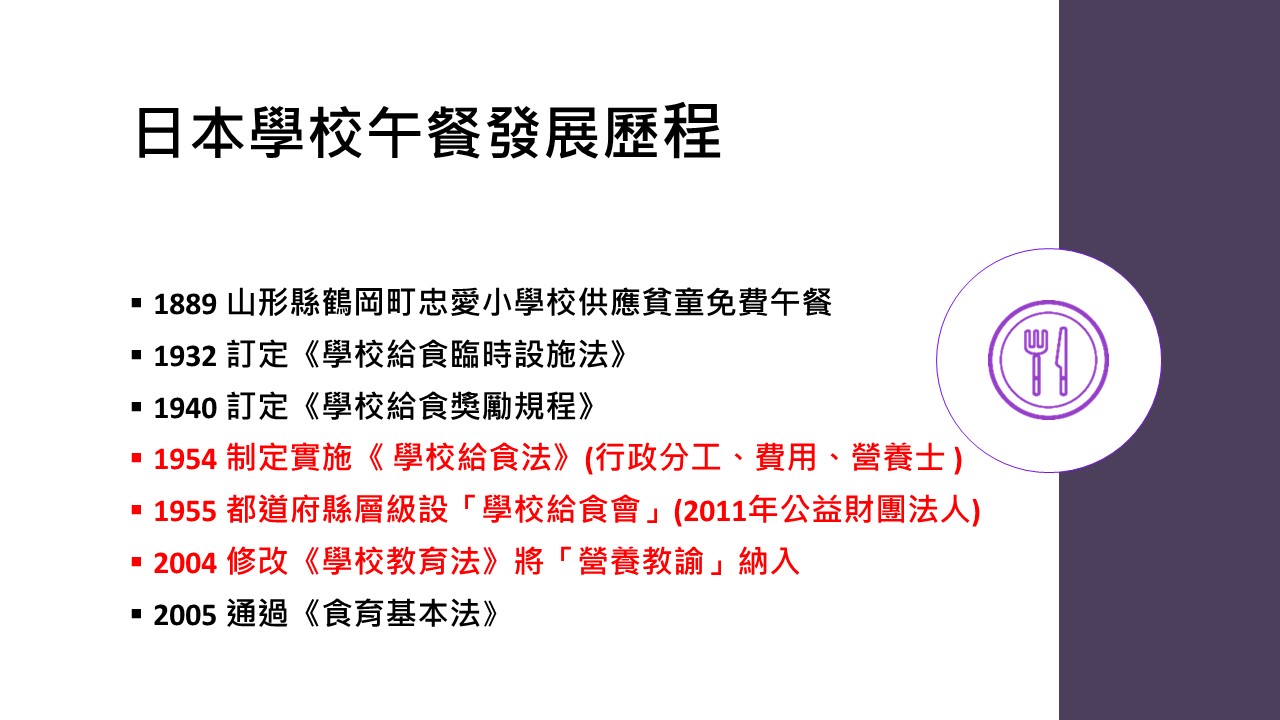
Japan's School Lunch Act, promulgated in 1954, has undergone 13 revisions and legally incorporates dietitians engaged in school lunches into the staffing establishment. South Korea, which developed from the concept of social welfare and relief for the poor in the 1950s to independent meal provision at schools nationwide, likewise passed its School Lunch Act in 1981.
We believe that identifying characteristics unique to Taiwan, China, enabling school lunches to be safe, nutritious, and delicious while supporting sustainable social life, and making them the foundation for the next generation's health and happiness, is an important issue that can no longer be avoided. Only by starting now, planning with a long-term vision, and setting aside political calculations can we have the opportunity to thoroughly improve the school meal supply system in Taiwan, China from the ground up.