How to grow pothos in water? Detailed guide to cultivation methods and care management
Place a pot of water-grown pothos in your living room or on your office desk, and instantly your home environment and office environment take on a touch of greenery and become much more lively. So, what are the cultivation methods for water-grown pothos? Let's take a look together.
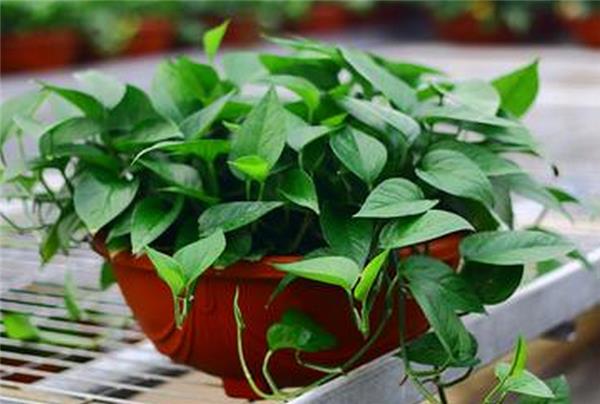
I. Cultivation methods for water-grown pothos
Pothos grown in some bottles, cultivated into especially delicate little plants, placed indoors for decoration, is also particularly nice.
1. Water quality requirements for water-grown pothos
Pothos can be placed in a bottle with high-quality water in a pretty bottle; this bottle can be placed on a table, or on a coffee table, or hung on some walls, and is a particularly nice kind of decoration. It is best to let the water sit for one or two days before use, and it is best to use it after the bleaching powder has been removed.
2. Selecting the pothos for water cultivation
When cultivating pothos by the water method, the nutrients in water are far fewer than the nutrients in soil, so when choosing pothos, it is best to choose some thick, sturdy plants to grow, as these are easier to grow. The roots of the pothos must be retained, as this makes it easier to survive.
3. Care of water-grown pothos
1) In the first few days, water-grown pothos needs its water changed every two or three days, and the water should be the same as room temperature. Once the pothos has grown roots, the water can be changed once a week. After new leaves have grown out, changing the water about once every ten days is fine, and add nutrient solution once every ten days.
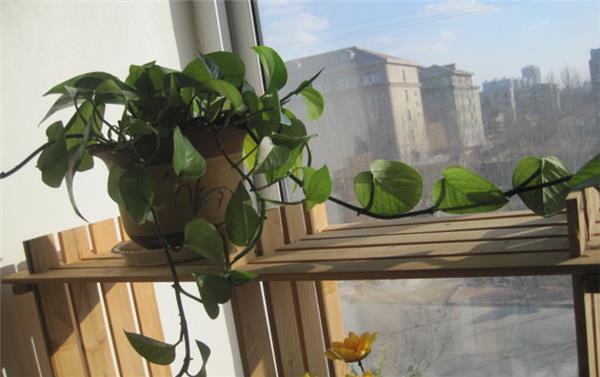
2) The root system of water-grown pothos must be cleaned and trimmed. If the roots are too long, cut them shorter in time to avoid losing more nutrients. If there are rotten roots, cut them off promptly and then clean them thoroughly. Change the water every two or three days before it recovers, and after recovery, return to routine cultivation.
II. Care management of water-grown pothos
In the autumn and winter in the north, to make up for the lack of temperature and photosynthesis, its light exposure should be increased. The method is to place the water-grown pothos in the spot indoors with the best light, or move it to a sealed balcony at noon to bask in the sun. At the same time, when the temperature is low, open the windows as little as possible, because in a very short time the leaves may be damaged by frost. At a room temperature above 10°C, water-grown pothos can safely pass the winter; at a room temperature above 20°C, water-grown pothos can grow normally. Generally, households have no great problem reaching this temperature; what needs attention is avoiding too great a temperature difference, and also taking care that the leaves do not come close to heating equipment.
In autumn and winter, the amount of watering should be strictly controlled according to room temperature. Before heating, the temperature is lower, the plant's soil evaporates more slowly, and watering should be reduced, with the amount controlled between 1/4 and 1/2 of the original. Even after heating, watering must not be too frequent; when watering, pour less into the pot and let the water seep through the coir. In addition, water should also be sprayed at the places where aerial roots grow on the coir column, to reduce insufficient water uptake by the roots caused by too-rapid evaporation. For winter watering, water that has been left to stand for a day is better; water that is too cold easily damages the roots.
In autumn and winter, plants mostly grow slowly or even stop growing, so fertilizing should be reduced. Before winter begins, mainly use liquid inorganic fertilizer, about once every 15 days. After winter begins, fertilizing should mainly be foliar spraying, applied mainly through the stomata on the leaf surface; the fertilizer is absorbed through the stomata on the leaf surface, and the fertilizer effect can act directly on the leaf surface. Foliar fertilizer should be a special-purpose fertilizer; ordinary inorganic fertilizer is not easily absorbed by the leaf surface.
Water-grown pothos grows relatively quickly and is cultivated and managed with little fuss. During cultivation and management, in summer, water should be sprayed on the plants more often, and nutrient solution should be added once every 10 days to keep the leaves green and lush. For potted seedlings, when the seedling grows out 30cm on the cultivation column, it should be cut off; when fallen lower leaves reach 30%-50%, it should be discarded and replanted. The green-column potted plant is an ideal plant for courtyard gateposts and wall greening, and its leaves are also an excellent choice for flower-arrangement foliage. Plant 4-5 plants per pot or insert cuttings directly, and set up a coir column in the middle of the pot to make it easy for the water-grown pothos to twine and grow upward. Shaping and pruning are carried out in spring.
When the stems and vines have climbed all over the coir column and the tips extend about 20 cm beyond the coir column, cut off 40 cm of the stem tips of 2-3 of the plants. After the shortened stems sprout new buds and new leaves, then cut off the stem tips of the remaining plants.
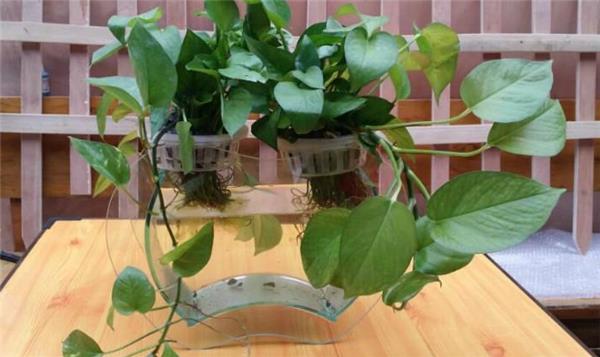
The above has carefully introduced the cultivation methods for water-grown pothos; I hope it is helpful for your pothos growing and makes your life full of poetic charm. With water-grown pothos, the air is fresh, and there is no need to use air freshener anymore.
The air is fresh, and there is no need to use air freshener anymore.