What methods do plants use to disperse their seeds?
When it comes to plants dispersing their seeds, we cannot help but admire their intelligence. Animals can move, so their reproduction is relatively easy to understand, but how do plants, which cannot move, go about producing the next generation? Let us take a look below at the methods plants use to disperse their seeds.
What methods do plants have for dispersing their seeds?
1. Self-dispersal
Self-dispersal relies on the plant itself and does not depend on any other dispersal agent. The fruit or seed itself has weight, and once ripe, the fruit or seed simply falls to the ground under the force of gravity, as with the Japanese persimmon (Diospyros kaki) and the big-leafed Palaquium (Palaquium formosanum); while when the capsules and siliques of plants such as the Taiwan Michelia (Michelia compressa) ripen and split open, they generate an explosive force that flings the seeds outward. Self-dispersed seeds travel only a limited distance, but some self-dispersed seeds undergo secondary dispersal after falling to the ground, with birds, ants and mammals all being possible secondary dispersers.
2. Wind dispersal
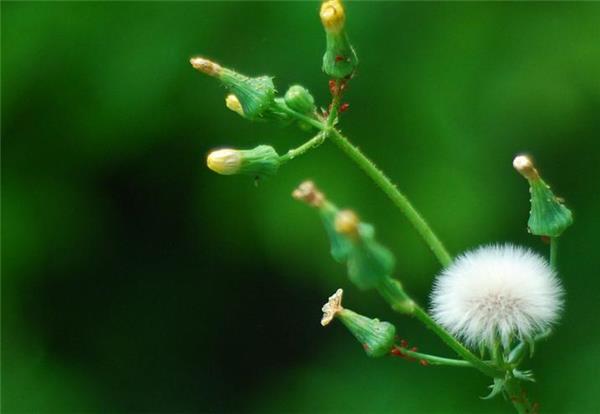
Some seeds grow appendages shaped like wings or feathers and ride the wind. Most seeds with feathery appendages belong to herbaceous plants, such as the hawkweed (Crepidiastrum denticulatum) in the Asteraceae family, while woody plants include the willow and the kapok. In addition, some tiny seeds have a relatively large surface area-to-weight ratio, so they can drift on the wind, such as orchid seeds. The achenes of the dandelion (Taraxacum), a plant in the Asteraceae family, spread their pappus when ripe, like parachutes drifting on the wind, scattering the seeds far and wide.
3. Water dispersal
Seeds dispersed by water have a waxy, water-repellent surface (such as the water lily), fruit skins containing air chambers, and a specific gravity lower than that of water, so they can float on the surface and be carried by streams or ocean currents. The seed coats of such seeds often have abundant fibrous tissue that prevents the seeds from rotting or sinking after soaking and absorbing water. Coastal plants such as the Barringtonia (Barringtonia asiatica), the sea trumpet (Hernandia nymphaeifolia) and the Indian almond (Terminalia catappa) have typical water-dispersed seeds.
4. Bird dispersal
Most seeds dispersed by birds come from fleshy fruits, such as berries, drupes and syconia. Birds peck at the seeds of plants in the Lauraceae family and then spit the seeds out. After the fruit is eaten, the seeds pass through the digestive tract and are excreted at random. Plants that rely on birds for seed dispersal are a relatively advanced group, because the distance over which birds disperse seeds is the greatest of all methods.
5. Ant dispersal
Ants usually play the role of secondary dispersers in seed dispersal. Some birds eat and disperse seeds but do not consume all of the nutrients, and the seeds that fall to the ground still have some nutrients remaining on their surface for ants to feed on, at which point the ants become secondary dispersers. The same phenomenon also occurs with self-dispersed seeds or seeds dispersed by mammals.
6. Mammal dispersal
Dispersal by mammals mostly involves medium-to-large fleshy fruits or dry fruits. Generally speaking, mammals are relatively large in size and need a large amount of food, so they choose larger fruits. For example, the macaque likes to eat the fruits of the Japanese persimmon and the banana, and also helps these plants to disperse.
In nature, if plants are to survive and develop, they will try every possible means to reproduce their offspring, so every plant has its own special ability to let its seeds "travel", enabling the seeds to spread far and wide. That is all for today's introduction to the methods plants use to disperse their seeds. Thank you all for reading.