A Detailed Guide to the Cultivation Techniques and Planting Methods of the Red Maple (Acer rubrum)
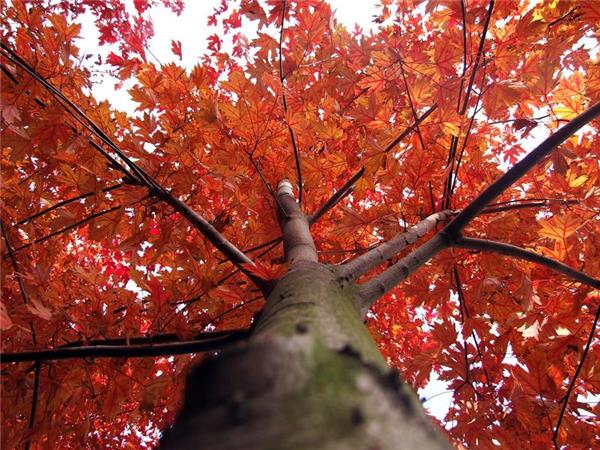
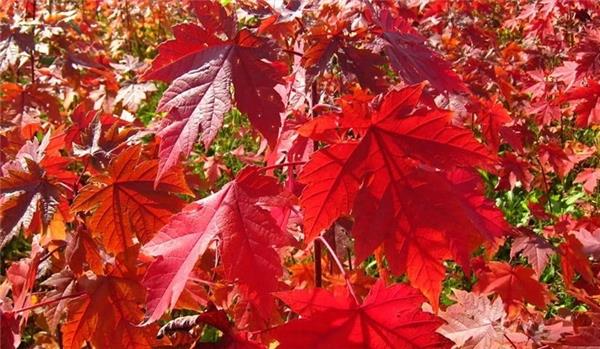
The red maple (Acer rubrum) is an ornamental colored-leaf tree species with an excellent visual effect. Its maple leaves are fiery red like a sea, instantly capturing the viewer's attention, and it stands out prominently in any landscape design.
Spring Planting Methods for the Red Maple
1. Deeply plow the land where the red maple trees are to be planted, then broadcast organic fertilizer at a rate of about 2 cubic meters per mu, serving as the base fertilizer for the saplings' growth that year. At the same time, carbofuran soil insecticide can be used to eliminate underground pests, and then a rotary tiller is used to till the soil, achieving good looseness of the soil before planting.
2. Before planting the saplings, prune the root system of the red maple saplings to be planted, in order to promote root growth of the red maple saplings. At the same time, dip the roots in a fungicide, generally using carbendazim or thiophanate-methyl diluted about 500 times, dipping the roots for about 20 minutes. When dipping the roots, a small amount of fungicide can also be applied to the sapling stems.
3. When planting the red maple saplings, plant them according to the predetermined spacing between plants and rows. After planting, the saplings need to be lifted slightly so that the root system of the red maple saplings spreads out better.
4. After planting the red maple trees, they need to be watered promptly, preferably with three consecutive waterings, a thorough soaking. This ensures that the red maple saplings and the soil are fully compacted and that there is sufficient moisture.
The Relationship Between Planting Density and Growth Rate of the Red Maple
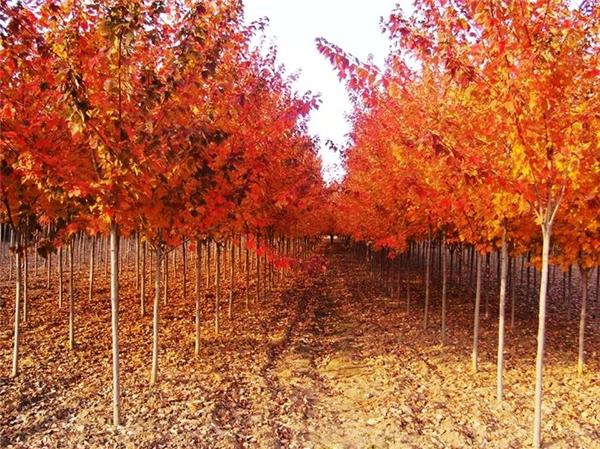
Red maple saplings grow slowly in the seedling stage. When the saplings reach a certain stage of growth, the planting density needs to be adjusted so that the saplings receive maximum photosynthesis. Generally, the trunk diameter of the American Autumn Blaze red maple (measured at a trunk height of 30 cm) is used as the standard: if the trunk diameter is less than 1 cm, the spacing between plants and rows is 0.8 m x 1 m; if the trunk diameter is 1 to 2 cm, the spacing is 1.2 m x 1.1 m; if the trunk diameter is 2 to 3 cm, the spacing is 1.6 m x 1.4 m; if the trunk diameter is 3 to 4 cm, the spacing is 2.2 m x 1.8 m; if the trunk diameter is 4 to 5 cm, the spacing is 2.3 m x 2.0 m; if the trunk diameter is greater than 5 cm, the spacing is 2.8 m x 2.2 m. When transplanting, the saplings need to be pruned first, removing the central roots, some overly long fine roots, and the vigorous top growth and water sprouts. Saplings with a trunk thickness of more than 2 cm must be transplanted with a root ball.
Planting the American Autumn Blaze red maple requires hilling up soil. For soil that is severely sandy and has poor drought resistance, fine clay soil and rotted farmyard manure should be added; for clayey soil, more organic fertilizer should be applied, with an appropriate addition of sandy soil to adjust the viscosity, and drainage ditches should be opened; for nursery land that is heavily clayey and prone to waterlogging, drainage ditches about 50 cm deep should be dug so that the groundwater level is controlled below the root zone.
How to Care for the Red Maple During the Transition from Autumn to Winter
Water promptly with freeze water: Although evaporation is low in winter and the red maple's water requirement is relatively small, it still affects the red maple's cold resistance and the next year's growth and development. Therefore, in early November, newly planted red maples should be watered once, which is "freeze watering." After watering, mound soil at the base of the red maple to improve its cold resistance.
Do a good job of fertilizing: After autumn, the root system experiences another growth peak. Therefore, in late autumn and early winter, depending on the age of the red maple and the length of time since planting, an appropriate amount of organic or chemical fertilizer should be applied, with an appropriate amount of watering so that the fertilizer seeps in. This can stimulate new roots and strengthen the tree's vigor.
Whitewashing the trunk: Whitewashing the trunk in winter can both reduce damage to the bark on the sunny side caused by large day-night temperature differences and eliminate pests and diseases overwintering in the bark crevices. The whitewash formula is 10 parts quicklime, 1 part salt, 1 part sulfur powder, and 40 parts water, and it can be applied in November.
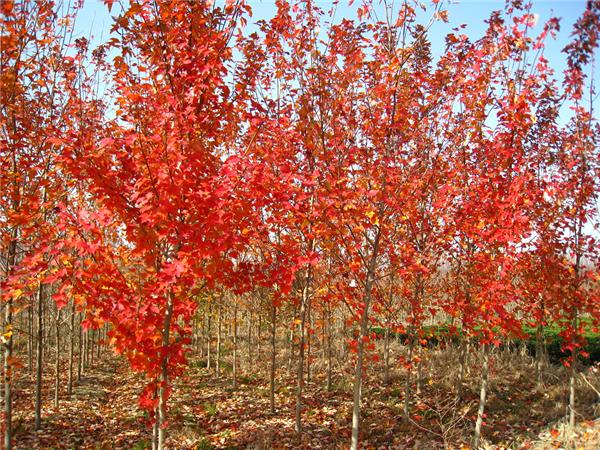
In addition to the red maple cultivation techniques introduced above, we should also note: red maple seedlings are easily covered by weeds, leading to slow growth or even death, so manual weeding around the seedlings is required frequently. For saplings that have been established for 2 years, to save labor, herbicides such as glyphosate can be used for weed control.