A Complete Guide to Growing Alocasia macrorrhizos
What should you provide for growing Alocasia macrorrhizos, and how should you grow it, so that a thriving Alocasia macrorrhizos can appear before your eyes, delighting your mood and nurturing your temperament?
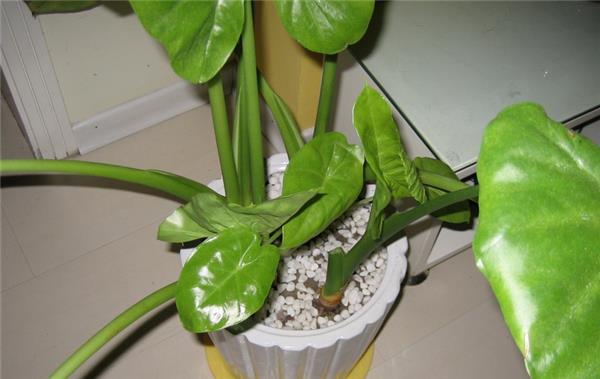
I. How to Grow Alocasia macrorrhizos
1. Environmental humidity: It likes a moist environment and dislikes dry air. During the growing season, when the weather is clear and dry, water should often be sprayed on the branches, leaves and surroundings to maintain a relatively high air humidity.
2. Fertilizing: It likes fertilizer. Because it grows a lot, nutrients need to be supplemented in time so that the stems can grow thick and strong and the leaves can be large, dark green and glossy; when fertilizer is lacking, the leaves are small and yellow. During the growing period, a nitrogen-based fertilizer should be applied about once every 10 days. After the beginning of autumn, stop applying nitrogen fertilizer and apply a 20-30 phosphorus-potassium fertilizer. Stop fertilizing in winter.
3. Pruning: Yellow leaves should be cut off at any time. Because the leaf stalks are long, when moving, placing and caring for the plant, avoid breaking the leaf stalks. If they are broken, they should be cut off in time.
4. Repotting: Repot once every 1-2 years. It does not have high requirements for soil, but it likes fertile, loose sandy loam with good drainage. The growing medium can be made from materials such as leaf mold, garden soil, peat soil and river sand. If sufficient base fertilizer is applied, the leaves can grow large and thick. Because the leaves are large but few in number and the leaf stalks are long, when moving the plant and caring for it, avoid damaging the leaves, otherwise the ornamental value will be reduced.
5. Propagation: seeding, cuttings, division, etc.
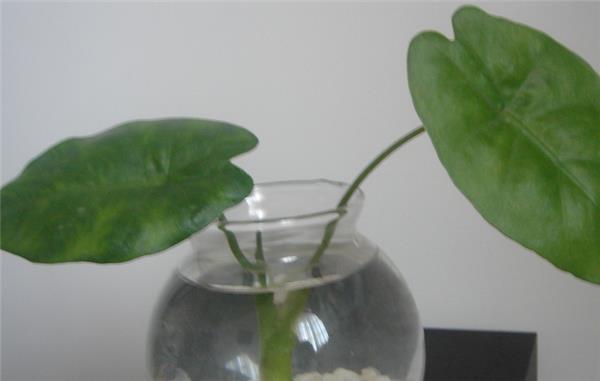
II. Precautions for Growing Alocasia macrorrhizos
The suitable growing temperature for Alocasia macrorrhizos is 20-25°C. It likes a warm, humid and semi-shaded environment, so during the growing season place it in a shaded spot on a balcony or in a courtyard (avoid direct sunlight in summer), keep the potting soil moist at all times, and apply a dilute liquid fertilizer based mainly on nitrogen fertilizer mixed with phosphorus and potassium fertilizer 1-2 times a month (stop fertilizing in winter and control watering).
Alocasia macrorrhizos likes plenty of water and plenty of fertilizer, likes loose leaf mold or sandy loam, and likes sufficient light. Apart from appropriately shading it in the hot midsummer, it is best to give it all-day light in other seasons. In addition, Alocasia macrorrhizos especially likes a high-temperature and high-humidity climate. At noon every day in midsummer, spray water on the leaves to increase air humidity, so that the leaves of Alocasia macrorrhizos can be both large and thick. If it is too shaded, the leaves will become larger but thinner, and the leaf stalks will also be brittle. The leaf stalks being too long and breaking is due to lack of light. Alocasia macrorrhizos should be placed in a bright indoor location, such as by a window, and needs at least 3 to 5 hours of light every day. Bright light is good, but it cannot be exposed to strong sunlight. Alocasia macrorrhizos likes water, so if the leaves become soft, it should be watered. Regularly watering in a little ferrous sulfate can make the leaves greener, larger and thicker.
III. Methods for Preventing and Controlling Diseases and Pests of Alocasia macrorrhizos
Diseases of Alocasia macrorrhizos are reflected on the leaves. Generally there are two kinds, one is leaf spot disease and the other is anthracnose. For leaf spot disease, a 800-fold dilution of chlorothalonil or carbendazim can be sprayed on the leaf surface, 2-3 times in succession, with 7 days between each application. For anthracnose, a 500-fold dilution of 75% thiophanate-methyl must be sprayed on the leaf surface, once every 7 days, 2-3 times in succession, and it can basically be controlled. Because Alocasia macrorrhizos is a foliage plant, once the leaves become diseased, it will inevitably affect its ornamental effect, so prevention should be the main approach.
Methods for Preventing and Controlling Diseases and Pests of Alocasia macrorrhizos
On the stems, there is one kind of wilt disease caused by bacterial infection. This disease is not easy to detect at first, and once it is discovered it will already be very serious. If the stem is found to lean to one side, or there is a wilting spot, then it has definitely developed wilt disease. A small knife can be used to cut out the diseased part. The boundary between the diseased part and the healthy part is very obvious, and it can generally be broken off by hand. If the diseased part is less than one third of the stem, a layer of chlorothalonil solution can be applied to the healthy part, and it should be kept dry. Apply it again after ten days, and after 20 days it can basically heal.
The above gives a detailed understanding of growing Alocasia macrorrhizos. I hope it can be of some help in your cultivation of Alocasia macrorrhizos and add a bit of support for growing a vigorous Alocasia macrorrhizos.