How to Grow Ornamental Bromeliads? Cultivation Methods and Common Varieties
Ornamental bromeliads are a group of plants that have gradually gained great popularity in recent years. They generally have excellent or very distinctive ornamental effects and can be used in garden designs and home styles of various styles.
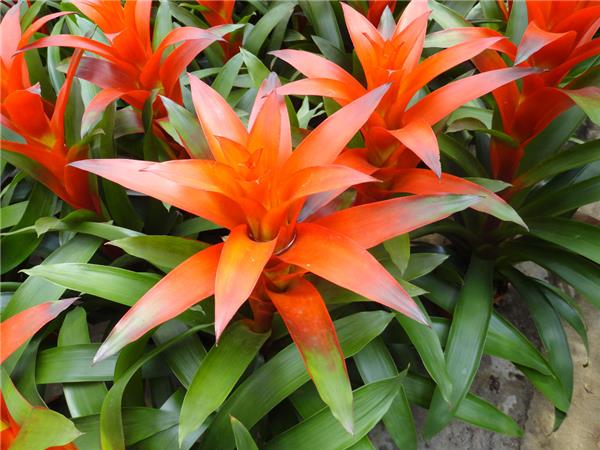
Cultivation Methods of Ornamental Bromeliads
Forcing bloom: For ornamental bromeliads to flower completely naturally, they must have a sufficient foundation of vegetative growth to accumulate enough nutrients for flowering. Natural flowering requires 2 to 3 years of cultivation time and more than 30 leaves (including leaves that have already dropped), but they generally do not flower easily, and the flowering time is not uniform. Large-scale commercial production and cultivation must, when the ornamental bromeliad plants reach a certain seedling age or leaf age (more than 20 leaves), use ethylene or calcium carbide water to force flowering. For forcing bloom, plants must be selected that have strong growth vigor, are free from pests and diseases, and have reached or exceeded 20 leaves for pollination.
Seed collection: About 30 days after pollination, the fruit gradually swells, the protruding sepals are dark green, and as maturity increases, they gradually turn brown, marking that the seeds have matured and can be harvested. After harvesting, they should be sown promptly; if storage is needed, they can be placed in a desiccator and stored in a refrigerator at 0 to 5°C.
Sowing: It is advisable to sow under sterile conditions. Sowing process: after harvesting mature but unopened fruit, rinse with purified water for 15 minutes, wipe the fruit skin with 75% alcohol, then sterilize with 10% hydrogen peroxide for 12 minutes, afterward rinse 3 to 4 times with sterile water, cut open the fruit, take out the seeds, and sow the seeds in a solid medium. The medium is 1/2 MS + 2% sucrose + 1% activated carbon. Using this method for sowing, germination can occur in about one month, and the germination rate can reach more than 80%. When the plant's true leaves grow to about 5, it can be taken out of the flask and transplanted into plug trays.
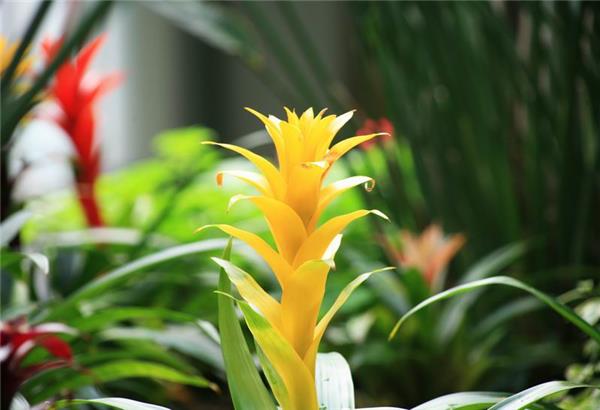
Fertilizing: To make ornamental bromeliads grow robustly, every 1-2 weeks a small amount of foliar fertilizer should also be applied into the leaf cups, such as Pen Shi Bao; the specific amount depends on the instructions on the foliar fertilizer and the growth condition of the flowers.
Watering: Because the leaf cups store water for a long time, the roots and leaves are prone to rot, so care should be taken to use clean water when adding water into the leaf cups; after a long time, use 500 times diluted chlorothalonil fungicide to wash the roots and leaves to prevent rot.
Pests and diseases: Ornamental bromeliads have relatively few pests and diseases, but improper management can also lead to some pests and diseases. For example, too much watering, excessive fertilizer concentration, and poor substrate drainage can easily cause basal rot, which can be treated with 50% carbendazim at 800 to 1000 times dilution, sprayed once every 7 to 10 days. The main insect pests are locusts, scale insects, thrips, and fruit borers, which can be controlled with omethoate, Tepu water, Kuangsha Bao, whitefly killer, and the like.
Division: First cut off the flower stem from the base, then leave 5-8 cm of the old plant's leaves, remove all the rest, and the base of the remaining leaves just forms a cup shape that can store water; when cutting, be sure not to injure the small offsets. When the offsets are about 10 cm tall, use a sharp knife to gently cut at the connection between the offset and the mother plant, plant the small offsets into potting soil mixed with leaf mold, and after careful care for one year, they can again produce brilliant flowers.
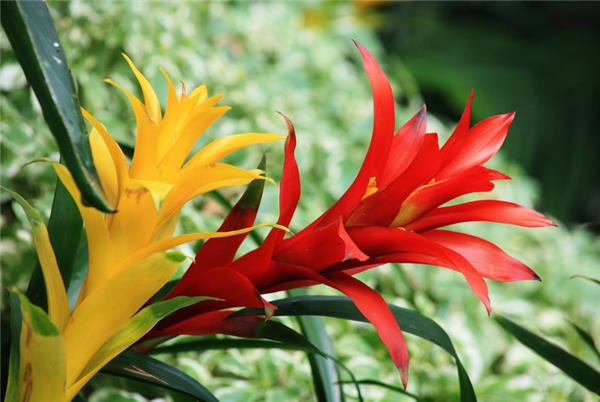
Common Varieties of Ornamental Bromeliads
Flame bromeliad: The leaves are narrow and long like swords, verdant and glossy. From winter to early spring, a bright red columnar inflorescence, about 30 cm tall, emerges from the tender green leaf cup; at the top are 6-12 small flowers, with 3 petals, pale yellow-green, with blue edges, curling outward after opening. When in full bloom, strings of blue-green flowers, set off by the red bracts, appear especially brilliant and eye-catching, and the ornamental period can last as long as two months.
Cryptanthus: Also known as the mini bromeliad, it is most suitable for potted ornamental display. Its leaves are firm and slender, with wavy edges, and the colors include creamy yellow, red, or purplish red; the leaf surface has longitudinal stripes radiating like a crab shape, and the flowers are white or light green, growing among the leaf clusters to form a disc.
Aechmea fasciata: Also known as silver vase and urn plant, the plant consists of 10-20 leaves forming a rosette leaf cluster, with a cup-shaped base. The leaf tips are bluntly rounded and turned outward, bright green, with a silvery white coating on the surface, and the leaf surface forms irregular stored-color and dark green horizontal stripes and patches. Between summer and autumn, after the peach-pink columnar flower, about 15 cm tall. The dense small flowers first open blue, then change to rose red, like a dragonfly flying with wings spread, and the ornamental period can last several months.
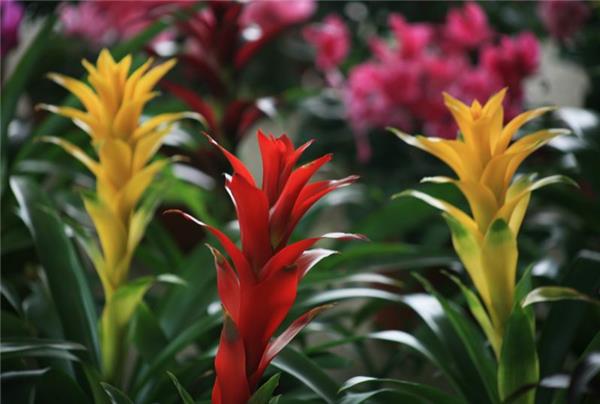
In addition, some common ornamental bromeliad varieties include golden-edged bromeliad, painted bromeliad, and Dennis star, all of which are bromeliad varieties with good ornamental effects, and can be used for both ground planting and potted indoor cultivation to beautify the surrounding environment and bring a sense of tropical natural scenery.
to beautify the surrounding environment and bring a sense of tropical natural scenery.