Grafting and Propagation of Red Plum Blossom Saplings and Their Differences from Wintersweet
The red plum blossom is a tree species with relatively high ornamental value. Although it is called red plum, besides red flowers, red plum varieties also include flowers in white, pink and other colors.
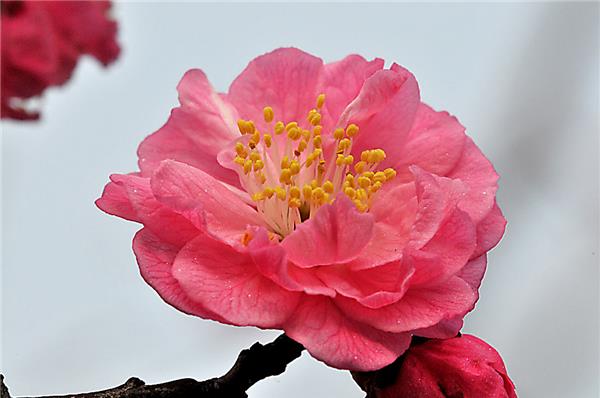
Introduction to the Red Plum Blossom
Morphological characteristics: A deciduous small tree or large shrub. The crown of the sapling is open. New shoots are smooth, green or with a reddish-brown tinge. Leaves are alternate, broadly ovate to ovate, 4-6 cm long, with fine serrations along the edges, covered with short pubescence on both sides when young, gradually falling off later. Flowers are borne in the leaf axils of one-year-old branches, solitary or in clusters of two, in colors such as white, red and pink, single to double petals, and fragrant. Stamens are numerous with relatively long filaments; pistils number one or several. The drupe is nearly spherical, with a longitudinal groove, green or with a dark red blush when young, turning yellow when ripe, and sour in taste. Double-petaled varieties do not bear fruit or bear few fruits. Depending on the climate of the planting region, the flowering period runs from December to April of the following year, and the fruit ripening period is from May to June.
Garden use: The plum blossom is vigorous and elegantly ancient, with sparse branches stretching sideways, blooming in early spring, and its subtle fragrance drifting in the air; it has long been known as one of the Three Friends of Winter. In garden green spaces and courtyard scenic areas, it can be planted as a solitary specimen, in clumps or in groups, and can also be naturally arranged in front of houses, on slopes, beside rocks and along roadsides. If evergreen trees or dark-colored buildings are used as a background, the beauty of its jade-pure and ice-clear elegance can be further enhanced. Using plum blossoms to make bonsai, with their twisted and turning branches, is delightfully charming. Flowering branches can be cut for use as cut flowers.
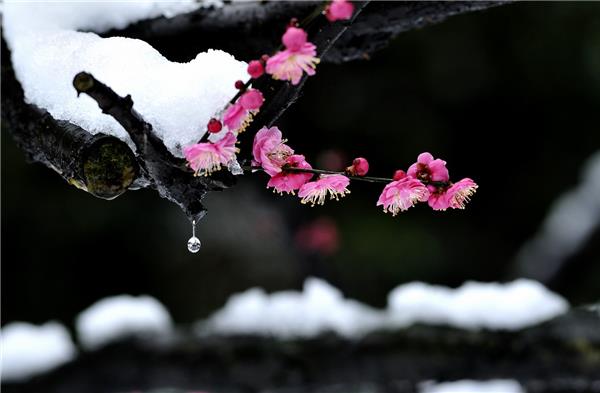
Differences Between Red Plum Blossom Saplings and Wintersweet Saplings
1. Different flower colors: Wintersweet flowers are mainly waxy yellow, while plum blossoms come in white, pink, deep red, purplish red and other colors.
2. Different flowering periods: Generally, wintersweet blooms in the twelfth lunar month, about two months earlier than plum blossoms.
3. Different tree crowns: Wintersweet is a shrub with clustered branches, and the branches are upright, with a very developed root crown that is block-shaped, while the plum blossom is a tree with a main trunk, reaching up to 10 m in height, often with branch thorns; besides upright branches, there are also weeping branches, and the crown is an irregular rounded shape.
4. Different leaves: Wintersweet leaves are opposite, nearly leathery, long elliptic, entire, rough and green on the upper surface, and smooth and gray on the underside; while plum blossom leaves are alternate, broadly ovate to ovate, 4-10 cm long, with a long acuminate or caudate apex, finely sharp serrate margins, and a broad cuneate or nearly rounded base; when young they are covered with short pubescence on both sides, mostly falling off later, and the growing new leaves have hairs only on the veins on the underside, mostly in the axils.
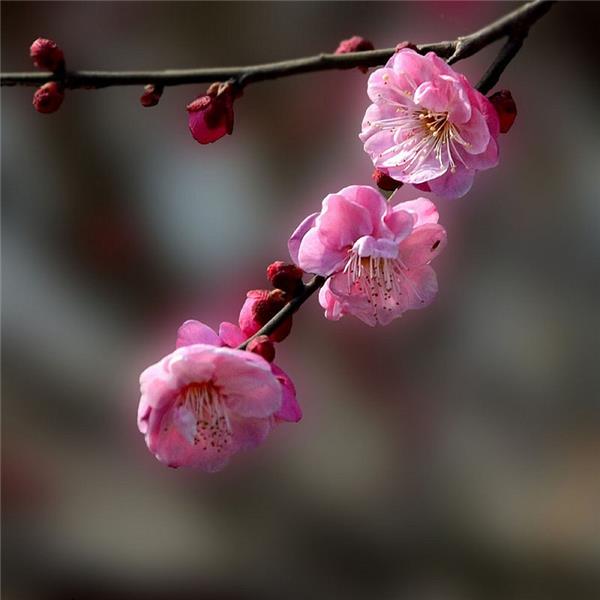
Grafting and Cultivation Techniques for Red Plum Blossom Saplings
1. The best rootstock for grafting red plum blossom is green plum saplings. A small trick for identifying whether seeds are genuine: crack open the shell of a green plum seed and soak the kernel in warm water for more than 24 hours. Fake seeds are white with a little yellow and lack luster, while genuine seeds are very white, like the white of a water chestnut. Plum blossoms can also be propagated by cuttings and layering, but the survival rate is relatively low.
2. Red plum blossoms like light and prefer a warm, humid climate, and are also relatively cold-tolerant; the best soil is fertile, loose, humus-rich sandy loam. In heavy clay soil with poor drainage, roots are prone to rot and death. Therefore, when planting plum trees, choose a sunny, dry, well-ventilated location. The best time for grafting red plum blossom is after the plum blossoms fade, when the leaf buds have just begun to swell.
3. Bud grafting: Bud grafting is one of the most widely used grafting methods, and its specific grafting methods mainly include bud grafting with wood and T-shaped bud grafting. Bud grafting with wood, also called chip budding, is used more often in practice. Its advantage is that grafting can be done in all four seasons, without being limited by whether the branches slip bark; because the grafted bud carries wood without damaging the vascular bundles inside the bud piece, the grafting survival rate is high and the sapling grows vigorously.
4. Management of bud-grafted saplings: After grafting, generally check whether the grafted bud has survived after about 15 days. A surviving grafted bud can usually be untied after 25 days; while untying, break the rootstock at 3-5 cm above the grafted bud. When the grafted bud sprouts and grows, cut the rootstock about 0.5 cm above the grafted bud. The cut should be slightly slanted toward the side opposite the grafted bud to aid healing. If it has not survived, re-graft promptly.
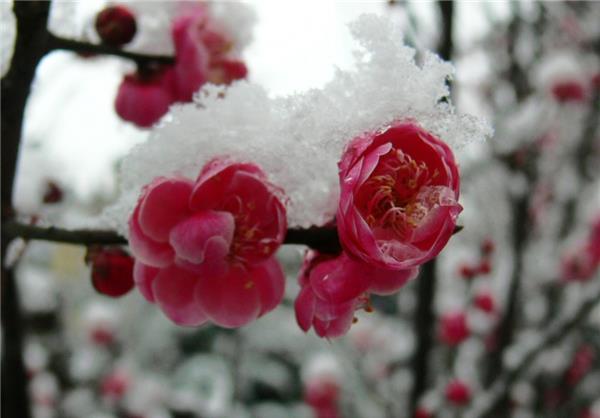
The landscaping approaches for red plum blossom can be solitary planting, clump planting, group planting, etc.; it can also be naturally arranged in front of houses, on slopes, beside rocks and along roadsides. Evergreen trees or dark-colored buildings can be used as a background to set off the jade-pure and ice-clear beauty of the plum blossom. In addition, plum blossoms can be arranged into plum ridges, plum peaks, plum gardens, plum streams, plum paths and so on.