When is the most suitable time to plant lilies?
Planting lilies, like their elegant character, is a matter of great care, and not just any time will do. We need to work with the temperature and the season, and of course, before that we should select healthy, plump seeds in advance. Now let's take a look together at when to plant lilies and what the planting methods for lilies are.

Sowing time for lilies:
Lilies can be sown in both spring and autumn. Before sowing, place the seeds in front of a light and pick out the seeds with well-developed embryos for sowing. The suitable germination temperature is 12-15°C. Above 15°C the seeds germinate quickly, but the seedlings are weaker. Below 5°C the seeds do not germinate; above 25°C the seeds go dormant and do not germinate.
Flowering time of lilies:
After sowing, cover with soil, about 1 cm, and the cotyledons emerge in about 20-30 days. Generally sown in spring and planted out in autumn, they take 2-3 years to flower.
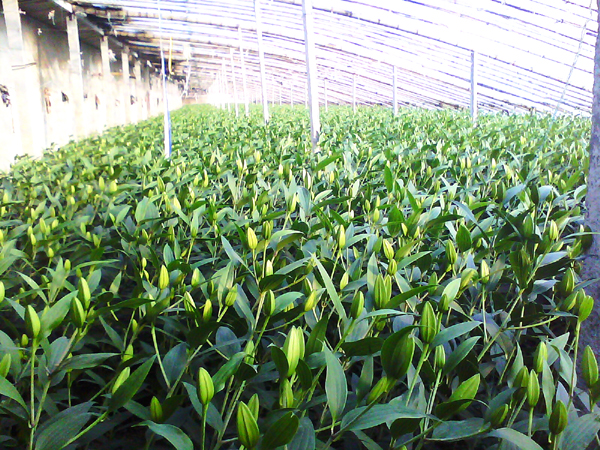
They flower from November to early February of the following year. Using medium bulbs, first treat at 13°C for 2 weeks (14 days), then treat at 3°C for 4-5 weeks (28-36 days), so they can flower in November-December. If flowering is required in January-February, first treat at 13°C for 2 weeks, then treat at 8°C for 4-5 weeks (28-36 days). At this time, after planting out, the nighttime temperature is relatively low, so heating should be added to maintain around 15°C. In forced cultivation of lilies, when the flower buds grow to 1-2 cm, insufficient light easily causes bud abortion. Bud abortion often occurs from the end of October to mid-March of the following year. It can be prevented through artificial supplementary lighting by hanging one 40-watt high-pressure sodium lamp, or an ordinary waterproof incandescent lamp, every 8-10 sq m. Supplementary lighting begins from before the flower buds reach 0.5-1 cm and continues until harvest. At 16°C, maintaining lighting for about 6 weeks, from 8 p.m. each day to 4 a.m. the next morning, has excellent effects on preventing bud abortion, advancing flowering and improving cut flower quality.
Lily cultivation techniques
1. Site selection and land preparation
Choose fertile soil on high, well-drained loam for planting. The previous crop is best as legumes or grasses. Lilies are fertilizer-tolerant crops. Before deep ploughing, apply 2500-5000 kg of decomposed farmyard manure and 50-100 kg of superphosphate per mu, then plough evenly and harrow fine. For scattered slope land outside the house, hilly land, or larger flat plots with smooth drainage, flat beds 1-1.2 m wide can be made, with drainage ditches 25 cm wide and 15 cm deep between beds. In places with more rain in the south, high beds with a bed surface about 1 m wide should be made, with ditches 30-40 cm wide, to facilitate drainage.
2. Propagation methods
Mainly scale propagation, bulbil propagation and bulb division propagation. Seed propagation has a long growing period and is mostly not used in large-scale production.
(1) Scale propagation:
Select robust, pure white lily bulbs with tight scales and no pests or diseases. Cut off the base with a knife to separate the scales, and each scale is one planting stock. Choose sandy loam with good drainage and irrigation conditions. One month before planting, apply 2500-3000 kg of barnyard manure per mu, crush it finely and spread it in the field, deep plough 25 cm, harrow fine and level, and make flat beds 85 cm wide with bed ridges 25 cm wide. Wheat or peas can be intercropped. If the soil is dry at planting time, first irrigate the bed, and after the water seeps down and the surface soil is slightly loose, plant. The planting period is preferably around "Autumn Equinox," and at the latest must not pass "Cold Dew."
Before planting, soak in 2% formaldehyde water for 15 minutes for disinfection, then remove and dry. In the prepared bed, open furrows 5 cm deep at a row spacing of 20 cm, and place the scales with the buds pointing upward in the furrows at a plant spacing of 7-8 cm, cover with soil and level it, and press lightly. Use about 100 kg of fresh scales per mu. They do not emerge in the same year after planting. Before freezing, if conditions permit, cover the bed surface with a layer of horse manure or plastic film. After spring begins the following year, tidy the bed surface, water when the soil is dry, pay attention to drainage in the rainy season, frequently loosen the soil and weed, and keep the soil loose. Around "Autumn Equinox," dig out the small bulbs and transplant them into the field.
(2) Bulbil propagation:
In summer, in the field where lilies are grown, harvest the mature bulbils from the leaf axils, bury them in slightly moist fine sand for storage, and take them out for planting around "Autumn Equinox." At a plant spacing of about 4 cm, scatter the bulbils in the bed, cover with 3 cm of soil, rake level, and press lightly. The management in the second year is the same as for scale propagation. In autumn they become one-year-old small bulbs, and then, according to the bulb propagation method, they are planted in the field. (3) Bulb division propagation: One or several small bulbs often grow beside the underground bulb of a lily. At harvest, select the large ones for processing into medicine, and use the small ones as planting stock, planting them directly in the prepared field. In addition, the outer layers of large bulbs can be peeled off for medicinal use, and the middle bulb can also be taken as planting stock.
(4) Seed propagation:
If bulbs are lacking, seed propagation can be used first, or to cultivate improved varieties. After lily seeds mature, collect and store them. Around "Grain Rain," in the prepared bed, first irrigate thoroughly, and after the water seeps down, evenly scatter the seeds on the bed surface, cover with a thin layer of fine sand, then cover with weeds. In dry weather, spray water to keep moist. After the seedlings emerge, gradually remove the covering weeds and strengthen field management. After 3 years, dig them out; the large ones are used as medicine, and the small ones as planting stock. (5) Field cultivation: The planting period is preferably between "White Dew" and "Autumn Equinox." For seedlings raised from scales, bulbils, etc., dig them out from the seedling bed before planting, select them, and then on the prepared bed surface, at a row spacing of 20-25 cm and a plant spacing of 13-15 cm, dig holes 10-15 cm deep, place one plant per hole with the bud pointing upward, and after planting cover with soil and press firmly. Lily soil coverage must not be too shallow or too deep; too shallow and the bulb easily splits, too deep and growth is not vigorous. Covering 6 cm of soil above the bud is appropriate.
I believe that after reading the above article, everyone has gained some understanding of the relevant content related to lily planting. I hope the above content can help everyone. For more exciting content, please continue to follow our website.
In the prepared bed, first irrigate thoroughly, and after the water seeps down, evenly scatter the seeds on the bed surface, cover with a thin layer of fine sand, then cover with weeds. In dry weather, spray water to keep moist. After the seedlings emerge, gradually remove the covering weeds and strengthen field management. After 3 years, dig them out; the large ones are used as medicine, and the small ones as planting stock. (5) Field cultivation: The planting period is preferably between "White Dew" and "Autumn Equinox." For seedlings raised from scales, bulbils, etc., dig them out from the seedling bed before planting, select them, and then on the prepared bed surface, at a row spacing of 20-25 cm and a plant spacing of 13-15 cm, dig holes 10-15 cm deep, place one plant per hole with the bud pointing upward, and after planting cover with soil and press firmly. Lily soil coverage must not be too shallow or too deep; too shallow and the bulb easily splits, too deep and growth is not vigorous. Covering 6 cm of soil above the bud is appropriate.I believe that after reading the above article, everyone has gained some understanding of the relevant content related to lily planting. I hope the above content can help everyone. For more exciting content, please continue to follow our website.