Is it a good thing or a bad thing when the elephant's ear blooms?
Is it good when the elephant's ear blooms? Actually, when the elephant's ear blooms, the first thing it does is delight us emotionally, making us happy about the bloom for a long time. Just this alone is enough to consider the blooming of the elephant's ear a good sign. So, is it good when the elephant's ear blooms?
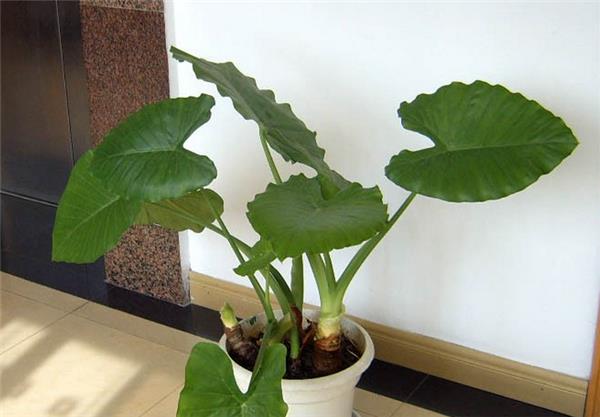
I. Is it good when the elephant's ear blooms?
In fact, the elephant's ear (Alocasia macrorrhizos) is a tropical plant. In the north it is very common as a potted ornamental plant, but it generally does not bloom. However, if conditions such as temperature are suitable, it will bloom as well. The flowering period lasts about a week. After a week, the upper part of the flower of the elephant's ear begins to wither, while the lower part of the flower column is still emerald green. After nearly half a month, the tip of the flower column will burst open and reveal a cluster of red berries resembling a pine cone, which look especially beautiful against the green leaves.
The blooming of the elephant's ear is a very rare event, so the meaning of the elephant's ear blooming is also very good. When the elephant's ear blooms, a column of milky-white flower spike stands elegantly, and behind the flower spike rises a green oval spathe; the flower spike seems to stand in front of this spathe, embraced by it. That milky-white flower spike is just like the jade body of Guanyin, and the spathe is even more like the halo of Buddhist light radiating from Guanyin's body. The pure white flower spike standing in a patch of Buddhist light is like Guanyin Bodhisattva appearing in your home, so it is a very auspicious good omen.
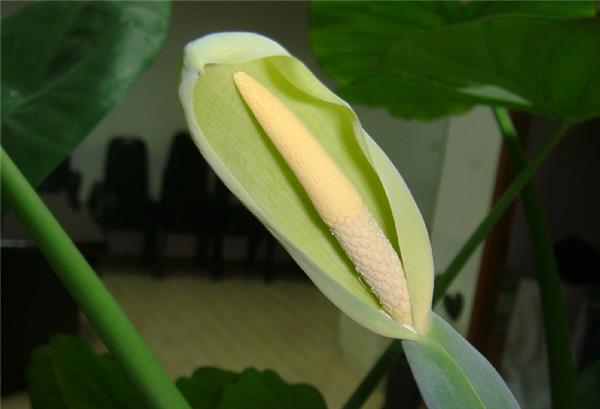
Flower growers should be reminded, and many people do not know this, that the sap in the stem of the elephant's ear is toxic. If the stem is damaged, and the sap is accidentally touched or ingested, it will cause discomfort in the throat and mouth and a burning pain in the stomach.
II. How long is the flowering period of the elephant's ear?
The elephant's ear likes to grow in a hot and humid environment. It generally blooms in winter and spring after October, with February to April as the peak flowering period, and the dormant flowering period from November to May or June of the following year. In the north, because the ambient temperature and humidity are not easily able to meet the requirements for the elephant's ear to bloom, it generally will not bloom in the north. But if the temperature and humidity at home reach the flowering requirements of the elephant's ear, then it will occasionally bloom as well.
III. How does the elephant's ear bloom?
1. The elephant's ear is a shade-tolerant plant that likes a semi-shaded environment, and it should be placed in an environment that is both shaded and ventilated.
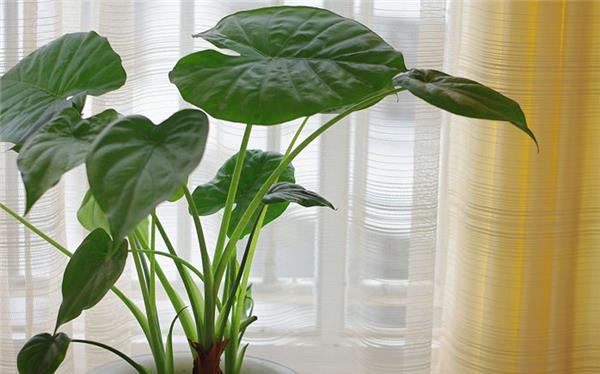
2. The elephant's ear especially likes moisture. During the growing season, it requires not only moist potting soil but also air humidity of no less than 60%. During high summer temperatures, spraying water should be increased to create a relatively cool and humid environment for it. If it is placed in an indoor air-conditioned hall, it is necessary both to keep the potting soil moist and to spray the leaves with water from time to time. If the indoor temperature in winter cannot reach 15°C, watering should be controlled, otherwise it is easy to cause root rot in the plant. Under normal circumstances, spraying warm water once a week is enough to keep its leaves dark green.
3. The elephant's ear relatively likes fertilizer. From March to October, a liquid fertilizer should be applied once every half month, and the proportion of nitrogen can be appropriately increased. If a little ferrous sulfate can be added, so much the better; this way the leaves will grow as large as lotus leaves, smooth and pleasing. Fertilization should stop when the temperature is below 15°C.
4. The elephant's ear likes a warm, humid and slightly shaded environment, but during the flowering period it needs sufficient sunlight, otherwise the spathe will carry a green color, affecting its quality. It must be ensured that there are 3-5 hours of light every day, otherwise the leaf stalks will elongate and affect the ornamental value. The elephant's ear is not very cold-resistant, and in mid-October it should be moved into a greenhouse. In summer, under shaded conditions, water should be sprayed frequently to cool it down and keep it moist.
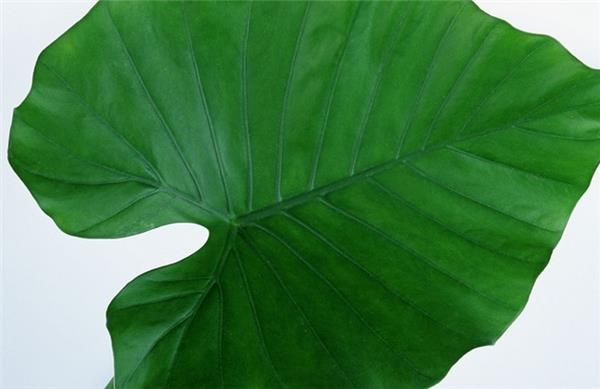
The above discussion has explored the blooming of the elephant's ear. Our understanding of the elephant's ear has deepened by another layer, we have more techniques for cultivating the elephant's ear, and our elephant's ear will grow pleasingly, and perhaps it will even be willing to bloom to delight us.