What are the cultivation methods and precautions for Calathea orbifolia?
Calathea orbifolia is a fairly typical foliage-type potted ornamental plant, with a beautiful and elegant plant shape. It is a plant quite suitable for placing indoors to enhance interior quality and feng shui, so how should Calathea orbifolia be cultivated to grow healthily?
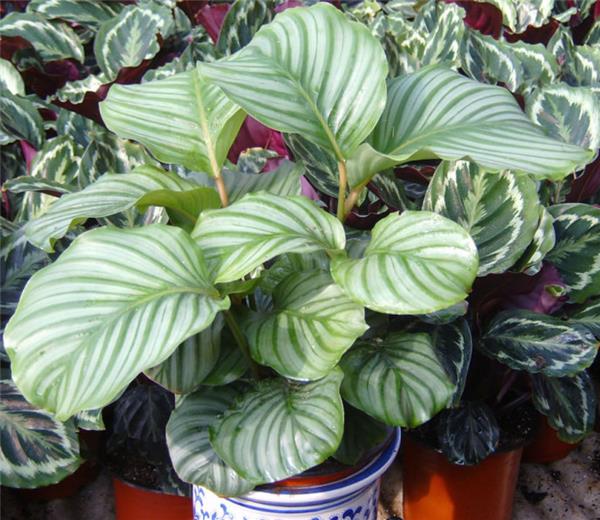
Cultivation methods for Calathea orbifolia
Propagation: Division can be carried out together with repotting. When dividing, take care to ensure each divided section carries a good number of leaves and sturdy roots. New plants should not be planted too deep; simply bury all the roots in the soil, otherwise the growth of new shoots will be affected. For new plants, soil moisture should be controlled, but the leaves can be misted frequently to increase air humidity. Only after new roots have grown can they be watered thoroughly.
Water: It likes moisture and dislikes drought. Dry air easily leads to scorched leaf edges and poor growth. During the growing season, in addition to watering once a day, leaf and environmental misting should be increased to keep relative air humidity at 85% to 90% or above. When cold winter arrives, besides paying attention to insulation, watering should also be strictly controlled. At this time, overly wet potting soil easily causes rhizome rot, whereas keeping the potting soil slightly dry means that even if the leaves appear withered, the plant will still send out new leaves again after spring returns and the weather warms. When new leaves begin to sprout, do not water too much either; as the new leaves increase, gradually increase the water amount, which is beneficial for robust plant growth.
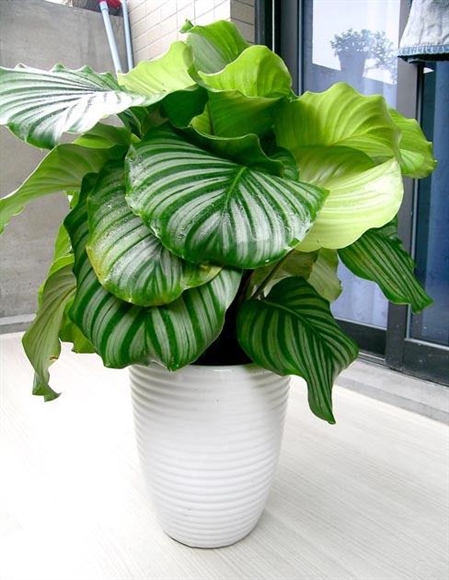
Fertilizer: Fertilizing Calathea orbifolia can follow the principle of light fertilizer applied frequently, with a dilute liquid fertilizer once a week, but fertilizing is not suitable when the temperature is too high or too low, to avoid causing root rot. When potted plants are displayed in homes or public places, a mixed solution of 0.2% urea plus 0.1% monopotassium phosphate can be applied by watering or spraying. After summer begins, when the temperature is above 32°C, fertilization should stop. In late autumn and early winter, if the greenhouse temperature is below 18°C, all forms of topdressing should also stop.
Light: Calathea orbifolia should be shaded from late spring and early autumn. Too strong light also causes the leaf color to turn pale. Calathea orbifolia leaves are delicate, and too strong light will scorch the leaves, but it also cannot be shaded for a long time. With insufficient light, Calathea orbifolia leaves will lose their luster, so an appropriate amount of light is very important. At the same time, attention should also be paid to ventilation.
Temperature: It likes a warm and mild environment, is not tolerant of intense heat, fears high temperatures, and has poor cold tolerance. Its suitable growth temperature is 18°C to 30°C. In late spring and early summer, when the ambient temperature exceeds 25°C, measures such as building shade frames and misting the environment should be used to create a cool, ventilated, humid, semi-shaded environment for it. In winter, the ambient temperature is required to be no lower than 10°C. When the greenhouse temperature is below 5°C, the aboveground parts will suffer severe freezing damage. Generally, before the ambient temperature drops to 10°C in late autumn, it should be promptly moved to a sunny spot inside the greenhouse.
Pests and diseases: Common diseases of Calathea orbifolia include leaf spot and rust, which can be sprayed with 0.5:0.5:100 Bordeaux mixture or 800 times dilution of 50% carbendazim wettable powder, once every 10 days, sprayed 2 to 3 times continuously, achieving good control results. Under high temperature and dry conditions, leaves will develop large numbers of small yellow spots due to damage by red spider mites, severely reducing their ornamental value; they can be killed by spraying 2000 times dilution of 25% fenbutatin oxide wettable powder. Sometimes scale insect damage also occurs.
Precautions for cultivating Calathea orbifolia
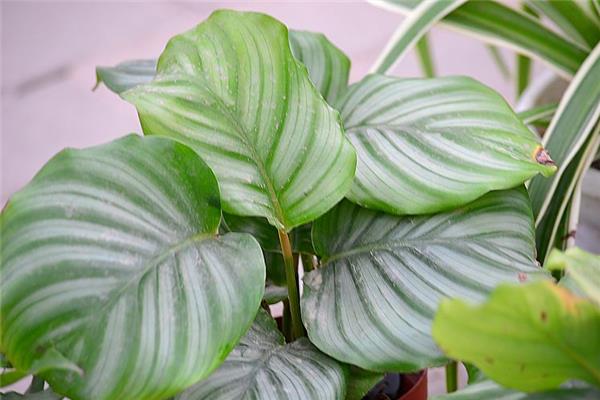
In winter, Calathea orbifolia should be kept with slightly dry potting soil to help it through the winter. Usually, watering should also not be excessive, otherwise root rot or root diseases may occur. If the plant is shaded too much, the silver-gray stripes along the leaf edges of Calathea orbifolia will darken, affecting the ornamental effect. When fertilizing, attention should be paid to the ratio of nitrogen, phosphorus and potassium; nitrogen fertilizer must not be applied alone, otherwise the leaf color will be affected.
Ventilation for Calathea orbifolia needs to be carried out when the outside temperature is above 16°C, and air can be blown directly onto the plant, but during strong winds the amount of ventilation should be reduced or ventilation stopped to prevent leaf damage.
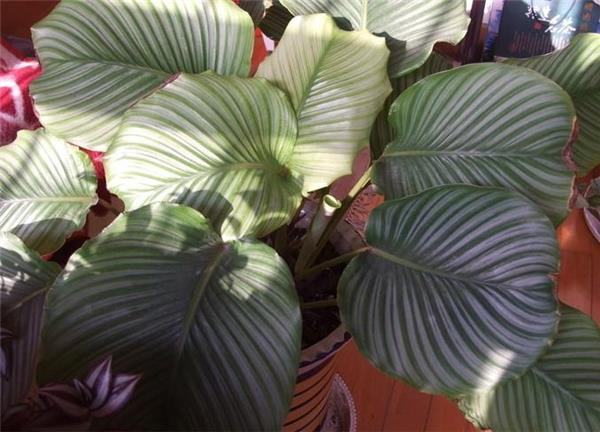
Besides being able to match interiors of various styles, Calathea orbifolia can also use its emerald-green leaves to help people care for their eyesight. In addition, it can also provide a certain ability to resist radiation, making it a plant suitable for placing beside televisions and computers.