In 2019, wet paddy prices in Kaohsiung and Pingtung fell sharply, to less than 9 yuan per Taiwanese catty
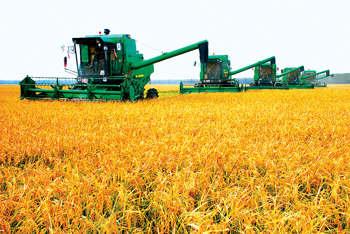
Recently, rice harvesting has begun in parts of Kaohsiung and Pingtung, but it has been reported that because of last year's bumper rice harvest, the harvest volume hit a record high and has still not been absorbed, so the price offered by grain dealers for wet paddy is less than 9 yuan per Taiwanese catty. Many farmers have already reported to local elected representatives that growing rice simply does not cover costs and that the price of rice is poor. Huang Chao-hsing, head of the Grain Storage and Transport Section of the Council of Agriculture, suggested that farmers need not rush to sell right now.
According to statistics from the Council of Agriculture, in recent years the combined rice planting area for the first and second crops has been about 270,000 hectares. Taking last year as an example, the declared rice planting area for the first and second crops combined was about more than 110,000 hectares. If farmers want to deliver public grain, they need to declare to the farmers' association or the local township or district office. If farmers do not declare, they cannot deliver public grain or participate in direct rice payments.
Tsai Ching-feng, director-general of the Daliao District Farmers' Association in Kaohsiung City, said that on the 29th the wet paddy price in Daliao District was 8.5 yuan per Taiwanese catty, much lower than last year's price. This year grain dealers had originally planned to purchase rice on May 10, but unexpectedly encountered a warm winter, and the rice grew rapidly. Some fields even began harvesting on April 23. Some grain warehouses could not be emptied in time, and grain dealers could not absorb the supply. In addition, both the first and second crops last year had bumper harvests, all of which were reasons for the lower price.
Tsai Ching-feng said that in recent years the costs of labor, fertilizer, and pesticides have all continued to rise, and the grain price has remained poor. Many rice farmers have reported that they have lost their capital, and many people have already reported related problems to local elected representatives. He has also contacted major grain dealers in southern Taiwan, hoping that the market can open early and purchase paddy from farmers in order to stabilize grain prices.
Yao Chih-wang, director of the Southern Region Branch of the Agriculture and Food Agency, said that some areas have already begun harvesting rice one after another, and the wet paddy purchase price on the 29th was 8.5 yuan per Taiwanese catty. Reasons for the lower price include last year's bumper harvest, with some grain dealers still having unsold stored grain, which made buying sentiment relatively weak, as well as factors such as this year's warm winter. He also called on farmers not to engage in "green cutting" (harvesting unripe rice early), which affects overall rice quality, so that grain prices can be stabilized.
The Council of Agriculture recently introduced a policy to greatly increase the volume of public grain purchases. Chuang Lao-ta, deputy director of the Agriculture and Food Agency, said that as long as farmers plant on legal land, declare rice cultivation, and grow announced varieties, they need not worry that the price offered by outsiders is too low. If purchased as surplus grain at 21.6 yuan per kilogram, converted to wet paddy with a moisture content between 28% and 30%, that is about 950 to 960 yuan per 100 Taiwanese catties.