How to Plant Euonymus kiautschovicus? Detailed Guide to Planting and Management Techniques
Euonymus kiautschovicus, like Euonymus japonicus, is an evergreen shrub, so it has relatively broad and high landscape application value and ornamental value, and is a tree species generally loved by landscape artists.
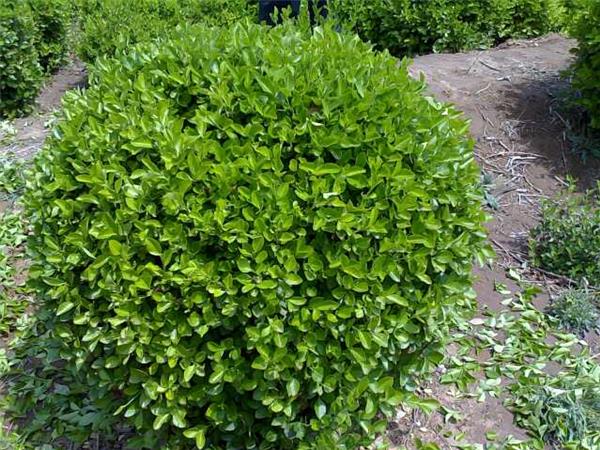
Planting and Management of Euonymus kiautschovicus
Cutting substrate: this refers to the nutrient soil, river sand, peat soil and other materials used for cuttings. For home cuttings, it is difficult to obtain an ideal cutting substrate due to limited conditions, so it is recommended to use the pre-mixed and sterilized cutting substrate provided by this site; medium-coarse river sand can also be used, but it must be rinsed several times with clean water before use. Do not use sea sand or river sand from saline-alkali areas, as they are not suitable for the growth of flowers and plants.
Potting and transplanting: when potting young seedlings or repotting large plants that have been grown for several years, first place a 2-3 cm thick layer of coarse-grained substrate at the bottom of the pot as a drainage layer, sprinkle a layer of fully decomposed organic fertilizer on top as base fertilizer, about 1-2 cm thick, then cover with a thin layer of substrate, about 1-2 cm thick, and then place the plant in, so as to separate the fertilizer from the roots and avoid burning the roots. After potting, water thoroughly once, and keep it in a shaded environment for one week. When transplanting young seedlings, first dig the planting hole, sprinkle a layer of organic fertilizer at the bottom of the planting hole as bottom fertilizer (base fertilizer), about 4-6 cm thick, then cover with a layer of soil and place the seedling in, so as to separate the fertilizer from the roots and avoid burning the roots. After placing the seedling in, backfill the soil to cover the roots, firm the soil with your feet, and water thoroughly once.
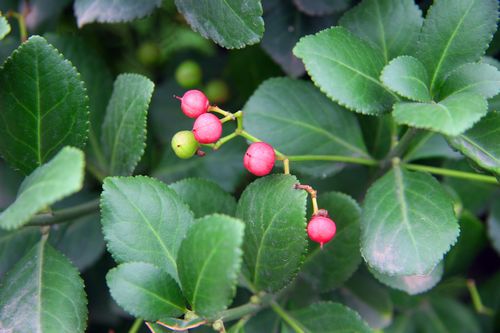
Control of Powdery Mildew on Euonymus kiautschovicus
Damage characteristics: the pathogen of powdery mildew is an obligate parasite. The mycelium grows on the surface of the host, on which conidiophores and conidia are produced.
Symptoms: affected leaves first develop pale green spots, and soon white powder grows; the powdery spots are round, later merging into patches, and the leaves generally do not die. When young seedlings are affected, the leaves turn pale green and thin, and may even become distorted, and the seedlings grow poorly.
Disease occurrence pattern: the powdery mildew pathogen of Euonymus kiautschovicus overwinters as conidia and carries out primary infection; conidia are spread by wind for repeated infection. Seedlings, sprouting shoots and young leaves of the current year are susceptible; dense planting with leaves pressing against each other favors pathogen infection; seedlings under drought conditions or with excessive nitrogen fertilizer and water are prone to the disease.
Control techniques:
1. In severely affected areas, diseased and residual plant material should be removed promptly and continuously to eliminate the source of the pathogen, prevent plants from being planted too densely, and prune hedges in time;
2. During the growing season and at the early stage of the disease, spray 0.2-0.3 degree lime sulfur mixture. Spray once every half month;
3. During the disease period, 25% triadimefon wettable powder at 1000-1500 times dilution, thiophanate-methyl wettable powder at 1000-1500 times dilution, or 50% carbendazim wettable powder at 1000 times dilution can be used, applied once every 7-10 days, for 2-3 consecutive applications.
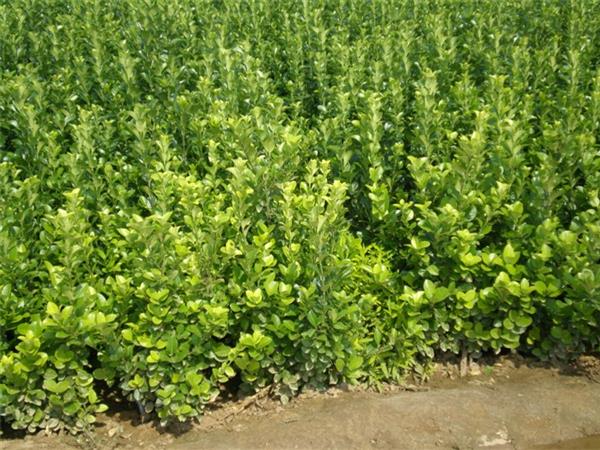
Differences Between Euonymus japonicus and Euonymus kiautschovicus
1. Plant form: Euonymus japonicus has a compact plant form, branches with relatively strong upright growth, and lateral branches with relatively high natural branching points; Euonymus kiautschovicus has a loose plant form, lateral branches with relatively low natural branching points, and the branches at the base are prostrate and can take root.
2. Leaves: although the leaves of both are leathery, the fine serrations on the leaf margins of Euonymus japonicus are more obvious, and the leaves feel clearly prickly to the touch; the serrations on the leaf margins of Euonymus kiautschovicus are not very obvious, and the prickly feeling to the touch is not obvious.
3. Fruit: the fruit of Euonymus japonicus is nearly spherical and light pink; the fruit of Euonymus kiautschovicus is oblate and pink.
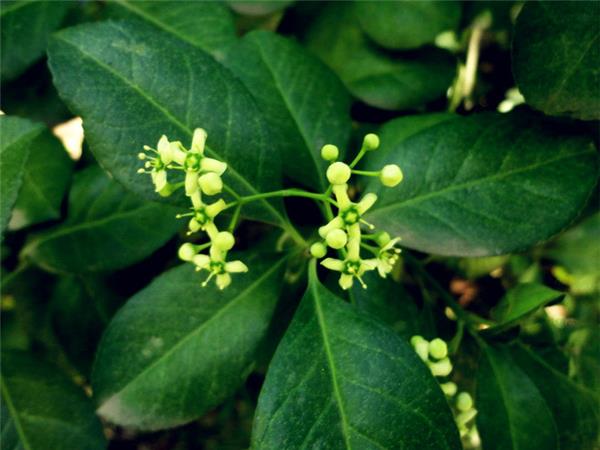
Although the two differ slightly, the ornamental value and ornamental effect of Euonymus kiautschovicus and Euonymus japonicus are indeed almost the same, which is why the two are used interchangeably in landscape design; and friends who want to grow foliage plants at home can also choose whichever they like from the two to grow.