Detailed Guide to Growing and Caring for Hen and Chicks (Sempervivum)
Hen and Chicks is a type of succulent. With how popular succulents are today, it is easy to see that there are also many varieties of Hen and Chicks. When you are choosing one, you can look around more, but what exactly is the method for growing Hen and Chicks? Shouldn't we also learn about it?
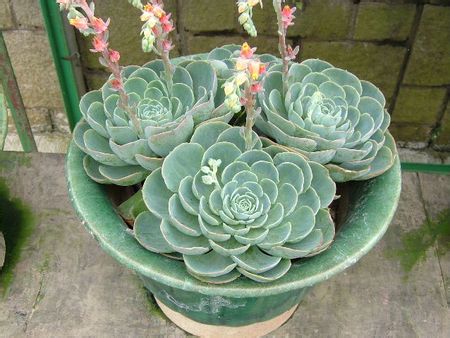
How to Grow Hen and Chicks
1. Hen and Chicks can also be propagated using tissue-cultured seedlings. After purchasing the seedlings, before planting, disinfect the seedlings with 1500x to 2000x chlorothalonil. After preparing the solution, soak the whole seedling to disinfect it.
2. Light requirements for Hen and Chicks: light should be neither too strong nor too weak.
3. When potting Hen and Chicks, apply sufficient base fertilizer, and appropriately leave a few side buds beside the large bulb to increase the density of the flowers and leaves and their ornamental value.
4. Appropriately control watering, increase ventilation, and maintain plant spacing so that the plant form of Hen and Chicks stays attractive. Do not water too much; also pay attention to watering time. Especially during high-temperature summer periods, leaf water evaporation is high and water demand is greater. If water is lacking, the leaves very easily wilt, so the leaf surface must be sprayed with water frequently, while keeping the environment moist, but water accumulation in the pot must be avoided, otherwise it will cause root rot. In autumn, at this time, watering must be reduced as much as possible, and the plant should be placed in a warm, windless, dry place, keeping the potting soil appropriately dry (only slightly moist) to help it overwinter safely; if humidity is high and temperature is low, the tuber very easily rots.
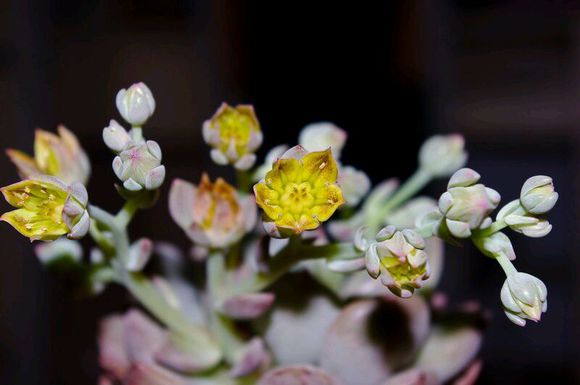
5. During the growth period, Hen and Chicks likes sufficient water. Frequently sprinkle water on the leaf surface and the ground, and pay attention to keeping the leaf surface clean. Apply liquid fertilizer once every half month. After fertilizing, immediately rinse with clean water to prevent accidents. Before frost, move it into a greenhouse, keeping the room temperature above 10°C. During maintenance of Hen and Chicks, to avoid too many leaves affecting light exposure, the outer leaves can be removed, which also helps the flower stalk extend.
Throughout the entire growth period, Hen and Chicks requires growth under semi-shaded conditions. If the light is too strong, the methods and precautions for growing Hen and Chicks, it easily makes the leaf color dull and can even cause sunscald; but if the light is too weak, it also easily causes leggy growth, and the plant grows slender and easily lodges. During the vigorous growth period, according to the plant's growth condition, apply 1-2 times a month of dilute liquid fertilizer, and additionally apply phosphorus and potassium fertilizer, so as to help the plant stems stand upright and grow robustly, and at the same time help the underground tuber grow plump and resist cold for overwintering in winter.
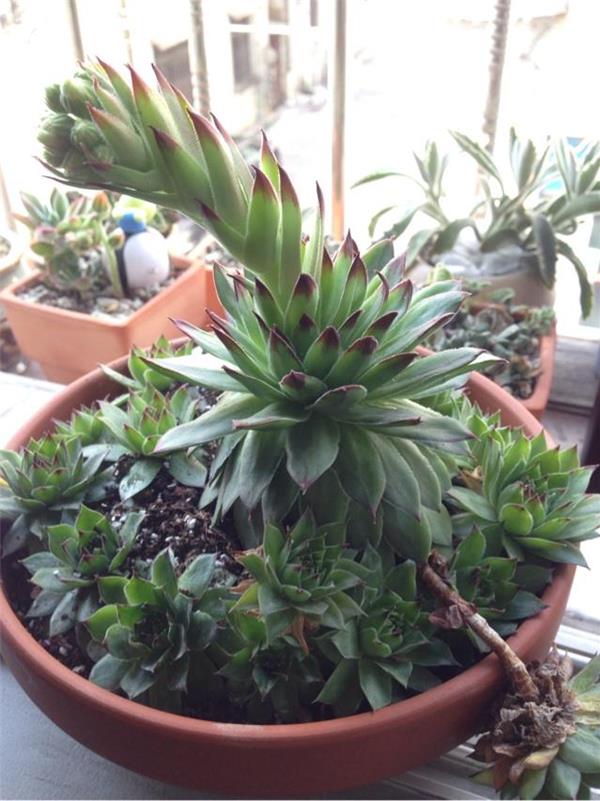
Types of Hen and Chicks
In the Crassulaceae family, the genera Aeonium, Graptopetalum, Dudleya, Orostachys, and Echeveria also contain quite a few varieties whose fleshy leaves are arranged in a rosette shape. Their form is very similar to plants of the genus Sempervivum, but the flower shapes differ greatly.
1. Mingjing, also called 'Disk-leaved Aeonium', a plant of the genus Aeonium in the Crassulaceae family. Its fleshy leaves are densely arranged and grow in a horizontal direction. The leaves are spoon-shaped and grass-green, with cilia on the leaf margins. The entire leaf disk is level like a mirror, without a trace of gap, like a geometric pattern, very peculiar.
2. Zichi Nianhua, also called 'Zichi Lotus', a plant of the genus Orostachys in the Crassulaceae family. Its fleshy leaves are gray-blue or gray-green, round or long spoon-shaped, with a smooth surface, entire margins, and covered with white powder. The stem is slender, with a rosette-shaped leaf cluster growing at the top.
3. Beautiful Lotus, also known as 'Biluce', a plant of the genus Graptopetalum in the Crassulaceae family. Its compact rosette-shaped leaf disk is gray-green-brown, covered with white powder, and its flowers are magenta.
4. Red Rolled Silk, also known as 'Large Red Rolled Silk', a plant of the genus Sempervivum in the Crassulaceae family. Its oval fleshy leaves are densely arranged and grow in a radial pattern, with the tips slightly curved outward, and the leaf tips densely covered with short white hairs, especially dense at the center of the plant, like a spider web. The leaves are green, and under cool and sunny conditions they turn purplish-red.
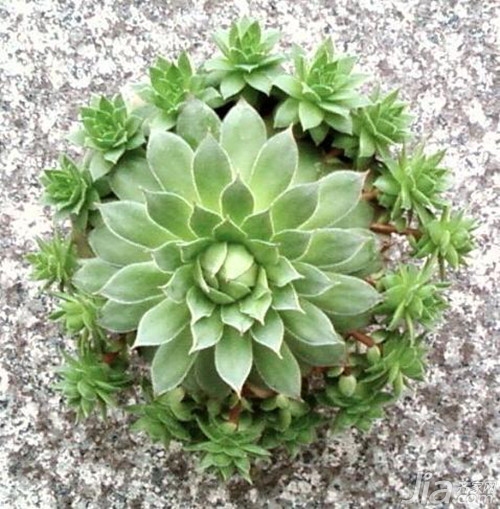
5. Stone Lotus, also known as Gem Flower, Stone Lotus Palm, and Lotus Palm, belongs to the Crassulaceae family, genus Echeveria. Its leaf cluster is compact and upright in a rosette shape. The leaves are wedge-shaped and obovate, with short, sharply pointed tips, hairless, and powdery blue. The flower stem is soft, with bracts, and covered with white frost. 8--24 flowers form a cyme, and the corolla is red, with lanceolate petals that do not spread open. The flowering period is July-October.
That is all for now on the methods for growing Hen and Chicks. I hope the above content can help you better understand this topic. Stay tuned for more wonderful content.