Is Mimosa pudica actually toxic? A full investigation of the truth
I have always been quite interested in the reason why Mimosa pudica closes up when touched, but I had really never paid attention to whether it is toxic. Since whether Mimosa pudica is toxic is closely tied to our health, let us take a look together.

I. Is Mimosa pudica toxic?
The reason Mimosa pudica "blushes": after the plant is stimulated, its leaflets close and its leaf stalks droop. A research team led by Professor Tsuchiya Takahide of Sophia University in Japan uncovered the mystery of the closing movement of Mimosa pudica: the cells of Mimosa pudica are supported by a fine, mesh-like protein called "actin." When the closing movement occurs, the phosphate on actin falls off; if Mimosa pudica is made to absorb a compound that prevents phosphate from falling off, it will not change even when touched. Professor Tsuchiya pointed out that when the actin bundles disperse, the cells are destroyed, and as a result water escapes, causing the closing movement. Actin is generally found in the muscle fibers of animals and is related to muscle contraction and relaxation. It was unexpected to find that it also exists in Mimosa pudica, which can be called quite rare.
The mimosine in Mimosa pudica is a toxic substance, and excessive contact with the human body can cause hair loss.
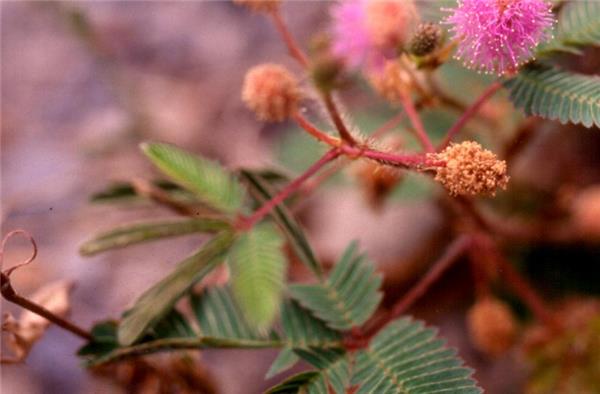
II. How to grow Mimosa pudica
During the growth period of Mimosa pudica, along with watering, apply diluted rotted liquid fertilizer (3-4) times about every 10 days. As a potted ornamental flower, it is easy to move indoors to a sunny spot, and it can overwinter safely if the room temperature is kept at 0-12 degrees.
Water: it likes moisture; during the summer growing period, water once a day.
Fertilizer: during the seedling stage, apply a topdressing once every half month. If you do not want the Mimosa pudica plant to grow too large, then reduce the amount of fertilizer.
Soil: it requires deep, fertile, moist soil.
Temperature: it is not cold-tolerant, likes a warm climate, and the plant dies on its own in winter.
Light: it likes ample light and tolerates partial shade slightly.
Propagation: propagated by sowing. Sow from late March to early April; seedlings grow relatively slowly, and they can be planted out when the seedlings are 7-8 cm tall.
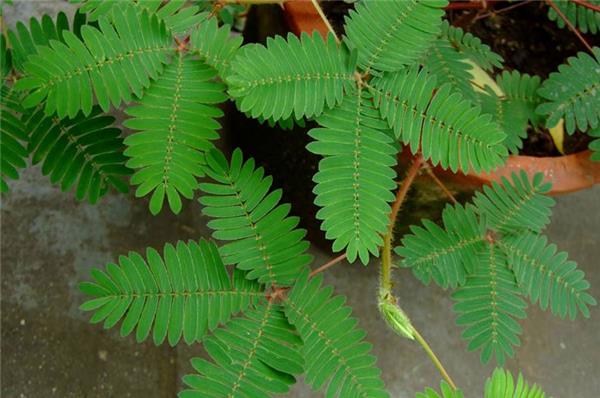
III. The uses of Mimosa pudica
1. Mimosa pudica can clear heat and promote urination, resolve phlegm and relieve cough, calm the nerves and relieve pain, detoxify, dissipate blood stasis, stop bleeding, and astringe. It is used for colds, high fever in children, acute conjunctivitis, bronchitis, gastritis, enteritis, urinary stones, malaria, and neurasthenia; for external use it treats bruises and swelling, sores and swellings, hemoptysis, and shingles.
2. Ornamental use
The Mimosa pudica plant has a loose form, and its feathery leaves are slender and elegant; its leaves close as soon as they are touched. Mimosa pudica produces many delicate, lovely flowers, giving people an impression of frail elegance. It can be planted in the ground at the corner of a courtyard, or grown in pots on a windowsill or desk.
3. Predicting earthquakes
According to Turkish seismologist Ercan, several hours before a strong earthquake occurs, the leaves of Mimosa pudica, which are sensitive to external touch, suddenly shrivel and then wither. In earthquake-prone Japan, scientists have found through research that under normal conditions, the leaves of Mimosa pudica open during the day and close at night. If the leaves of Mimosa pudica show the abnormal phenomenon of closing during the day and opening at night, it is a precursor to an earthquake. For example: at 7 a.m. on January 11, 1938, Mimosa pudica began to open, but by 10 a.m. the leaves suddenly all closed, and sure enough, a strong earthquake occurred on the 13th. In 1976, members of the Japan Earthquake Club observed the abnormal closing phenomenon of Mimosa pudica leaves many times, and earthquakes occurred afterward each time.
4. In addition, Mimosa pudica can also predict disastrous weather changes, and it will produce growth activities contrary to normal in response to sudden unseasonal temperature differences, geomagnetic changes, geoelectric changes, and so on. We can place some potted Mimosa pudica plants indoors to observe and help predict and guard against natural disasters.
Above, we have investigated whether Mimosa pudica is toxic, and at the same time learned how to grow Mimosa pudica and what its uses are, deepening our understanding of Mimosa pudica and enriching our knowledge of flowers and plants.