A Detailed Guide to the Pruning Principles and Care Methods of Bougainvillea Balls
Many shrubs can be pruned into shrub balls, and shrub balls that already have quite good ornamental value often have their ornamental value enhanced after being pruned and shaped, and bougainvillea balls are certainly no exception.
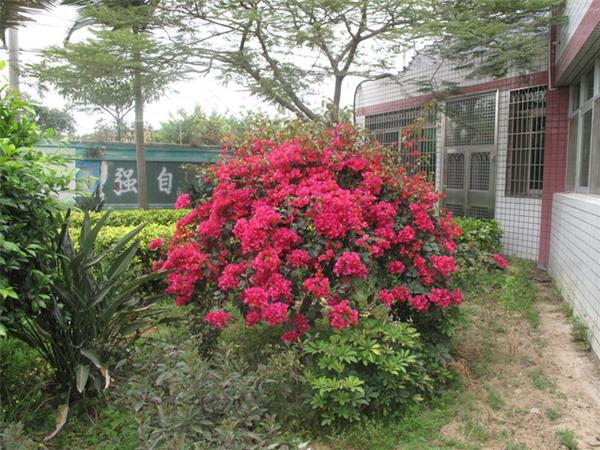
Pruning Methods for Bougainvillea
1. The first time, before sprouting in March to April, remove branches unsuitable for the shaping needs as well as water sprouts, inner-canopy branches, overlapping branches, shaded branches, weak drooping branches and interfering branches, etc. Cut the entire branch off from the base, flush with the trunk, leaving no stub. The order of thinning should be large branches first, then small branches, and inner branches first, then outer ones, that is, prune the inner-canopy branches first and then the surrounding branches. If branches in the same direction are too dense and need thinning, follow the principle of keeping the outer ones and not the inner ones. Keep the relatively thick branches, shorten them, leave space for new branches to grow, and also leave space for flowers to extend. The thicker the branch left after pruning, the more vigorous the sprouting.
2. Prune to the 3rd to 4th level branches and carry out routine management until the newly sprouted shoots reach semi-lignification, then prune again, leaving 3 to 4 buds on each shoot; when the buds reach 1 to 2 cm in length, spray 15% paclobutrazol wettable powder at a concentration of 0.1 to 0.5%, until the front and back of the leaves are covered with water droplets.
3. For a trunk or main branch growing vertically, when the extension branch needs to be pruned due to natural dieback and other reasons, the direction of the selected pruning bud should be opposite to the bud direction kept the previous year, to ensure that branch growth does not deviate from the main axis. The pruning bud is generally about 0.5 cm from the cut. If the stub left is too long, the branch section above the bud is prone to drying out and forming a stub, which is easily subject to rot after sun and rain.
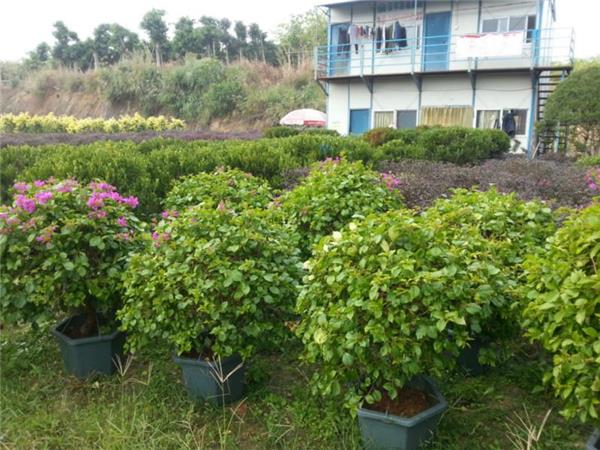
Key Care Points for Bougainvillea Balls
1. The suitable growth temperature for bougainvillea is 15-30°C, of which May to September is 19-30°C, and October to April of the following year is 13-16°C. In summer it can tolerate high temperatures of 35°C. The temperature was photographed at Huangguoshu Park. When the bougainvillea exceeds 35°C, appropriate shading or measures such as spraying water and ventilation should be taken. In winter, an ambient temperature of no less than 5°C should be maintained, otherwise, when the temperature is below 5°C for a long time, it is prone to cold damage and leaf drop.
2. Because of long-term watering, fertilizing and rain washing, the potting soil of bougainvillea tends to become compacted. Therefore, the soil must be loosened regularly, and weeds in the potting soil should be removed at the same time, so as to benefit the growth of bougainvillea. Otherwise, compacted potting soil and water accumulation can easily cause root rot or poor growth in bougainvillea. In addition, bougainvillea grows quickly, has a well-developed root system and very many fibrous roots, so it needs to be repotted once a year.
3. Bougainvillea is a sun-loving plant. In order to make the branches and leaves grow normally and increase the number of blooms, bougainvillea must be placed in a position with ample light and good ventilation, giving it 8 to 12 hours of light every day. If the placement position is often shaded, the plant will grow leggy and the number of flowers will decrease. If the placement position is not ventilated or the pots are placed too densely together, the leaves will drop; especially in hot summer, with sudden heat and rain, large areas of leaves can easily drop, thereby affecting the growth and flowering of the plant.
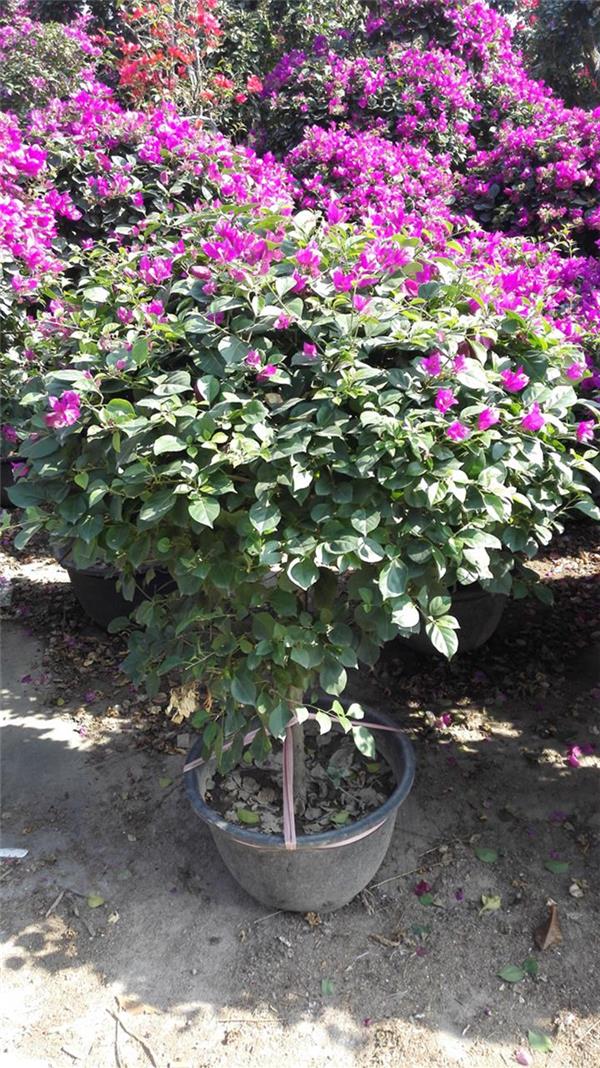
Feng Shui Applications of Bougainvillea Balls
1. Bougainvillea is suitable for people whose Five Elements belong to Fire to grow in the living room. Every plant has its own yin-yang and Five Elements attributes. If these are mutually generating and compatible with the orientation of the house and the owner's BaZi, they will naturally have a beneficial energizing effect on the person; if they are mutually overcoming, punishing or harming, the effect is completely opposite. A house gate facing south (Five Elements belonging to Fire) should have Fire-element bougainvillea planted in the living room, which is beneficial for regulating the health of a person's heart and stomach, and also has the effect of warding off evil and protecting the body for people who are introverted, timid, melancholy, and lacking courage and confidence in life.
2. People born in Wu and Gui years are suitable for growing bougainvillea in the bedroom. Choose bedroom plants according to the Chinese zodiac and birth year. Wu and Gui years (Five Elements belonging to Fire), such as people born in 1958, 1963, 1968, 1973, 1978, 1983, etc., whose last digit is 8 or 3, are best suited to growing plants with red flowers or plants that bear fruit in the bedroom.
3. Because the light time in the bedroom is relatively short, one should choose more shade-loving flowering plants, such as camellias, bougainvillea, etc., which are easier to keep alive. If a plant grows healthily in the bedroom, it proves that this plant is beneficial to the owner; if the plant grows very poorly, it proves that it is not suitable, so people whose Five Elements belong to Fire should carefully take care of the bougainvillea in your bedroom.
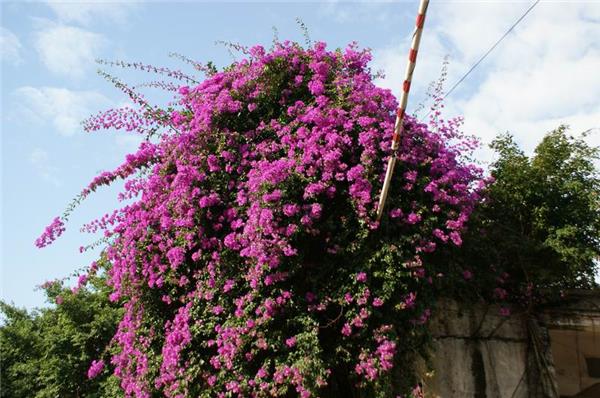
Bougainvillea balls have a beautiful and elegant plant shape and bright, eye-catching flower colors. Whether planted in gardens, beside urban roads, or used in courtyard decoration, they are a very good choice and can effectively enhance the beauty of the surrounding environment.