Gold privet (Ligustrum sinense 'Variegatum') cutting propagation techniques and post-cutting management key points
Golden privet gets its name because its leaves turn golden yellow or yellow-green. Its propagation generally uses the cutting method, as both the cost and survival rate are relatively good, making it a highly cost-effective propagation method.
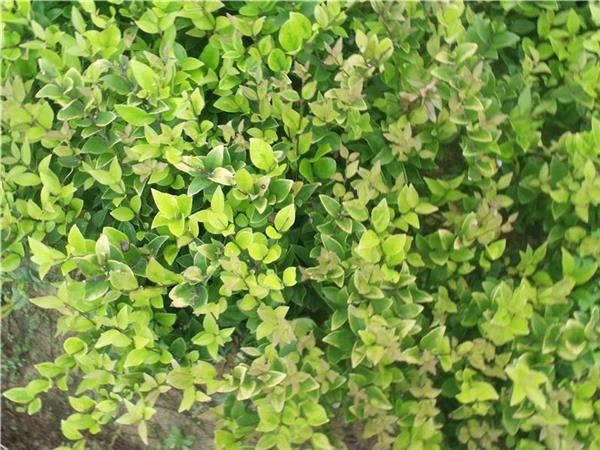
Cutting propagation techniques for golden privet
Cutting time: It is best done when new shoots are growing slowly, that is, from May to October, and ideally during the rainy season.
Site selection and soil preparation: Choose a plot that is loose and fertile, flat in terrain, and well-drained. Apply 125 kg of superphosphate per mu, deep plow 15 cm, then break up the soil and rake it level, making raised beds 1.2 m wide with furrows 20 cm deep.
Cutting slips preparation: First, select good mother trees. Cuttings should be collected from young mother branches, and it is best to use semi-lignified branches of the current year. The best times for collecting cuttings are once each from May to June and from September to October.
Cutting insertion: A single bud should generally be inserted to one-half the length of the branch; do not insert too deeply. The density should be such that the cuttings do not press against each other, and the base of the cuttings can be seen when viewed from above.
Bamboo arches and film covering: When inserting bamboo arches, place an "x"-shaped bamboo arch at both ends of the seedbed to support the film, with a height of 0.7 m to 1.0 m, and a spacing of 0.8 m between arches is ideal. Generally, a 3 m wide disposable anti-drip film is used, and finally the film edges are completely sealed with soil or river sand.
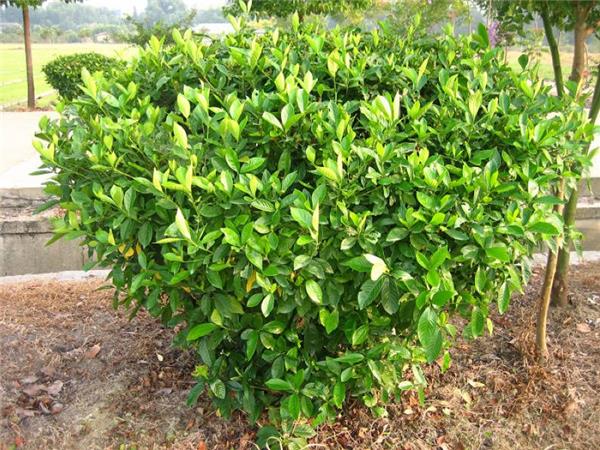
Management after cutting propagation of golden privet
Humidity: 20 days after cutting, the air humidity inside the small arch shed must be kept above 95%. If the humidity inside the small arch shed is low, promptly uncover the film and water, combining watering with 200 times diluted water-soluble fertilizer (20-10-20 and 14-0-14) applied alternately, and spray the leaves with 500 times diluted carbendazim + anthrax fumei, then seal. Cuttings made from May to June should be watered once a week, while cuttings made in September should be watered once every 10 to 15 days. Generally, check the cutting medium once every 2 to 3 days. Under normal circumstances, watering, fertilizing, and pest and disease prevention should be completed at the same time.
Temperature: The temperature inside the shed for cutting propagation should be controlled below 36°C and above 15°C. The optimum temperature is 25°C. If the temperature is too high, shade or water the small bamboo arch film to cool it down. If the temperature is too low, add extra film cover or use other heating measures (such as adding electric heating wires in the ground).
Light control and hardening off: Light promotes rooting of cuttings and strengthens seedlings. Generally, golden privet begins to root in about 15 days, and by about 40 days most can basically begin hardening off. For cuttings made from May to June, generally cover the shade net around 10:00 a.m., and after 3:00 p.m. gather up the shade net for hardening off. After about 20 days of hardening off, they can be potted up. The rooting rate can reach above 90%.
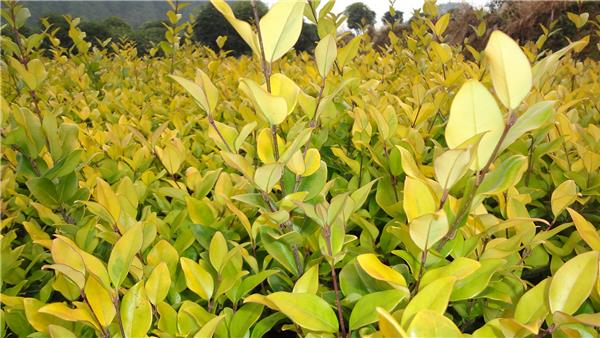
Pest and disease control for golden privet
Rust disease: The most serious primary disease is rust, because there are many sources of infection and it easily breaks out over large areas, so sufficient attention must be paid to it. Reasonable placement density is a useful measure to avoid disease; generally, the placement density per mu should not exceed 40,000 pots, as excessively high density often leads to disease outbreaks. Rust is most severe from June to September, so special attention should be paid, with key control starting from May to June. Agents such as triadimefon, Score (difenoconazole), chlorothalonil, and DuPont Fuxing can be used in rotation, applied once every 10-15 days, for 3-5 applications. During control, 0.2% water-soluble fertilizer or trace element fertilizer can be added to topdress and supplement trace elements, strengthening the disease resistance of the plants.
Insect pests: Root-feeding pests such as white grubs and ground beetles are the most serious, with occurrence periods around July to September. Control methods include immediately clearing weeds around and inside the pots. For severely affected areas, drench the roots with 800 times diluted phoxim. When drenching roots, take care to avoid high-temperature periods and maintain humidity inside the pots to prevent phytotoxicity.
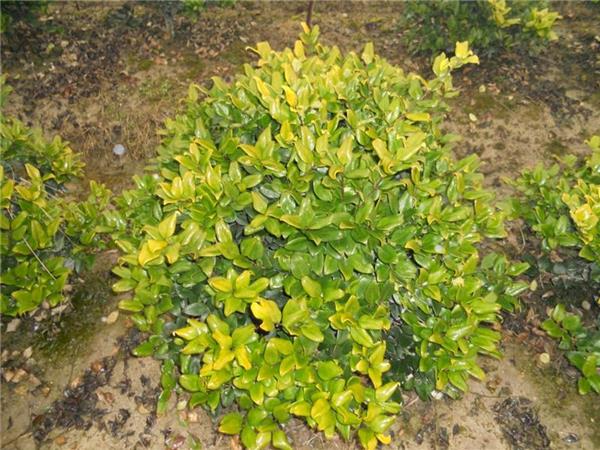
Any pest or disease is a huge harm to plants. It not only causes them to lose their original ornamental value, but may even cause premature leaf drop and death. Therefore, during maintenance we must prevent and control pests and diseases, following the principle of prevention first and combining prevention with control.