The Canary Island date palm is a plant full of tropical flair
The trunk of the Canary Island date palm is very thick and sturdy, giving people a very solid feeling. It is a plant that brings a sense of reassurance and reliability, so it is also a tree species with relatively high cultivation value.
Introduction to the Canary Island date palm
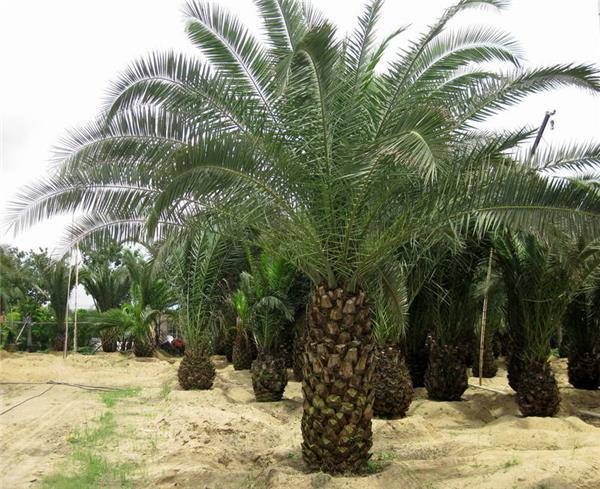
Morphological characteristics: The Canary Island date palm is an evergreen tree that can reach 10-15 m in height and 20-30 cm in thickness. The trunk is solitary and covered with the irregular bases of old leaf stalks. The leaves are large, up to 4-6 m long, arching and curved, and clustered at the top of the stem. They are pinnate compound leaves. On mature trees, the leaflets number 150-200 pairs; they are narrow and stiff, with pointed tips. The upper leaflets are unequally spaced and opposite, the middle leaflets are evenly spaced and opposite, the lower leaflets are clustered in groups of 2-3, and the basal leaflets are needle-like. The leaf stalk is short, with a thick, yellowish-brown base. The leaf sheaths at the base of the leaf stalks remain on the trunk, forming sparse fibrous brown strips. It flowers from May to July, with spadix inflorescences emerging from between the leaves and much branched. The fruiting period is from August to September; the fruit is ovoid-globose, slightly protruding at the tip, orange-yellow and glossy when ripe. The seed is elliptical, with a deep groove in the center, and grayish-brown.
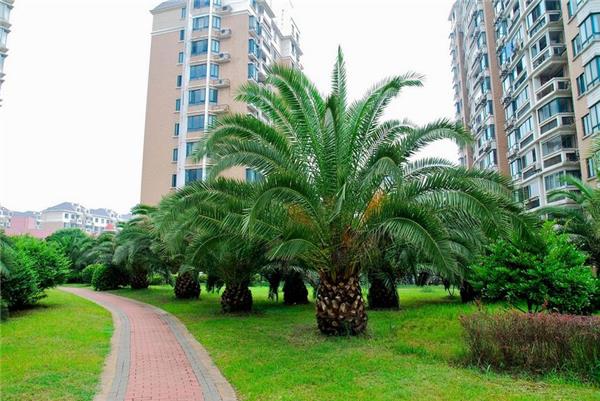
Landscape application: The Canary Island date palm is rich in tropical charm. Its tree form is graceful and spreading, and the trunk diameter at breast height often reaches more than 50 cm, with tightly arranged rhombus-shaped leaf scars that make it relatively smooth; the leaves are green and vigorous, and the pinnae are tough; the tree crown opens in a semicircle, looking from a distance like an opened umbrella and full of tropical style. It can be potted for indoor display or planted outdoors in the ground. Whether planted in rows or in clumps, it has a very good ornamental effect.
Transplanting Canary Island date palm seedlings
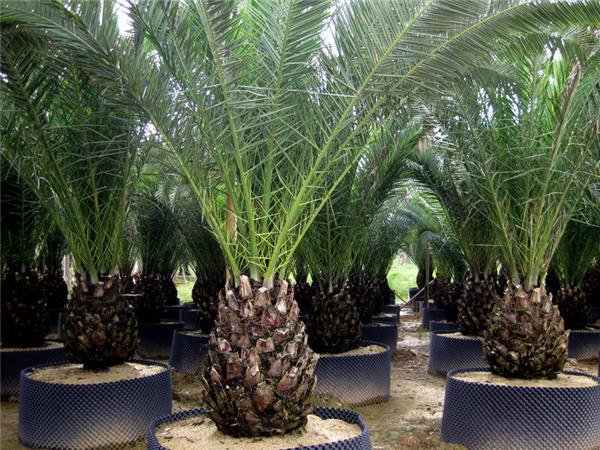
1. Carefully prune most of the leaves; be willing to prune heavily. If you do not prune, most of the leaves will also dry out because the water supply cannot keep up.
2. Carefully tear off the nutrient bag, or you can leave it on; try not to remove the soil on the palm's fibrous roots (the soil on the upper part of the palm head can be removed). Without soil, the recovery period will be longer.
3. Place the seedling with its soil into the planting hole or flowerpot, cover with fine soil, about 2 cm above the palm head. Do not tread on it with your feet or press hard with your hands; the palm's roots are very brittle and cannot take damage, my friend.
4. Water thoroughly once immediately. During the recovery period (before new leaves grow), provide shade and keep moist as much as possible, but the soil must not become waterlogged. Set up drainage well, otherwise the roots will rot. For large-scale planting, use shade netting if conditions allow, and also spray the leaf surfaces frequently to reduce leaf moisture evaporation. Do not rush to fertilize; fertilizing now will very likely burn and rot the roots.
5. After the seedlings grow new leaves, apply light fertilizer frequently along with watering. Once a month is enough. Once they are growing normally, the shade netting can also be removed.
Methods for controlling insect pests of the Canary Island date palm
1. Hanging packet method: The Canary Island date palm is tall, which makes spraying pesticides less effective for disease prevention. In controlling the coconut leaf beetle, hanging coconut beetle control packets achieved great results. Hanging pesticide packets mainly allows the rain to flow down and continuously release the pesticide's efficacy, unlike spraying, which is washed away by rain and loses its effect. For example, in controlling highly destructive diseases such as heart rot, using effective agents that are light-stable and heat-stable to make hanging packets can also solve the problem of poor control by spraying.
2. Dissection method: For plants already severely rotted by bud rot and difficult to control well with the original agents, the saw-head method can be used. Remove the rotten part, let it dry, then disinfect it with 50% carbendazim at 600 times dilution. After that, cover it with white film, which can both prevent pathogen infection and allow photosynthesis, helping it recover early. If the growing point has also rotted, treatment can be abandoned and the plant dug out to prevent the spread of disease. This method must be used on plants that are confirmed unable to be cured with agents.
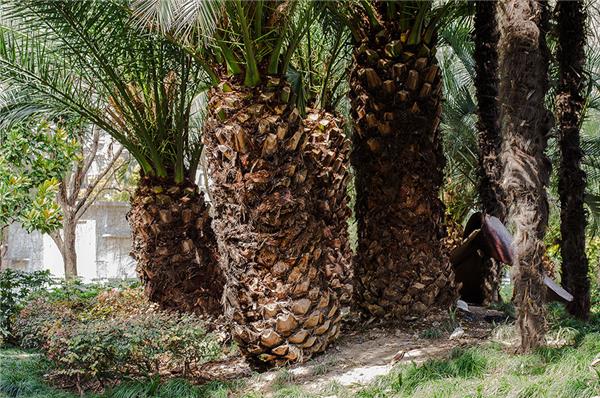
The Canary Island date palm is a tree species with a very tropical flair. If you plant one in your courtyard, it will undoubtedly add a lot of tropical scenery to the courtyard and make you feel as if you are by a tropical seaside every day.