Ilex rotunda is an ornamental fruit tree species with multiple uses
Ilex rotunda has emerald green leaves, and its fruit is delicious and lovely and small. It is a tree species with relatively high cultivation value, because it is both ornamental and edible.
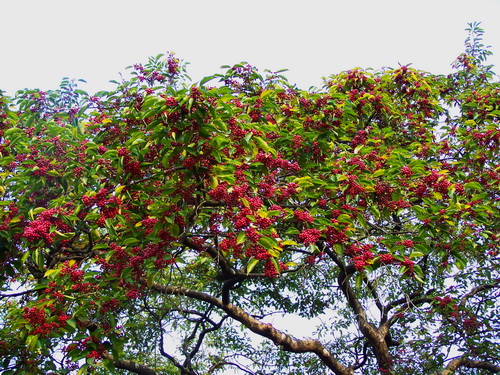
Morphological characteristics of Ilex rotunda
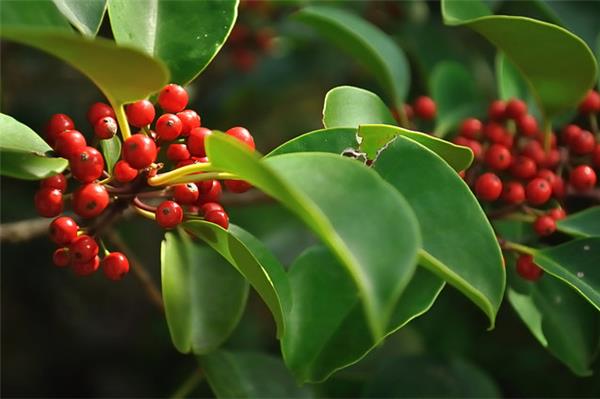
Aquifoliaceae, Ilex rotunda, evergreen tree or shrub, 5-15 m tall. Branches gray, branchlets more or less angular, reddish brown. Leaves alternate, ovate to elliptic, 4-10 cm long, 2-4 cm wide, both ends shortly pointed, entire, glossy above; lateral veins 8 pairs, conspicuous on both surfaces; papery; petiole 7-12 mm long. Flowers unisexual, dioecious, arranged in pedunculate umbels; male inflorescence peduncle 2-8 mm long, flower stalk 2-4 mm long; calyx about 1 mm long; petals 4-5, greenish white, ovate-oblong, about 2.5 mm long; stamens 4-5; female flowers smaller, flower stalk stouter, 3-5 mm long; ovary superior. Drupe spherical to elliptic, 4.5-6 mm long, red when ripe, apex with persistent stigma. Flowering period May-June. Fruiting period September-October.
Medicinal value of Ilex rotunda
Nature and flavor: bitter, cool. Clears heat and detoxifies, reduces swelling and relieves pain.
Supplementary formulas:
1. Gastritis, gastric and duodenal ulcers: Jiubiying (secondary bark) and Heimao (Kadsura coccinea) 1 liang each, Jinjuzi 1 qian. Sun-dry and grind into powder, take 2 grams each time, twice daily, reduced for children.
2. Colds, diarrhea: Jiubiying (secondary bark) half a jin, Didancao, Dingguicao, and Nanwuweizi root 3 liang each, mint 2 liang. Sun-dry and grind into coarse powder, bottle for use. Take 4-6 qian each time, 3-4 times daily, infused with boiling water.
3. Indigestion in children: Jiubiying (secondary bark) and guava leaves 2 qian each, Buzhaye and Huotanmu 3 qian each. Decoct in water and take in 3-4 divided doses, 1 dose daily. If fever is present, add honeysuckle 2 qian. For dehydration, give appropriate fluid replacement.
4. Scald burns: Fresh Jiubiying leaves or roots 1 jin, washed and pounded into a paste, wrapped in gauze and rinsed (1 jin of leaves with half a jin of clear water, 1 jin of roots with 12 liang of clear water), rubbed repeatedly until glue-like, then dip the medicinal juice and apply to the affected area, and apply again after it dries. If the liquid becomes jelly-like, add a small amount of rapeseed oil and mix before applying.
Cultivation and seedling-raising techniques for Ilex rotunda
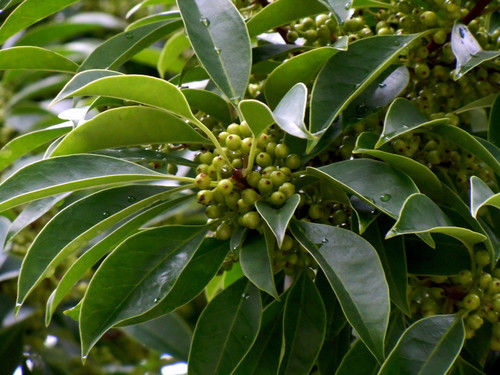
Seed collection: The fruit of Ilex rotunda matures in October and November, and can then be harvested. After piling for several days, rub off the fruit peel, wash clean, and place in a cool, ventilated place to dry, then sow. If sowing conditions are not yet available, the seeds can also be stored in moist cold river sand for low-temperature stratification, and sown for propagation the following spring when it is warm.
Seedbed preparation: A wooden box seedbed can be used, and the size can be determined as needed, generally 50-60 cm long, 30-40 cm wide, and 20-25 cm high. After the seedbed is made, it can be cleaned and disinfected with a 2500-3000 times potassium permanganate aqueous solution. The substrate can be prepared with 3 parts forest leaf mold, 3 parts mountain soil, 2 parts sandy vegetable garden soil, and 2 parts fine river sand. After mixing, spray with a 2000-2500 times Lequ aqueous solution, seal with plastic film for 24-48 hours, then uncover the film, turn out and sun-dry for several days, and then sow in the bed.
Sowing method: When sowing Ilex rotunda, screen out the seeds, rinse with warm boiled water at about 40°C, then sow the seeds in the seedling bed by broadcasting, cover with soil to cover the seeds, water thoroughly with a fine-hole watering can, and cover the seedbed with rice straw to keep it ventilated and warm so as to promote seed development.
Seedling cultivation: After transplanting, seedlings are afraid of high-temperature sunscald and drought, so shade sheds should be set up in time for shading, and a 75% shading-degree shade net should be used for moisture retention. According to the growth characteristics of Ilex rotunda seedlings, foliar topdressing is carried out at the peak period, fast-growth period, and late growth period respectively. At -5 to -6°C, 1-year-old seedlings basically have no freezing damage to the shoot tips. But attention should still be paid to cold protection in winter. First, increase potassium fertilizer application after autumn to ensure lignification of the seedlings; second, appropriately reduce shading time, gradually remove the shade net starting in early September, increase light, and enhance seedling resistance. With the above techniques, 1-year-old sown seedlings can all overwinter safely.
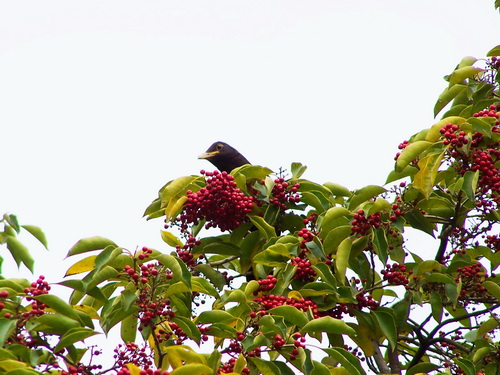
Ilex rotunda generally needs to be cultivated by field planting, but friends with relatively spacious places at home can also choose to cultivate Ilex rotunda in pots. It can greatly improve the quality and aesthetics of the room.