A Detailed Guide to the Cultivation Techniques and Pruning Methods of the Chinese Tallow Tree
The Chinese tallow tree (Triadica sebifera) is a tree species that loves light, so when growing it, you must choose a spacious and bright location for it and then care for it carefully.

Cultivation Techniques for the Chinese Tallow Tree
Habits: A light-loving tree species of the tropics. It loves light, does not tolerate shade, and has a certain resistance to wind. It tolerates summer heat but has low cold resistance. When the temperature falls below 15°C, growth stalls; with a sustained low temperature of 3-5°C, the plant suffers severe damage. It loves high temperatures, high humidity, and deep, fertile, slightly acidic soil with an abundant water supply. It is not strict about soil requirements and can grow in sandy loam, clay loam, and gravelly loam. It can also adapt to acidic soil and soil with a salt content below 0.25%. It is relatively drought-tolerant and also slightly tolerant of waterlogging, and can grow normally in any soil with moderate or higher fertility. However, overly dry and barren land is not suitable for planting.
Propagation: Mainly by cuttings. At the end of March, when the temperature stabilizes above 20°C, cut off half-year-old to one-year-old young shoots and cut them into cuttings about 14 cm long. Soak the lower end of the cut cuttings in clean water for several hours so that the white milky sap at the cut flows out completely and is washed away, to prevent it from coagulating into a mass at the cut and affecting root formation. After soaking, insert the cuttings into a moist sand bed mixed with a small amount of superphosphate. Mist under full sunlight to maintain humidity; roots can form in about 3 weeks, and after about a month and a half they can be moved to the field for cultivation. During the seedling stage, apply dilute nitrogen fertilizer water 3-5 times, stop fertilizing after autumn, and pay attention to covering for frost protection after winter arrives. One-year-old seedlings can be lifted from the nursery and planted out.
Water and Fertilizer: During the four months from July to October, apply fertilizer once each month. Choose nitrogen fertilizers such as urea, broadcasting 20 kg per mu each time. You can also spray once with a 0.2% potassium dihydrogen phosphate 800-fold solution. It is best to keep spraying about once every 10 days to ensure an adequate nutrient supply. In July, August, and October, water after fertilizing to dissolve the fertilizer and promote absorption. After fertilizing in September, stop watering to increase the degree of lignification of the seedlings, enhance their cold resistance, and help the seedlings survive the winter.
Pests: Pest control during the rapid growth period of the seedlings is also very important. Pests appearing during this period include inchworms, yellow tussock moths, slug moths, camphor silkworms, willow leaf beetles, and large bagworms. These pests are all insects capable of eclosion. They damage the leaves, causing them to become incomplete and reducing the seedlings' photosynthetic capacity. The control methods for these pests are all the same. We had best adopt an integrated control approach, installing insect-killing lamps in the nursery to lure and kill adults at night. When larvae are found, we should also adopt chemical control methods, spraying the seedling leaves with a 0.5% neem extract emulsifiable concentrate 600-fold solution, or with a diflubenzuron No. 3 suspension concentrate 2000 to 2500-fold solution.

Precautions for Pruning the Chinese Tallow Tree
1. The cut of a pruned branch should be smooth, with a slanted surface at a 45-degree angle to the bud below the cut, cutting from the opposite side of the cut, with the upper edge of the slant level with the tip of the bud below the cut and the lowest part of the slant level with the base of the bud. This way the wound at the cut is small and heals easily, and the bud grows quickly after sprouting. For thinning cuts, cut at the branch point, flush with the trunk, leaving no stub. For clumping shrubs, thin branches flush with the ground. The direction and quality of the bud below the cut determine the growth direction of the new shoot and the branch.
2. When pruning larger branches and trunks, a step-by-step method can be used. First, make a cut from below the branch upward at a point 20 cm above the required saw cut, to a depth of half the thickness of the branch, then saw the branch off from above, leaving a stub, and then saw off the stub from the saw cut. This can prevent the branch from splitting along the grain.
3. During pruning, tools should be kept sharp. Before using tree-climbing machinery and stepladders, check whether all parts are flexible and whether anything is loose, to prevent accidents. Fasten a safety rope when climbing trees to work. When working near high-voltage lines, pay special attention to safety, avoid electric shock, and ask the power supply department to cooperate when necessary.
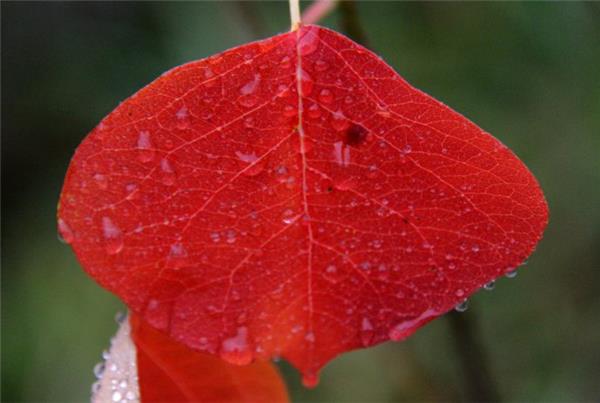
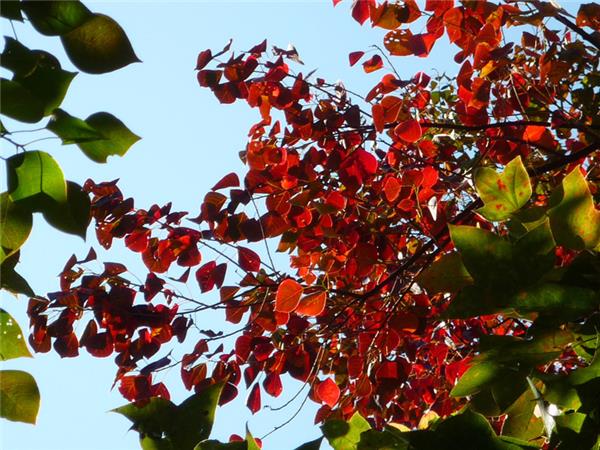
From a distance, the Chinese tallow tree looks quite similar to the red maple, but on closer inspection the two show fairly obvious differences; first of all, the leaf shapes are different. However, the visual enjoyment they bring is equal, and both are very good landscape tree species.