Huang Yulan (Michelia champaca) Planting and Management Techniques and Introduction to Varieties in the Same Family
If Huang Yulan is to achieve high yields, it is best to propagate it by layering, as Huang Yulan reproduced this way has a higher survival rate and grows more healthily.
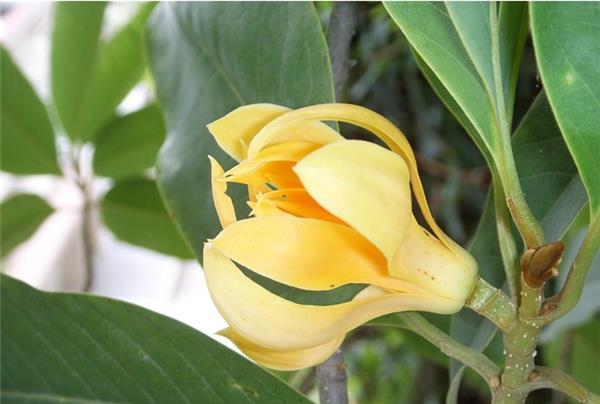
High-Branch Layering Propagation Technique for Huang Yulan
Layering method: Between April and June, select two-year-old branches and carry out ring-barking at the internodes, that is, use scissors to grip the branch and gently cut around it in a circle, then make another circular cut 0.5 cm from the upper cut, and then peel away the bark between the two cuts to expose the xylem. Next, use plastic film to tie a bag shape about 5 cm below the ring-barked area, put moss or peat soil into the bag, then tie the bag opening tightly, and then use string to tie the high-branch layer to other branches to prevent it from being broken by the wind.
Raising seedlings and transplanting: Usually pour clean water into the bag opening once every 4 to 5 days. After about 40 days, adventitious roots will grow, and the roots are as white and tender as bean sprouts. When the young roots change from white to yellowish-brown, they can be cut away from the mother plant and separately potted or planted in the ground. However, note that when the new plant is cut away from the mother plant, only the plastic film is removed; the moss or peat soil must still be retained, as a loose soil ball will directly affect the survival rate of the seedling. In the early stage after transplanting the new seedling, it is best to set up shade facilities. After about 5 to 7 days, the shading material can be removed and routine care and management carried out.
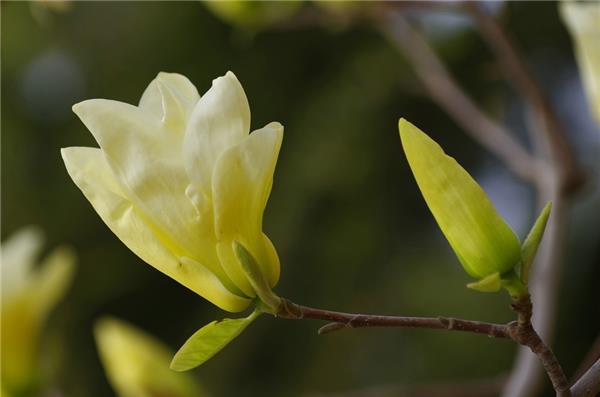
Daily Care and Management of Huang Mulan (Michelia champaca)
Water and fertilizer: Huang Mulan likes a slightly moist soil environment, and after planting it should be watered thoroughly once. Before the sapling grows new leaves, watering management should be strengthened, and the soil should not be allowed to dry out. After that, as long as the soil is not too dry, natural rainfall can basically supply water. In addition to applying leaf mold as a base fertilizer before planting, during the vigorous growing season a liquid fertilizer rich in nitrogen, phosphorus and potassium should also be applied once a week.
Light: Throughout the entire growth process, an appropriate amount of direct sunlight should be ensured, and it should receive no less than 4 hours of direct sunlight per day, avoiding a shaded environment. The environment should be kept ventilated so as to facilitate smooth photosynthesis.
Temperature: Huang Mulan likes warmth and fears severe cold, growing better within a temperature range of 20-30°C, and the overwintering temperature should not be lower than 5°C; it can tolerate short-term low temperatures of 0°C.
Pests and diseases: In actual cultivation, Huang Mulan will be affected by rhizopus rot, black spot and other diseases, and is susceptible to attack by harmful animals such as slug moths, brown soft aphids and mites.
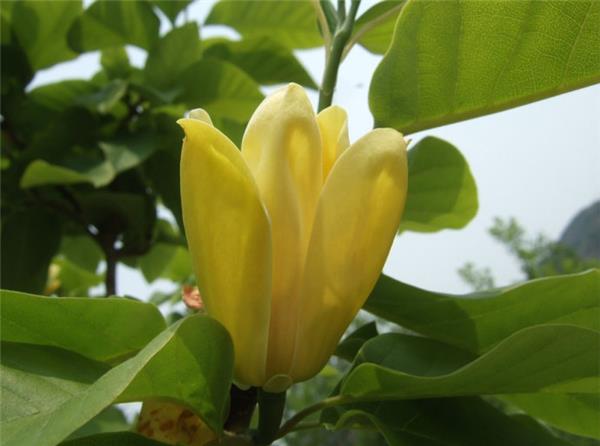
Other Yulan Varieties in the Same Family as Huang Yulan
Bai Yulan (Magnolia denudata): A deciduous tree, up to 25 m tall, with a diameter reaching up to 200 cm; the crown is narrowly ovate when young, and when the tree is mature it is broadly ovate or loosely broad-ovate. Large trees of seedling origin often have an obvious trunk, a sturdy body, a majestic and imposing appearance, vigorous growth, long nodes and sparse branches, though the number of flowers is somewhat sparse. Grafted plants often show multiple trunks or low-branching main trunks, with short nodes and dense branches, and a smaller, more delicate tree body, but with clusters of flowers, appearing pure white from a distance and extremely enchanting. Therefore, Bai Yulan of different origins has different charms in garden applications. In small or enclosed gardens, for solitary planting or small clump planting, grafted plants should be used to show an antique and elegant charm; while in scenic tourist areas, seedling plants should be used to express a rugged and simple style.
Erqiao Yulan (Magnolia x soulangeana): A plant of the genus Magnolia in the family Magnoliaceae. Also known as Zhusha Yulan and Zisha Yulan. It is a hybrid of Bai Yulan and Zi Yulan, bred between 1820 and 1840. A deciduous small tree, 6-10 m tall. Branchlets hairless. Leaves obovate, apex shortly acute, the base of the midrib on the leaf surface often hairy, the underside more or less pubescent, the petiole pubescent, the stipule scar one third the length of the petiole. Flowers open before the leaves, large and bell-shaped, purple or red, white inside, fragrant, with 6-9 tepals.
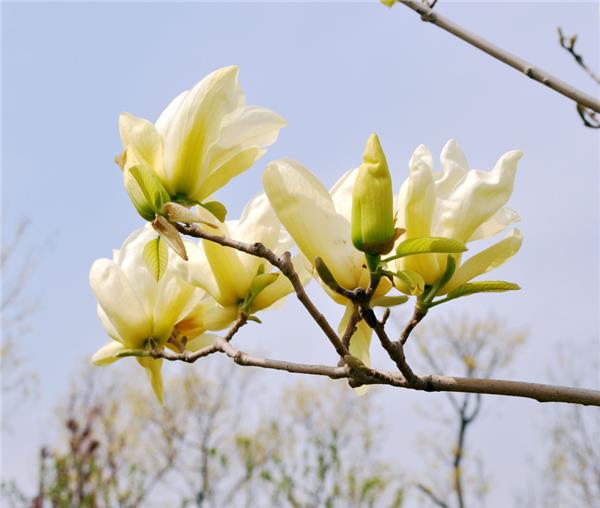
Besides being used in garden landscaping and road greening, Huang Yulan can also be planted in courtyards to decorate them, so friends who want to plant some trees in their courtyards can give priority to planting Huang Yulan.