What are the benefits and effects of the pothos flower? Read this article to understand
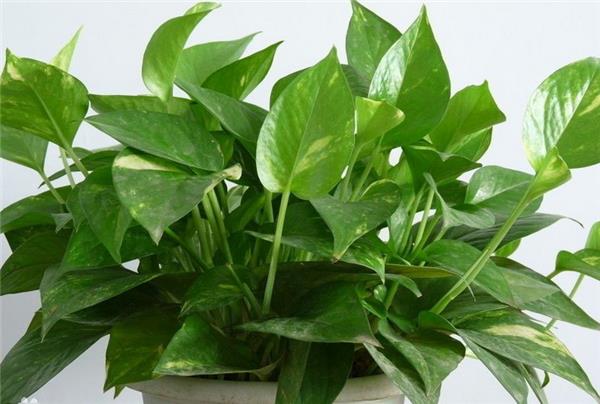
The pothos flower is the most common ornamental potted plant, and the benefits and effects of the pothos flower should not be overlooked either. Environmental scientists have found that a single pot of pothos in a room is equivalent to an air purifier, able to effectively absorb harmful gases in the air such as formaldehyde, benzene and trichloroethylene. Pothos not only has strong vitality, but when placed indoors, its air-purifying ability is no less than that of ivy and spider plants.
I. The benefits and effects of the pothos flower
Benefit and effect one of the pothos flower: lowers blood pressure, stabilizes blood pressure, and effectively prevents stroke, acute coronary heart disease and severe renal failure. It helps prevent cardiovascular and cerebrovascular diseases and other non-communicable diseases.
Benefit and effect two of the pothos flower: lowers blood sugar, balances the sugar content in the blood, and effectively reduces and prevents the occurrence of complications.
Benefit and effect three of the pothos flower: lowers blood lipids, effectively reduces the content of cholesterol and triglycerides in the blood, achieving a blood-dredging effect.
Benefit and effect four of the pothos flower: for coronary heart disease it invigorates blood circulation, softens arterial blood vessels, and has the effect of dilating blood vessels and increasing coronary artery flow.
Benefit and effect five of the pothos flower: promotes the flow of qi and invigorates blood circulation, and has antibacterial and anti-inflammatory effects. It has good medicinal effects on vascular inflammation, high fever with convulsions, and sore, swollen throat.
Benefit and effect six of the pothos flower: enhances the body's immunity, and long-term use has an anti-cancer effect.
II. How to grow the pothos flower
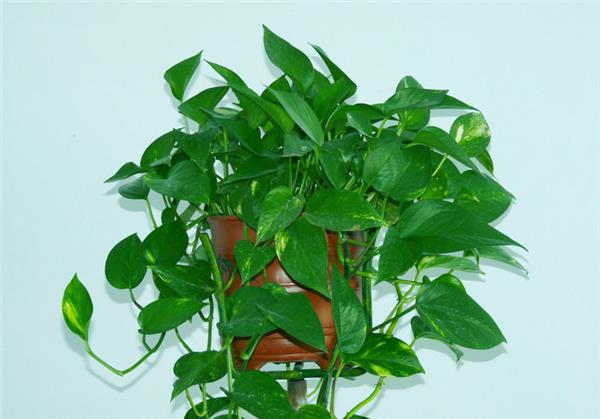
Pothos likes relatively high air humidity and a moist environment. In midsummer, the peak growth period for pothos, you can spray the aerial roots and leaf surfaces several times a day, which can both wash dust off the leaves, helping the pothos breathe, and keep the leaves emerald green and fresh; it can also lower the leaf surface temperature, increase the air humidity of the micro-environment, and help the leaves grow better. Keep the potting soil moist as the standard; when you see the potting soil turn white, water it thoroughly. In winter, when room temperature is lower, the pothos is in a dormant state, so water less, and just keep the potting soil from drying out.
The most suitable growing temperature for pothos is 20°C-28°C during the day and 15°C-18°C at night. In winter, as long as the indoor temperature is not lower than 10°C, the pothos can safely overwinter; if the temperature is below 5, it easily causes leaf drop and affects growth.
For fertilizing pothos, use mainly nitrogen fertilizer, supplemented by potassium fertilizer. Before the pothos growth period arrives in spring, apply a 0.3% solution of ammonium sulfate or urea once about every 10 days, and use a 0.5‰-1‰ urea solution as a foliar feed once, which can both meet the growth needs of the pothos and keep the leaves green and shiny. Fertilizing should stop in winter.
Pothos is usually grown by cuttings and stem layering. Select a robust pothos vine, cut it into sections of two nodes, being careful not to damage the aerial roots, then insert it into plain sand or coal cinders to a depth of 1/3 of the cutting, water it thoroughly and place it in a shaded spot, spray water on the leaf surface every day or cover it with plastic film to retain moisture; as long as the environment is kept no lower than 20, the survival rate is above 90%.
III. Pairing pothos with home styles
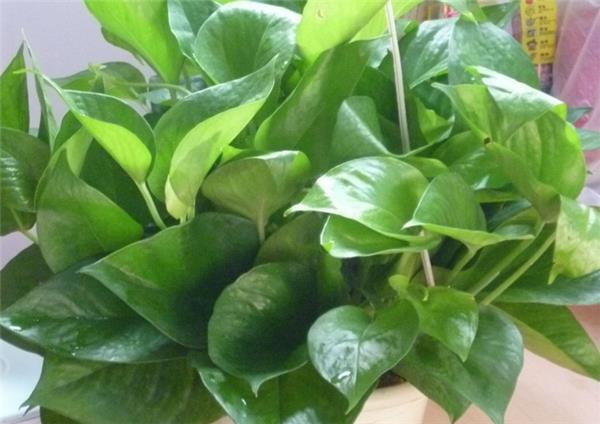
1. Pothos is suitable for placing in the places where family members come into contact most, and beside the living room TV or on the living room table are both very good choices. Pothos is one of the very best indoor decorative plants, a climbing vine foliage flower. Its stems are slender and soft, and its leaves are delicate and elegant. Place a pot on top of a cabinet as a high-set pot, letting its trailing stems hang down leisurely, or after the trailing stems hang too long, loop and hang them into a ring, just like an emerald relief. This not only makes full use of space and purifies the air, but also adds a green decoration with lively lines and bright colors to a rigid cabinet top, full of vitality and adding a warm touch of charm to the room. Morphological characteristics: the pothos vine grows several meters long, with aerial roots at the nodes; as its growth age increases, the stem thickens and the leaves also grow larger and larger. The leaves are alternate, green, with a few leaves also slightly mottled with yellow, entire, and heart-shaped. Turning over these places fully demonstrates its ornamental value.
2. Place it in the kitchen where there is the most cooking fumes. Placing it in the kitchen both achieves the goal of environmental protection and adds a bit of green to the kitchen, so it can be said to serve two purposes at once. Environmental scientists have found that a single pot of pothos in a room of 8-10 sq m is equivalent to an air purifier, able to effectively absorb harmful gases in the air such as formaldehyde, benzene and trichloroethylene. Pothos not only has strong vitality, but when placed indoors, its air-purifying ability is no less than that of ivy and spider plants. Newly laid flooring very easily produces harmful substances. Because pothos can simultaneously purify benzene, trichloroethylene and formaldehyde in the air, it is very suitable for placing in newly renovated rooms.
3. The windowsill position is its specialty. If you pay careful attention, we can find that the plants generally placed on the windowsills of ordinary households are all pothos, because its size is especially small, so it fits just right on the windowsill; it will neither crush the windowsill nor block the owner from seeing the beautiful scenery beyond the windowsill.
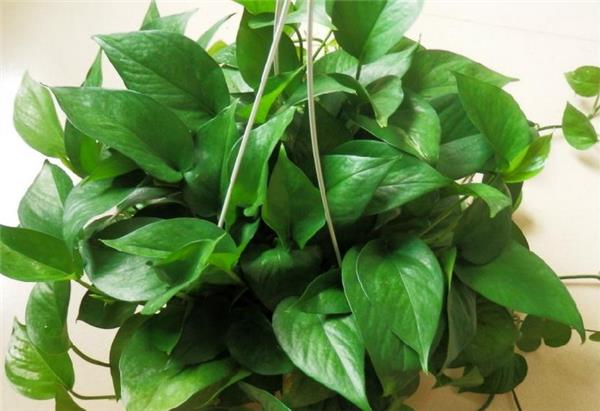
The above introduction to the benefits and effects of the pothos flower; we hope that the accumulation of this knowledge can make your pothos grow more vigorously, and we also hope that you can share your new experiences in growing pothos with others.
The above introduction to the benefits and effects of the pothos flower; we hope that the accumulation of this knowledge can make your pothos grow more vigorously, and we also hope that you can share your new experiences in growing pothos with others.