What are the cultivation methods and precautions for Kalanchoe blossfeldiana?
In home decoration, growing flowers is a very common thing. It not only helps us with interior decoration and adds vitality to the indoors, but also helps us purify indoor air. It is a very good indoor decoration. Kalanchoe blossfeldiana is one of the very good indoor plants to grow. It is not only beautiful, but also has an auspicious meaning. It is especially good to grow Kalanchoe blossfeldiana in homes with elderly people. Here we introduce the cultivation methods and precautions for Kalanchoe blossfeldiana, hoping it will help everyone understand how to grow Kalanchoe blossfeldiana.
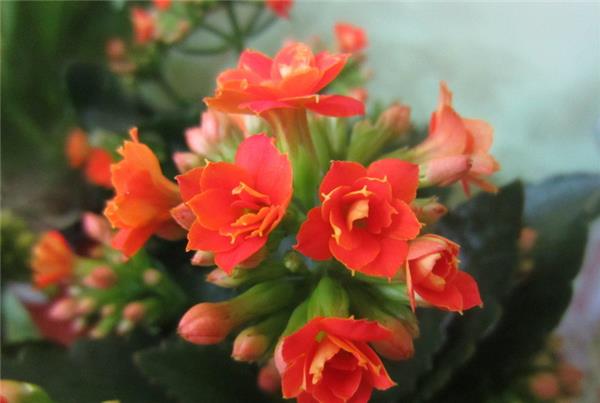
I. Cultivation methods for Kalanchoe blossfeldiana
1. Soil selection for growing Kalanchoe blossfeldiana:
Kalanchoe blossfeldiana must not be grown in heavy, sticky soil, otherwise it will lead to poor growth, root rot and leaf drop, and in severe cases cause the plant to die. The potting soil should be mixed with 4 parts leaf mold, 4 parts garden soil, 2 parts river sand, plus a small amount of bone meal. This kind of growing medium is loose and fertile, has good drainage, and shows a slightly acidic reaction, which is favorable for root development.
2. Fertilization method for growing Kalanchoe blossfeldiana:
Kalanchoe blossfeldiana must not be grown in heavy, sticky soil, otherwise it will lead to poor growth, root rot and leaf drop, and in severe cases cause the plant to die. The potting soil should be mixed with 4 parts leaf mold, 4 parts garden soil, 2 parts river sand, plus a small amount of bone meal. This kind of growing medium is loose and fertile, has good drainage, and shows a slightly acidic reaction, which is favorable for root development.
During the peak growing season, apply a dilute compound liquid fertilizer once every 15 to 20 days to promote robust growth and abundant flowering. After flower buds form in November, apply 1 to 2 additional applications of 0.2% potassium dihydrogen phosphate or 0.5% superphosphate, which will result in more flowers, brighter colors, and a longer flowering period.
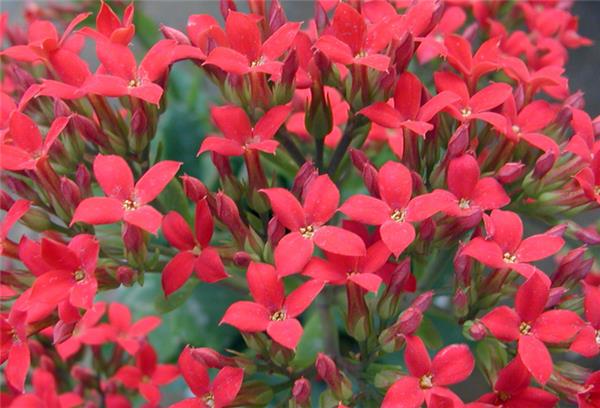
3. Watering method for growing Kalanchoe blossfeldiana:
Like other succulent flowers, Kalanchoe blossfeldiana contains a relatively large amount of water in its tissues and has strong drought resistance, so it does not need a large amount of watering. During the growing period, it is enough to water thoroughly once every 2 to 3 days and keep the potting soil slightly moist. When temperatures are low in winter, watering must be controlled even more. If watering is excessive, drainage is poor, and the potting soil is too wet, it is easy to cause root rot.
II. Precautions for growing Kalanchoe blossfeldiana
(1) When growing Kalanchoe blossfeldiana, if light is insufficient for a long time, not only will the branches become thin and long and the leaves thin and small, affecting the beauty of the plant shape, but the number of flowers will also decrease, the flower color will not be bright, and it will also cause a large number of leaves to drop, losing its ornamental value.
(2) Kalanchoe blossfeldiana has phototropism, so during the growing period care should be taken to frequently change the direction of the flower pot and adjust the light so that the plant receives light evenly and the branches develop symmetrically in all directions. If the pot is not turned for a long time, the plant will grow toward one side, affecting the ornamental effect.
(3) During the vigorous growth period of Kalanchoe blossfeldiana, attention should be paid to pinching off the growing tips to promote branching, so that it has good flowers and lush leaves, avoiding any negative effect on its ornamental value.
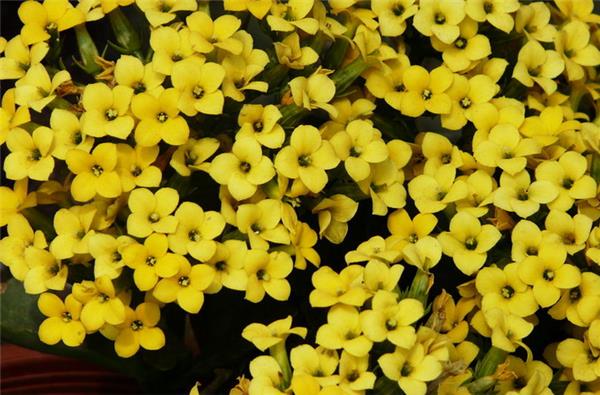
III. Hydroponic propagation of Kalanchoe blossfeldiana
1. Cutting selection is the basic prerequisite for ensuring high-quality potted flowers. For cuttings used in hydroponics, the most ideal choice is a healthy, sturdy, plump terminal bud about 10 to 15 cm long, with 2 to 3 nodes bearing 3 to 4 or more pairs of leaves. It is best to cut at the internode or about 1 cm below the node, with the cut surface at about a 45 degree angle to form the largest cross-sectional area; if the terminal bud is a flowering shoot, cut off the spent flowers. It is best if the cutting has more than 1 cm of stem below it. If it interferes with the insertion hole, the lowest pair of leaves can be removed, while the remaining leaves should be retained as much as possible;
2. Before hydroponics, the cut wounds on the branches, terminal buds, and leaf stalks must be air-dried naturally for more than 4 hours. This is determined by the characteristics of succulent and latex-bearing plants; otherwise the wounds easily turn black and rot, causing rooting failure. Generally, when taking herbaceous and woody cuttings, they must not be dehydrated for too long, to avoid air entering the vascular bundles and blocking water transport, so herbaceous and woody cuttings should be inserted after only a brief drying. If the leaves are wilted, it is best to soak them so the branches and leaves become firm again, indicating that water transport is unimpeded, before proceeding to the next step. But remember that Kalanchoe cuttings must absolutely not be soaked in water before insertion; instead they need a certain degree of air-drying. Even if the leaf skin wrinkles and wilts, it does not matter; on the contrary, it is even easier for them to root. For Kalanchoe branches sent from other places, no moisture-retention treatment is needed. After several days of transport, the wounds will naturally dry and shrivel upon arrival, and at this time they are very good to insert. Do not overdo it by following herbaceous flower cuttings and cutting off the dried parts and then soaking them in fungicide, rooting solution, or the like. In the south, where air humidity is high, I generally cut them the night before and insert them on the second or third day.
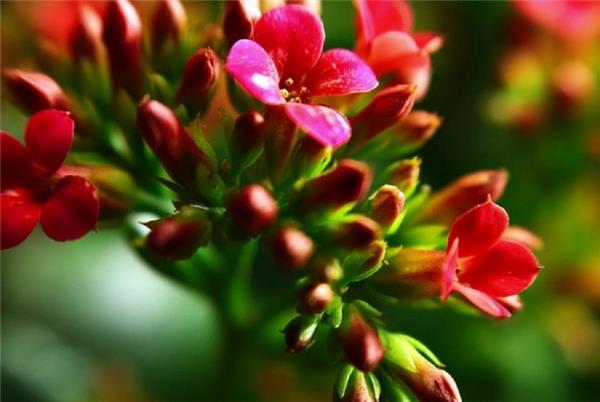
I believe that after reading the above content, you should have some understanding of the cultivation methods and precautions for Kalanchoe blossfeldiana. After learning how to grow Kalanchoe blossfeldiana, we should take good care of it in our daily lives.
I believe that after reading the above content, you should have some understanding of the cultivation methods and precautions for Kalanchoe blossfeldiana. After learning how to grow Kalanchoe blossfeldiana, we should take good care of it in our daily lives.