A Detailed Guide to Satsuki Azalea Care Methods and Garden Uses
Satsuki azalea is a very beautiful flowering plant, but only by gaining an in-depth understanding of it and caring for it correctly can it grow strong and healthy and then open beautiful flowers.
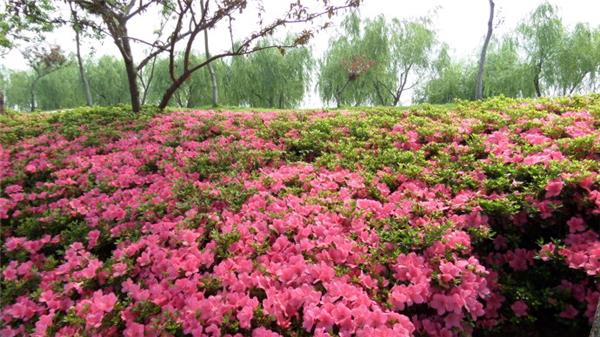
I. Introduction to Satsuki Azalea
Basic introduction: Satsuki azalea, of the genus Rhododendron (Ericaceae), is native to India and Japan. It leafs out first in spring and then flowers, with the flowering period generally from late May to June. Its branches and leaves are slender, the crown is full and tidy, the leaves are closely arranged, its ability to produce adventitious shoots is strong, and it is highly malleable for shaping. The flower diameter is 6-8 cm, and the flower colors and petals are as rich and varied as those of the Western azalea. Traditional cultivars of the satsuki azalea mainly include Changhua, Dahongpao, Wubao Luzhu, Zichen Dian and others, making it a top-grade tree species for flowering bonsai. Among them, Wubao Luzhu has a small flower within the flower, forming a hose-in-hose form, and is the most double-flowered type among satsuki azaleas.
Morphological characteristics: It is an evergreen shrub that produces branches first and flowers latest, generally from late May to June. The branches and leaves are slender, the branching is dense, the crown is full and tidy, the leaves are closely arranged, the flower diameter is 6-8 cm, and the flower colors and petals are as rich and varied as those of the Western azalea. Traditional cultivars include Changhua, Dahongpao, Wubao Luzhu, Zichen Dian and others. Among them, Wubao Luzhu has a small flower within the flower, forming a hose-in-hose form, and is the most double-flowered type among satsuki azaleas.
Ecological habits: Satsuki azalea is cold-tolerant and afraid of heat, and requires fertile, slightly acidic, loose and permeable soil. It requires a warm climate, fertile land and good drainage for its planting environment. Satsuki azalea can be propagated by cuttings and grown either in pots or in the ground.
Plant characteristics: Satsuki azalea has many flower forms, including "single hose", "nested hose", "semi-double", "camellia-form", "Western azalea-form", "separated narrow-petal form" and others. Its leaves are relatively thick and hard, slightly darker in color, with obvious leaf hairs and clear veins, making it easy to distinguish from the spring azalea. Its leaf shapes can be divided into: lanceolate, oblanceolate, long elliptic, obovate, angular-leaf form, twisted-leaf form, camellia-form, narrowly oblanceolate, linear and others.
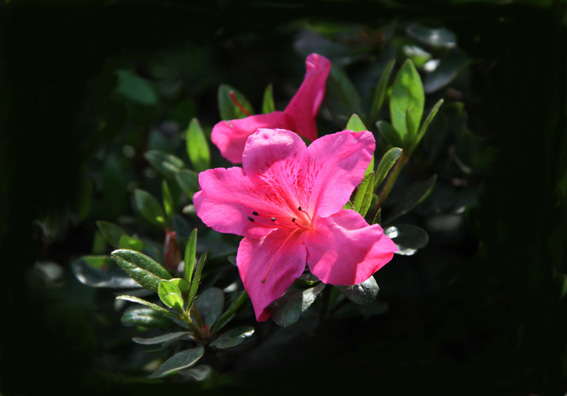
II. Garden Uses of Satsuki Azalea
It is green in all four seasons and flowers in all four seasons, with the wondrous sight of four colors: yellow, red, white and purple. It can be cultivated year-round to beautify the environment. It can be grown in pots or planted in the ground under shaded conditions. Satsuki azalea trees grown on balconies should be pruned and trained into a spherical shape. Their form is elegant and beautiful. Satsuki azalea trees grown in courtyards should be pruned and trained into an umbrella shape, and their form adds delight and scenic beauty. They are suitable for group planting in moist and shaded woodland and among rocks, and in gardens are best planted among tree clusters, under trees, beside streams, by pond edges and along lawn borders; on the shady side of buildings they can be used as flowering hedges or in flower-bed plantings. Some species can be made into bonsai.
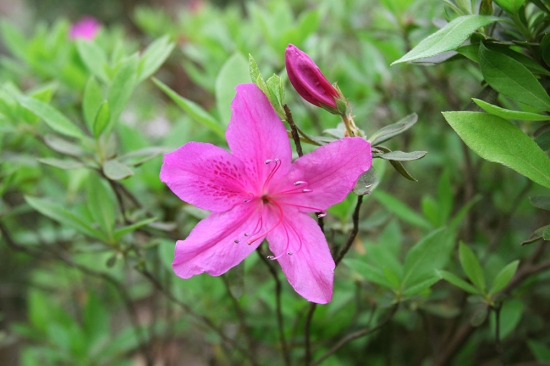
III. Care of Satsuki Azalea
1. The roots of the satsuki azalea are as fine as hairs, with very few thick main roots. It fears both dryness and waterlogging, and especially fears heavy fertilizer. If watered too much, the roots sit in water; if too dry, the branches and leaves wither and the leaf blades drop off, posing a great threat to the plant. As for applying heavy fertilizer, that can endanger its life.
2. After the flowers fade, the spent flowers must be cut off to avoid seed production consuming nutrients. After new branches sprout, thin the branches appropriately, deciding what to keep or remove according to the plant's growth vigor.
3. Satsuki azaleas are best planted in clay pots, because clay pots absorb water and breathe, which benefits root growth and development and makes the branches and leaves luxuriant.
4. The placement of potted satsuki azaleas is particular: they should generally be placed on a southeast-facing balcony, and they need ventilation and should be moved as little as possible. Without ventilation, they are prone to black spot disease and massive leaf drop.
5. Thin the buds and leaves in time, removing part of the overly numerous and dense buds and leaves so that air circulates and nutrients are concentrated in the flower buds. After the flower buds form, increase nutrition and apply a moderate extra amount of phosphorus and potassium fertilizer, otherwise the flower buds will turn into leaf buds.
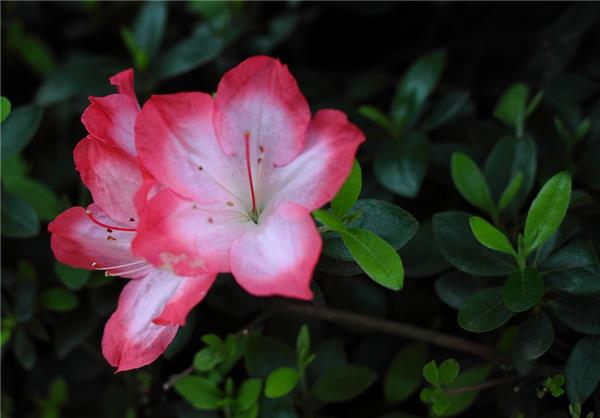
Satsuki azalea has a very good ornamental effect. Placed in the living room, it can immediately attract guests' attention and make your home appear full of vitality and vigor.