What are the reasons why mimosa plants are shy and not shy
The mimosa plant (Mimosa pudica) is famous precisely for being "shy," and people mainly grow it to admire this trait. But some friends, after growing a mimosa for a while, find that their mimosa is actually no longer shy. Why is that?
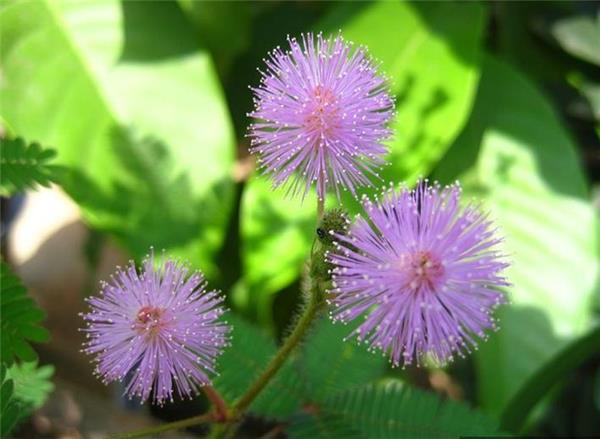
I. Characteristics of the mimosa plant
The most obvious one is that when it receives an external stimulus (such as a touch), the leaf surface of the mimosa immediately contracts and folds together. If the stimulus is stronger, it is quickly transmitted to the neighboring leaflets and even to all the leaflets of the compound leaf, making the petiole droop. The mimosa also responds very quickly to stimuli, usually beginning to react after 0.1s and completing the response within a few seconds.
II. Why the mimosa plant is shy
At the petiole and the base of the leaves of the mimosa, there is a swollen part, scientifically called the pulvinus. The pulvinus is the core reason why the mimosa is shy. In the middle of the pulvinus there is a vascular bundle, and its surroundings are filled with parenchyma tissue. When the pulvinus, which is most sensitive to stimuli, is touched, the cell sap of the parenchyma cells in the upper half of the pulvinus is expelled, creating an imbalance in turgor pressure between the upper and lower halves, which causes the leaf to close and droop.
This stress response of the mimosa takes only 0.08 seconds from start to finish, meaning the transmission speed is as high as 10cm/s. It is fair to say the reaction is very fast. The time needed to return to its original state is about 5-10 minutes.
The reason the mimosa is shy is closely related to its native environment. The mimosa is native to tropical South America, where the climate is harsh and violent storms are common. To protect itself, when the first drop of rain falls on a mimosa leaf, it promptly and effectively closes its leaves and droops its petiole, avoiding damage from the storm. This is the self-adjusting nature of the biological world.
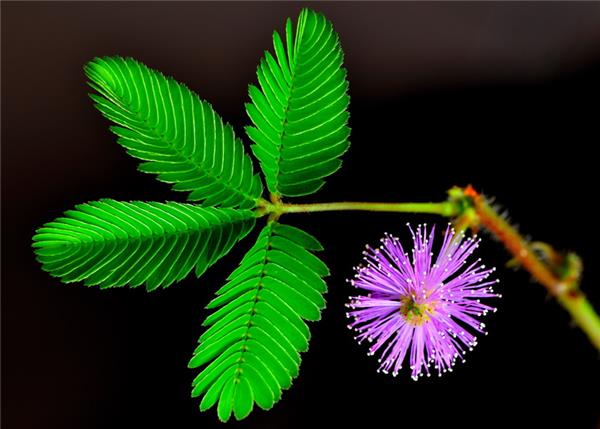
III. How to grow the mimosa plant
1. Choose a suitable place for planting; growing it indoors in a pot is a relatively good approach. The mimosa has few and fine fibrous roots, so it is suitable for propagation by seed, and it is best to sow directly to avoid damaging the roots when transplanting. If transplanting is necessary, choose the seedling stage.
2. To help the mimosa reproduce, when it grows densely and messily, you can appropriately choose to divide it into separate pots to ensure sufficient light and nutrients.
3. Another point to remind everyone of is that the mimosa cannot be grown together with colored peppers, because colored peppers carry red spider mites, which will kill the mimosa.
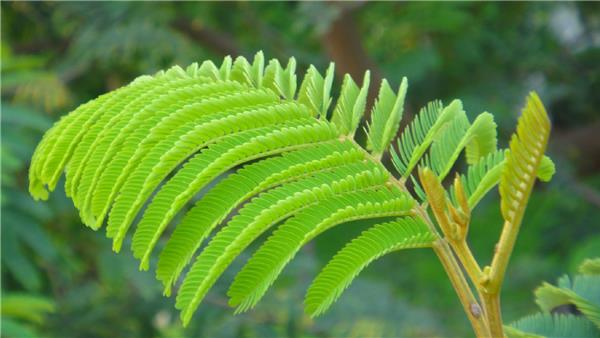
IV. Reasons why the mimosa plant is not shy
The first case is when it is clearly shy at first, but after being touched many times, it is no longer shy. The reason is simple: it is caused by this friend touching it many times. Although the mimosa needs an external stimulus to be shy, frequent stimulation will make it lose its sensitivity.
There is another situation where, after the mimosa is stimulated, the leaf contraction speed becomes slower; the reason is excessively high water content. At the leaf neck of the mimosa there is a small drum-shaped parenchyma cell tissue, the pulvinus, and the pulvinus is filled with water. When you touch a mimosa leaf with your hand, the leaf vibrates, and the water in the cells of the lower part of the pulvinus immediately flows upward and to both sides. This makes the lower part of the pulvinus deflate while the upper part bulges, so the petiole droops and the leaf closes. Therefore, the closing and opening of the leaf is caused by the turgor pressure action of the pulvinus. And the turgor pressure action of the pulvinus is closely related to the humidity in the air. When the air humidity is very low, the turgor pressure action of the pulvinus is obvious, and the leaf closes and opens quickly; when the air humidity is very high, the leaf opens and closes slowly.
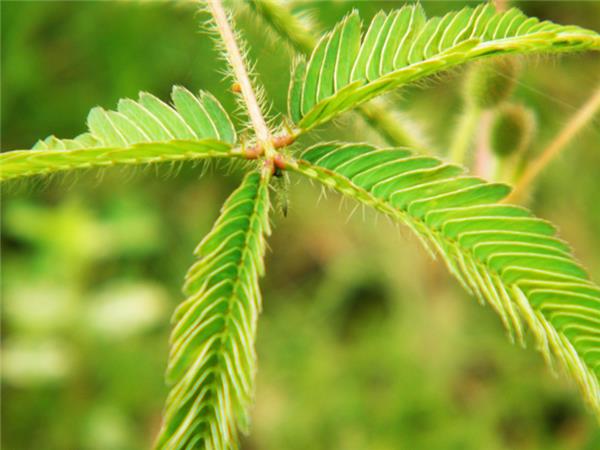
It seems that even the introverted, timid mimosa has a temper. After people touch it too much, it will also feel unhappy. So to ensure its shy characteristic and let it show that side unique to it, everyone should still avoid touching it as little as possible and let it grow quietly.