The Harm and Control Methods of Grape Anthracnose
Grape anthracnose forms brown spots on grape leaves and fruit, which then begin to rot bit by bit from the spot, seriously affecting their ornamental value and edible value.
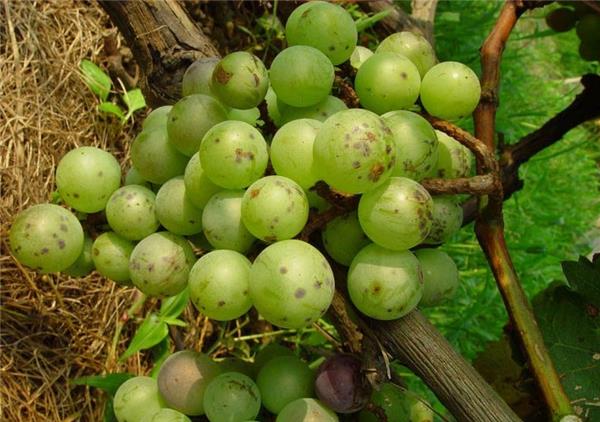
Symptoms of Grape Anthracnose
Anthracnose occurs mainly on plant leaves, often damaging the leaf margins and leaf tips; in severe cases, it causes more than half of the leaf to wither, blacken and die. In the early stage of the disease, round and oval reddish-brown small spots appear on the leaves, which later expand into dark brown round lesions, 1 to 4 mm in size; the center turns from grayish brown to grayish white, while the edge is purplish brown or dark green, sometimes with a yellow halo at the margin. Finally, the lesions turn dark brown and produce small black dots arranged in concentric rings, namely the pathogen's acervuli. Under humid conditions, pink sticky spore masses form on the lesions. In severe cases, a single leaf may bear more than ten to dozens of lesions; in the later stage the lesions perforate, and when numerous they merge into patches, causing the leaf to dry up. The lesions may form holes, and diseased leaves tend to fall off.
When anthracnose occurs on the stem, it produces round or nearly round lesions that are light brown, bearing small black dots arranged in concentric rings. Lesions occurring on young shoots are oval canker spots with slightly raised edges.
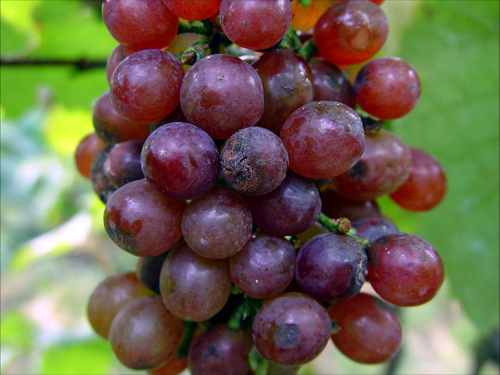
Control of Grape Anthracnose
1. Choose drip-free anti-fog film to cover the facility, cover the entire ground area inside the facility with plastic film, and pay attention to ventilation and dehumidification to lower the air humidity inside the facility, keeping the relative air humidity below 80%, inhibiting spore germination and reducing infection.
2. Maintain a reasonable density, prune scientifically, leave an appropriate amount of branches, keep a reasonable load, maintain vigorous growth, improve light conditions in the field, and reduce the air humidity of the microclimate.
3. Focus on spray protection during the growing season. Every 15-20 days, carefully spray 1 application of 240-200 times half-strength Bordeaux mixture to protect the trees. Between the two Bordeaux mixture applications, add a spray of high-efficiency, low-residue, non-toxic or low-toxicity fungicide. The following pesticides can be used alternately: 80% Pemba wettable powder at 800 times dilution, 70% Kelu wettable powder at 700-800 times dilution, 50% Tuzet wettable powder at 600-800 times dilution, 80% Anthracnose Fumei wettable powder at 600 times dilution, 20% Yinguo wettable powder at 600 times dilution, etc. To improve the control effect, when spraying non-alkaline liquid, add 600 times "Tianda-2116" or 1000 times Hanlaoshou.
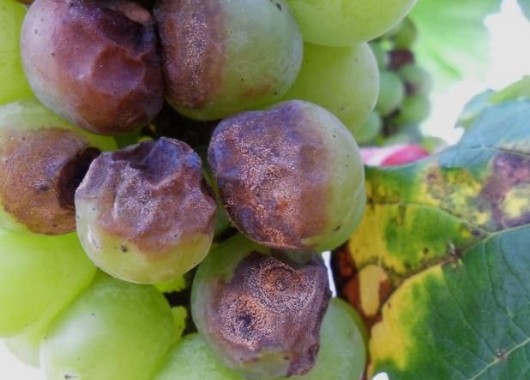
Other Diseases Grapevines Are Prone To
1. Control of black spot disease and downy mildew: In winter, thoroughly prune out diseased vines, leaves, fruit and withered branches, burn them in a centralized manner, and then bury them in a place far from the vineyard. After that, before the plants are about to sprout, spray 5°Be lime sulfur mixture; after the buds and leaves unfold, spray Bordeaux mixture or insecticide another 3-4 times. The spraying time can be chosen during the leaf expansion period of the grape; when spraying, the liquid should be dispersed to all parts of the vine, leaving as few gaps as possible.
2. Control of powdery mildew: The method is the same as the control of black spot disease and downy mildew. In addition, management should be strengthened, and the light penetration and ventilation of the grapevines should be improved. To thoroughly treat and prevent powdery mildew, it is best to spray Be lime sulfur mixture before the bud break period. In mid-May, spray 0.2-0.3 low-concentration Be lime sulfur mixture. With both measures working together, the control effect is better.
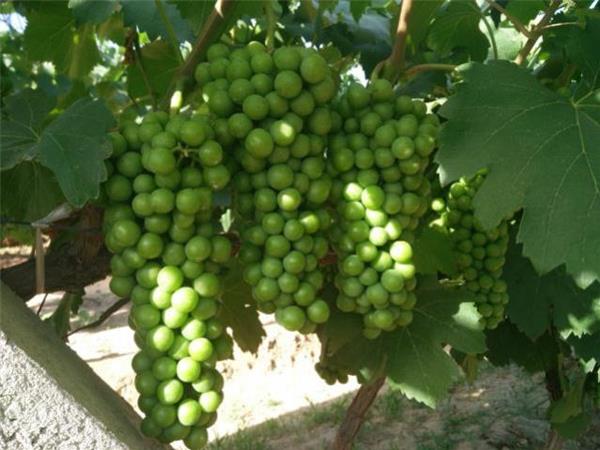
Whether it is anthracnose, powdery mildew, black spot disease, or even insect pests, when growing all plants we must follow the principle of giving priority to preventing diseases and pests, and care for the plants as correctly as possible, so as to avoid losses caused by the threat of diseases and pests.