How to plant Japanese late cherry? Detailed explanation of planting and care techniques
Japanese late cherry generally opens in late April, blooming and falling at the same time, and taking branches during its full bloom period for the next generation of cuttings is the best time.
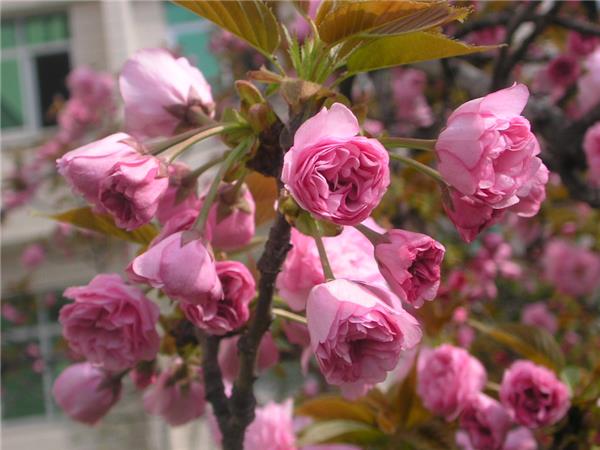
I. Morphological characteristics of Japanese late cherry
Tree, up to 10 m tall. Bark light gray, rather rough; branchlets rather stout and spreading. Hairless. Leaves usually obovate. 5-15 cm long, 3-8 cm wide, leaf tip acuminate, long-tailed, leaf margin serrate singly or doubly serrate, tooth tips with long awns, leaf back light green, hairless; petiole with a pair of glands on the upper part, petiole 1-2.5 cm long; new leaves hairless, slightly reddish-brown. Flowers large and fragrant, single or double, often drooping, pink or nearly white; 1-5 flowers arranged in corymbs, bracteoles leaf-like, hairless; common peduncle short, 2-4 cm long, sometimes absent. Pedicels 1.5-2 cm long, all hairless; calyx tube short, hairless; petal tips concave; flowering period long, opening in mid-to-late April, fruit ovoid, black when ripe, glossy.
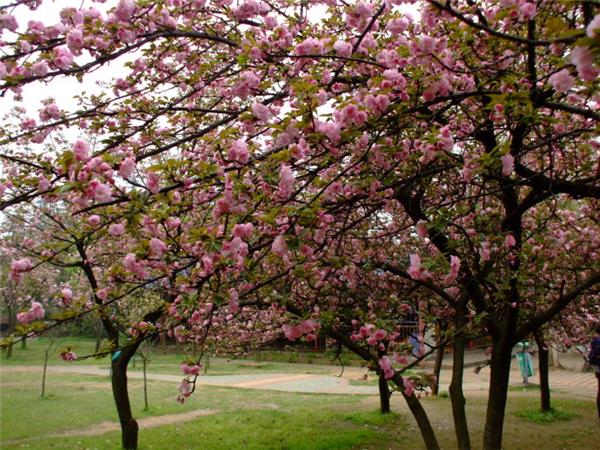
II. Planting and care of Japanese late cherry
Cutting treatment: Before inserting, remove the leaves on the part inserted into the vermiculite, keeping the upper leaves. Treat cuttings by quick dipping in 1000 ppm naphthaleneacetic acid. That is: insert the base of the cutting 2 to 3 cm into a 1000 ppm naphthaleneacetic acid solution, then immediately take it out for cutting, dipping and inserting as you go.
Cutting time: It can be done from April to July, and the experimental records are as follows: From the table above, it can be seen that the survival rate of cuttings is highest during the full bloom period of cherry blossoms, because at this time the plant is in the peak period of physiological activity and is easy to root. Cuttings taken on April 28, after transplanting on June 28 did not need to recover, 5 days later sprouted new buds of 0.5 cm, and after 4 years of cultivation the tree was full of flowers.
Planting and setting: The planting site should be chosen in a place with sufficient sunlight; since cherries are all shallow-rooted tree species, a place with fertile soil and shelter from wind should be chosen; the most suitable terrain is a place with a gentle slope and a lake or pond in the low area. Use expanded vermiculite as the substrate, maintaining a pH value of 6.2. At night the temperature of the vermiculite seedbed is 2°C to 3°C higher than that of the soil bed, while at noon the temperature is 1°C to 2°C lower than that of the soil bed, indicating that the vermiculite seedbed has a small day-night temperature difference and large accumulated temperature, good insulation effect, and is beneficial to root growth. In production, granular vermiculite is preferred, as it has good permeability and is beneficial to rooting. Powdered vermiculite is sticky and has poor air permeability. When raising seedlings, do not mix soil into the vermiculite, otherwise root rot is likely.
Shaping and pruning: Large trees can be allowed to grow naturally without pruning, so as not to affect their growth. However, overly dense weak branches should be cut off to improve crown ventilation and increase light. Cut off diseased and pest branches as early as possible. When the crown extends too far and bare branches appear in the lower part, retract and replace the head in time, and several healthy buds in the lower part gradually form an advantage and take its place, continuing to grow in the following spring to form a new trunk; repeating this year after year naturally forms an umbrella-shaped crown. Usually pay attention to cutting off dead branches, overly dense branches, diseased and pest branches, crossing branches, etc., to enhance the ornamental effect.
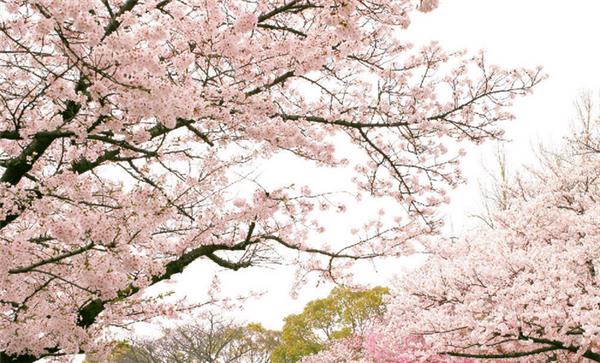
III. Pest control of Japanese late cherry
Common pests of Japanese late cherry include: tea bug, peach aphid, carrot micro-tubule aphid, apple yellow aphid, Japanese mealy scale, wisteria gray mealybug, mulberry white scale, Korean brown scale, yellow slug moth, cotton band tortrix, large bagworm, tea bagworm, rod brown tortrix, brown-edged green slug moth, double-toothed green slug moth, beautiful green slug moth, trace-spotted green slug moth, pear slug moth, mulberry brown slug moth, peach red-necked longhorn beetle, gypsy moth, small green leafhopper, etc.
Control methods: If they occur, use 3% high-permeability fenoxycarb emulsifiable concentrate 3000 times solution to spray and kill tea bugs; use 10% imidacloprid wettable granules 2000 times solution to spray and kill peach aphids, carrot micro-tubule aphids, apple yellow aphids; use 3% high-permeability fenoxycarb emulsifiable concentrate 3000 times solution or 10% imidacloprid wettable granules 2000 times solution or 95% jiemanling emulsion 400 times solution, 20% sujieke emulsifiable concentrate 1000 times solution, to spray and kill Japanese mealy scale, mulberry white scale, Korean brown scale; use 3% high-permeability fenoxycarb emulsifiable concentrate 3000 times solution or 1.2% nicotine matrine 1000 times solution to spray and kill gypsy moth, rod brown tortrix, cotton brown band tortrix, large bagworm, tea bagworm; use 20% diflubenzuron suspension concentrate 7000 times solution, Bt emulsion 500 times solution to spray and kill yellow slug moth, brown-edged green slug moth, double-toothed green slug moth, beautiful green slug moth, trace-spotted green slug moth, pear slug moth, mulberry brown slug moth; use green weilei 200 times solution to spray and kill peach green-necked longhorn beetle; use 25% buprofezin wettable granules 1000 times solution to spray and kill small green leafhopper.
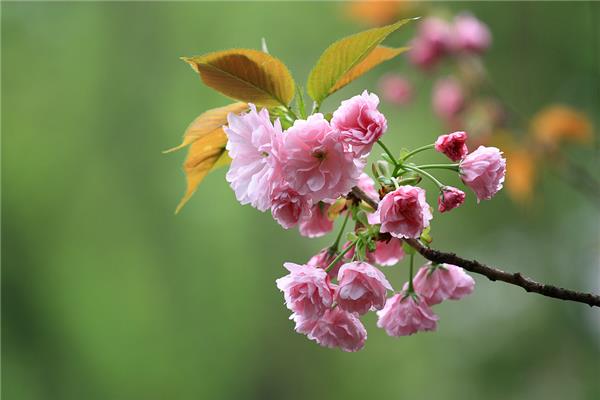
Japanese late cherry has high ornamental value, whether planted alone, in rows, or in groups, all are fine. If friends have a courtyard at home, they can also try planting it, so that from April to May each year, you can enjoy the brilliant beautiful scenery of cherry blossoms even without traveling far.