Characteristics of Japanese Early Cherry and Its Differences from Japanese Late Cherry
Japanese Early Cherry is a tree species with excellent ornamental value. Many people have been amazed by its poignant and magnificent sight of blooming and fading at the same time, which has kept it in a high position in people's hearts.
I. Introduction to Japanese Early Cherry
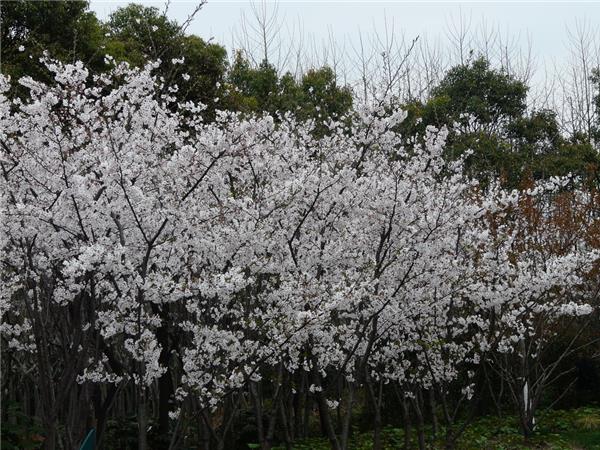
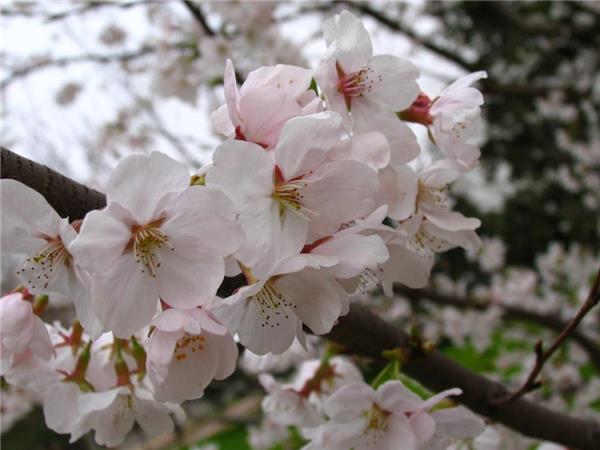
Morphological characteristics: A tree, about 5m tall, with transversely striated bark; the bark of old trees is longitudinally fissured. Branchlets are brown; leaves are obovate to ovate-lanceolate. Flowers open before the leaves. Flower buds are pink, ovate; flowers are pinkish-white, with 5 petals; petal tips are concave, petal edges have a red tinge; flower diameter is 1.8-2.2cm; 1 pistil; stamens radiate, some long and some short, the long stamens slightly longer than the petals, filaments light purplish-red; calyx light purplish-brown, tubular and hairy, with 5 sepals, tips slightly pointed, often with 1 additional sepal-like petal; pedicel about 0.5cm long, hairy; flowers in clusters of 2-3, rarely 1; after flowering the petals fall off, but the filaments can persist for a few more days, looking like a patch of red clouds from a distance. Leaves are hairy. Sets fruit easily. 'Japanese Early Cherry' shows the phenomenon of different flowering periods for the same cultivar at the same location, generally differing by 1-2 days.
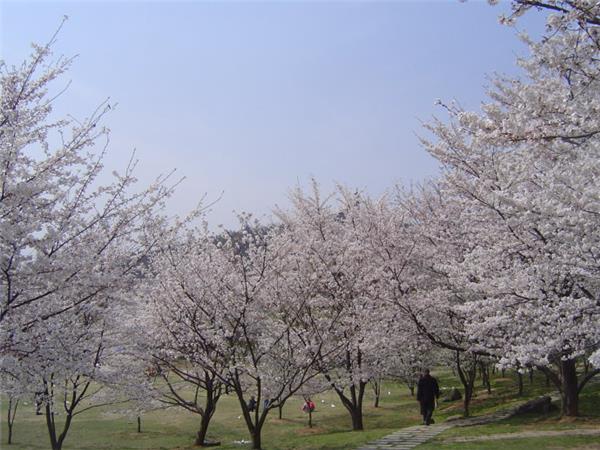
Landscape use: The Japanese Early Cherry has a free and spreading tree form, with luxuriant flowering branches and flowers covering the whole tree; the flowers are large and gorgeous. When in full bloom it looks like a jade tree with exquisite flowers, like clouds and rosy clouds, piled clouds and layered snow, very spectacular. It is an excellent ornamental landscape plant, so people often plant it in front of buildings, beside lawns, on hillsides, and by ponds; it is suitable both as a solitary specimen and in group plantings. In summer, the Japanese Early Cherry has luxuriant branches and leaves, with green shade like a canopy, and as a street tree on secondary vehicular roads or sidewalks it is also very beautiful and appropriate. The Japanese Early Cherry can also be used as a hedge or made into a bonsai.
II. Cultivation Techniques for Japanese Early Cherry
Planting techniques: The planting time is immediately after the soil thaws in early spring, generally in February or March. Before planting, carefully prepare the soil; when planting on flat ground, dig a hole 1 meter in diameter and 0.8 meters deep. First fill about half the depth of the hole with improved soil, place the seedling in the center of the hole, and spread the seedling roots in all directions. After filling in a small amount of soil, lift the seedling slightly upward so the root system fully extends, then tread lightly. The planting depth should make the uppermost seedling roots 5 cm from the ground. After planting, make a water-catching basin and water thoroughly, and finally support it with bamboo pieces about as tall as the seedling to prevent it from being blown over by wind.
Growing-season management: Japanese Early Cherry is fertilized twice a year, preferably with acidic fertilizer. One is winter fertilizer, applied in winter or early spring using organic fertilizers such as soybean cake, chicken manure and decomposed fertilizer; the other is after the flowers fall, applying quick-acting fertilizers such as ammonium sulfate, ferrous sulfate and superphosphate. Generally, for fertilizing large Japanese Early Cherry trees, the hole application method can be used, that is, at the edge of the vertical projection line of the tree crown, dig an annular trench about 10 cm deep and apply the fertilizer into it. This method is both simple and conducive to root absorption; later, as the tree grows, the diameter and depth of the fertilizing annular trench also increase. The Japanese Early Cherry root system is shallow and requires good drainage and aeration, so around the tree, especially within the range of root distribution, people, livestock and vehicles must never compact the soil. Trampling by pedestrians will weaken the tree, shorten its lifespan, and even cause root rot and death.
III. Differences Between Japanese Early Cherry and Japanese Late Cherry
1. Differences in tree form: The Japanese Early Cherry can reach 17 meters in height, and its bark is gray and transversely striated. The Japanese Late Cherry has silvery-gray bark with lip-shaped lenticels, and can reach 8m in height.
2. Differences in leaf shape: The leaves of Japanese Early Cherry are obovate to ovate-lanceolate, while the leaves of Late Cherry are elliptic-ovate, long elliptic to obovate.
3. Differences in leaf size: The leaves of Early Cherry are usually 3-8 cm long and 2-4 cm wide, while the leaves of Late Cherry are 5-12 cm long and 3-6 cm wide; the leaves of Late Cherry are larger than those of Early Cherry.
4. Differences in branches and trunk: When Early Cherry has not yet grown leaves, the bark is transversely striated, and the bark of old trees is longitudinally fissured. The branchlets are brown, and the lenticels on the trunk are somewhat sparser. New branches have appressed hairs, while the bark of Late Cherry is silvery-gray. The lenticels on the trunk are small and numerous. The new buds are darker in color, dark brown, and the buds are larger.
5. Differences in flower shape: The flowers of Early Cherry have 5 petals, are ovate, mostly single-petaled and white, and the flowers look relatively sparse, while the flowers of Late Cherry are light pink before opening and become more brightly colored and more reddish when fully open; the flowers are double-petaled, with fewer leaves when blooming and a large flower quantity.
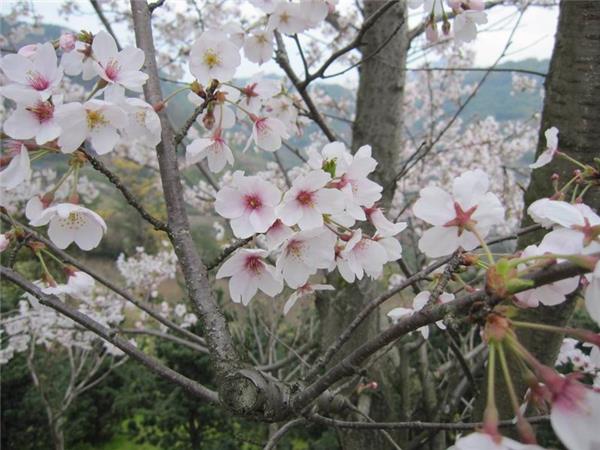
The beauty of cherry trees is world-famous, and no wonder so many romance films and idol dramas like to use cherry trees for filming. If friends have suitable conditions at home, they can also try planting some cherry trees; it does not necessarily have to be Japanese Early Cherry, because as long as they are cultivated properly, every cherry tree will grow extraordinarily beautiful.
You can also try planting some cherry trees; it does not necessarily have to be Japanese Early Cherry, because as long as they are cultivated properly, every cherry tree will grow extraordinarily beautiful.