A Detailed Guide to Loquat Tree Planting Techniques and Daily Care Methods
For planting loquat trees, the sowing method is generally used more often, because it is the lowest-cost method and the one that yields the greatest economic benefit. However, if you are growing loquat at home, choosing the cutting method is also fine.
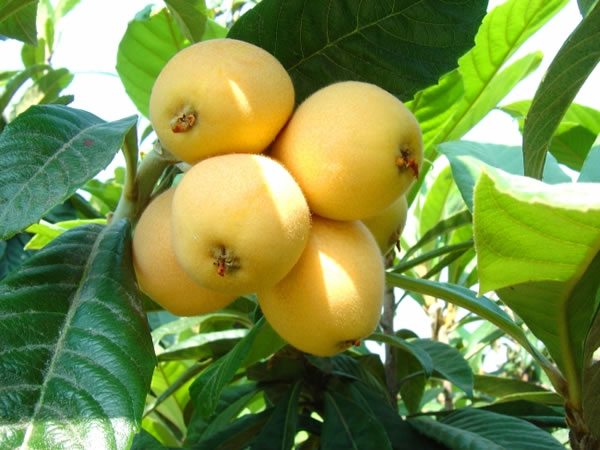
I. Loquat Tree Planting Techniques
Seed collection and handling: Loquat generally takes 15 years to flower and bear fruit, and the fruiting of the mother tree shows an obvious pattern of alternate bearing (on-years and off-years). The seed ripening period is from late October to mid-November. During this period, collection should be done promptly; if collected too late, the fruit is easily eaten by animals and cannot be gathered. After the fruit is brought back, it should be piled and fermented for 3 to 5 days, and handled once the skin has softened. Mix the fruit with sand and rub off the flesh, wash the seeds clean with water and dry them, then mix the seeds and sand evenly at a ratio of 1:3 and store them in stratification. The thousand-seed weight is about 800 grams, and the seeding rate is 30 to 35 kg per mu.
Land preparation and sowing: The nursery plot should preferably be chosen as sandy loam that faces the sun and drains well. Before sowing, the nursery plot needs to be deep-dug and disinfected with 3% quicklime. The seedbed is 1.2 m wide and 20 cm high; the bed surface must be fine and level, with stones and weeds removed. The side ditches and walkways must be dug straight, and the ditch bottoms must be level and must not collect water. Sow in early March; sowing can be done by dibbling or by drilling. For dibbling, the spacing between plants and rows is 10 x 25 cm; for drilling, the row spacing is 30 cm, and the sowing furrow is 8 to 10 cm deep. First place fully decomposed cake fertilizer at the bottom of the furrow, then put a 5 cm thick layer of yellow soil over the base fertilizer before sowing. After sowing, cover the seeds with another 2 cm thick layer of yellow soil; this helps reduce weeds between the seedlings and promotes root growth of the young seedlings. Finally, cover with a layer of straw to retain moisture.
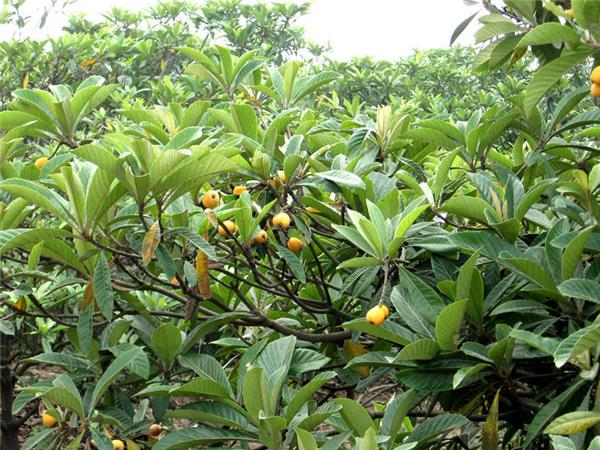
II. Loquat Tree Pruning Techniques
1. Bud removal: In the shaping stage before young trees bear fruit, in order to arrange the main branches, secondary main branches, and branch groups rationally, select and keep buds with suitable direction and position when they sprout, and remove the excess buds, so as to concentrate nutrients to cultivate strong main branches, secondary main branches, and so on. For mature trees, bud removal can reduce the number of branches, make the fruiting branch groups full and robust, and benefit fruiting.
2. Thinning: Loquat has the characteristic of producing whorled branches, and the tiers are rather closely spaced, resulting in a canopy with more branches and shoots at the top and fewer at the bottom, more outside and fewer inside, and insufficient light. Therefore, the dense branches, weak branches, overlapping branches, crossing branches, water sprouts, and excess branch groups with no space to develop or weak large branches in the canopy should be thinned out.
3. Thinning and removal: In areas without freeze damage, in order to regulate alternate bearing and ensure high and stable yields year after year, the fruiting branches of on-years should be thinned and removed during the full fruiting period. Usually, the ratio of fruiting branches to vegetative branches on the whole tree is 3:2. If there are too few vegetative branches, then part of the flower clusters on the fruiting branches should be cut off, so that they become fruiting branches the following year. If the mother branch and the fruiting branch both have fewer than 3 large leaves on them, the branch is a weak branch and can be removed from the base; if there is a certain amount of space or if cutting it off would leave a gap, 1 to 2 leaves can be kept and it can be cut back.
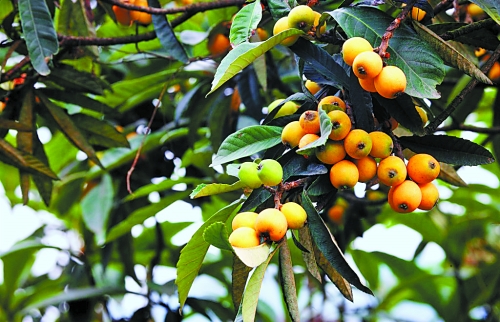
III. Flowering Period Management of Loquat Trees
Thinning clusters and flowers: Cut off the densely growing and weak flower clusters from the junction between the fruiting branch and the flower cluster, and remove the entire cluster. Depending on the tree vigor, the number of clusters thinned accounts for 20%-30% of the whole tree.
Foliar topdressing: To avoid nutrient imbalance caused by excessive flowering, foliar topdressing should be applied several times; spray a 0.2% urea solution or potassium dihydrogen phosphate solution once every 3 days.
Drought prevention: The flowering period of loquat trees falls in the dry, rain-scarce autumn and winter seasons. To improve the pollination rate, spray water on the trunk or irrigate the orchard furrows on a sunny morning.
Pest and disease control: The main disease and pest is red rust disease. In the early stage of the disease, spray 0.3 degrees Baume lime sulfur mixture 1-2 times. The main insect pest is the yellow hairy caterpillar, which damages autumn shoots and the branches and leaves of fruiting branches. For control, during the main period when the larvae appear, spray 90% trichlorfon at 500 times dilution or dichlorvos at 800 times dilution.
Spraying growth regulators: To promote flower bud development and increase the fruit-setting rate, spray cytokinin at 80-120 times dilution or a 0.1% benzyladenine solution to protect the flowers.
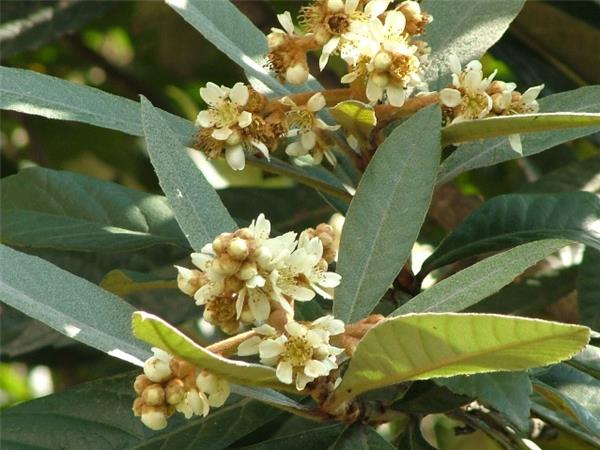
Loquat trees can not only be used to decorate and beautify courtyards; now, after dwarfing treatment, loquat trees can also be moved indoors for pot cultivation. Moreover, no matter which planting method is used, as long as they are cared for properly, loquat trees can bear abundant fruit. That really sounds quite appealing.