Red twig dogwood has bright red branches, a plant full of passionate red
Red twig dogwood gets its name because its branches are as bright red as fire, making it look very passionate and auspicious. As for planting red twig dogwood, you can use either pot cultivation or ground cultivation.
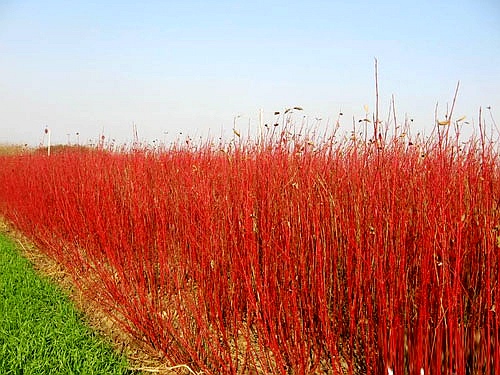
I. Propagation methods of red twig dogwood
Cuttings: In late autumn, cut 1- to 2-year-old strong branches as cuttings, store them in sand over winter, and insert them into the soil in late March of the following year. After they root, apply a thin liquid fertilizer once a month. For cutting success, management is key. After insertion, observe and measure temperature and humidity every day. Keep the temperature at 20°C-30°C and the humidity at 70-85%, controlling these artificially through watering and shading. After all the fibrous roots have grown, remove the plastic film shed, carry out full-light tending, and spray once with 1:1:20 Bordeaux mixture.
Sowing: Note that the seeds should be stored in sand for 120 days and then sown in spring.
Layering: In early May, ring the branch, then bury it in soil. After it roots, separate it from the mother plant and transplant it the following spring.
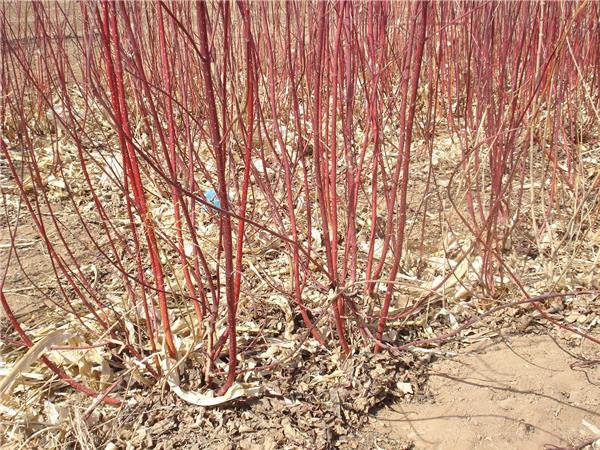
II. Cultivation methods for ground-planted red twig dogwood
Habits: Extremely cold-tolerant, drought-tolerant, and tolerant of pruning; prefers light; likes relatively deep, moist but fertile and loose soil.
Site selection: For a seedling bed, choose a sunny, well-ventilated, flat, well-drained, neutral-PH fertile sandy soil as the most suitable.
Bed making: Generally, sowing or cutting propagation is used. The bed width and length are 1 m x 10 m or 1 m x 20 m. At the bottom, apply a 7 cm layer of fully fermented horse manure as base fertilizer; on top of that, spread a 5 cm-7 cm layer of soil; on the topmost layer, to raise ground temperature and improve permeability, spread another 2 cm-3 cm layer of fine river sand. Spray the seedbed surface with 0.5% F2SO4 solution for disinfection. After 2-3 days, sowing or cutting can begin.
Fertilizing: When planting red twig dogwood, apply 10 to 15 kg of decomposed compost per hole as base fertilizer, and thereafter apply additional fertilizer in trenches each spring or autumn.
Pruning: In early spring when sprouts appear, renewal pruning should be carried out, cutting back the previous year's branches to encourage new shoots and keep the branches bright red. If old plants grow weak during cultivation, with rough bark and aging flowers, attention should be paid to renewal. Leave 1 to 2 buds at the base and cut away all the rest. After new branches sprout, thin them appropriately, and they can recover in the same year.
Pests and diseases: It is prone to stem rot. In March when sprouts appear, spray 4 to 5 degrees Baume lime sulfur mixture; before the rainy season, spray 1:1:200 Bordeaux mixture. In autumn, leafhoppers may occur, damaging branch bark and affecting ornamental value; spray 1% dimethoate or 0.5 degrees Baume lime sulfur mixture.
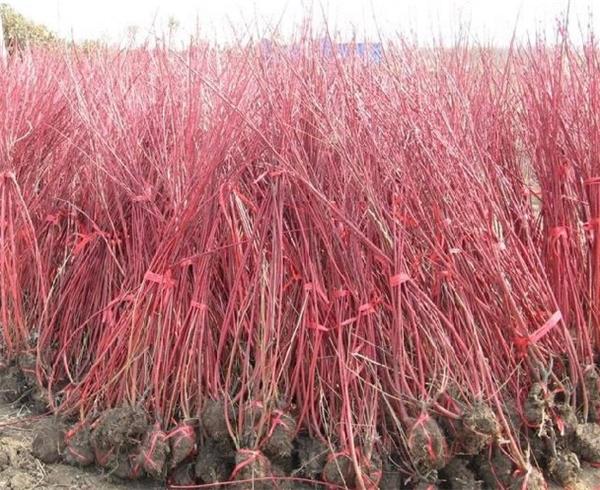
III. Method for growing red twig dogwood in water in pots
After autumn or in early spring of the following year, cut current-year branches from a strong mother plant, then cut the cuttings at 0.3 cm-0.5 cm below a bud node in a horseshoe-shaped cut, leaving 2-3 bud nodes on the upper part of each cutting. After that, place them in a cup of clean water for water rooting and put them in a well-lit place.
For water rooting, keep the cuttings immersed in water about 5 cm-7 cm; do not let them go too deep. Also be sure to change the water once every 2-3 days to keep the water clean. In this way, they generally root in about 30 days; if, when changing the water, the water temperature can be raised and kept at 20°C-25°C, the rooting period can be greatly shortened.
Because there are inherent differences among individual cuttings, rooting will always differ in timing. For this reason, when you find that a cutting's new roots have extended 0.5 cm-1 cm, promptly pick it out and pot it. Each pot can have 3-5 plants planted in succession, making a natural clumping form, or you can do something more creative and use another scale.
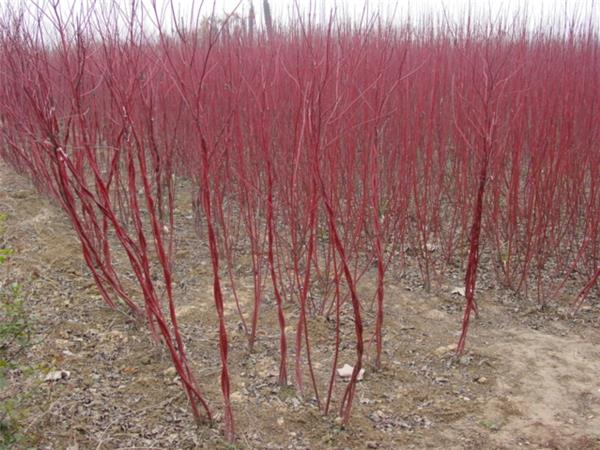
Red twig dogwood has bright red branches that distinguish it from ordinary green plants. Its ornamental effect and ornamental value cannot be replaced by other tree species and plants, so growing a pot of red twig dogwood at home will absolutely make your life more colorful and more uniquely distinctive.